
I recently has a student during office hours, meeting to discuss her paper on the dangers of AI so-called (her older brother has recently been laid off at Amazon due to chatbots, so it was already a topic near and dear to her heart), when I made a passing mention to The Terminator that drew a black stare. I quickly remembered that this student was a Gen Z immigrant from India, so why would she have heard of this 40+ year old low-budget American slasher flick?
Call it old Millennial nostalgia if you must, but I could not let this harmless bit of pop-cultural ignorance stand, so I pulled up on YouTube the clip from the first film when Arnold Schwarzenegger storms the police precinct, on the flimsy pretense that it might be tangentially relevant to her paper. (Hey, the AI in this flick is literally trying to kill everyone, how could it not be relevant?)
Her responses to the clip were certainly instructive to me! For when Mr. Schwarzenegger first saunters into the station, her initial reaction was “Wow, that guy is huge!” And when he opened his mouth and asked to see Sarah Connor, she—with the authority of one with an accent herself—also said, “Wow, that’s a heavy accent.”
Which in turn caused me to laugh and reflect at how utterly hilarious it was that, back in the ‘80s and ‘90s, we made a massive movie star out of this jacked Austrian body-builder with a thick accent, a comically-long surname, and the dramatic range of a cinder block—and then regularly cast him as a normal-joe American with names like John Kimball, Douglass Quaid, and Howard Langston from Minnesota! Don’t get me wrong, I think we were all in reasonably aware of how silly the Schwarzenegger phenomenon was even back in the ‘90s (The Simpsons certainly did excellent parodies of him via McBain), but sometimes it takes a true outsider to really drive home the absurdity of your own pop-culture. (She definitely gave me the side-eye when I mentioned the terminator later got elected governor of California; I could kinda tell she didn’t want to hear a single Westerner talk trash about Bollywood ever again.)
Suddenly I regretted pulling up this clip from an old movie in the first place. I hadn’t actually watched The Terminator since high school myself I realized, and was now painfully self-conscious that maybe it wouldn’t hold up at all; that between the cheesy synth soundtrack, severely dated haircuts, and wooden acting of the lead, it could only come off as cringe and dated to the rising generation, just as my parent’s and grandparent’s favorite films came off to me; that this would be yet another example of how sometimes the kindest thing we can do for the artists of our youth is never revisit them.
But then the Terminator crashed the car through the front door, crushed to death the cop filling out paper work behind the front desk, stepped out duel-wielding a shotgun and machine-gun, and began systematically massacring everyone in the precinct. I thought I detected a smile curling at the corners of the student’s mouth at the start of the video, but once the killing began, her smile vanished entirely, as she became engrossed in the film. For as much as he devolved into self-parody in the decades to come (including in the Terminator sequels), it’s easy to forget that in the very first Terminator, Arnold Schwarzenegger is genuinely terrifying.
After the YouTube clip wrapped up, the student fell silent a moment, then finally asked, “You said this robot was sent back in time from some future AI war?”
“To kill the mother of the resistance leader, yes.”
“What year does this AI war take place?”
“2029.”
“Oh.”
___________
I go through a similar set of reactions every October, the one time a year when I (for what I trust are self-evident reasons) bust out my old Smashing Pumpkins albums. Because just as its wild that we once collectively made this jacked, one-note Austrian Republican into one of the biggest movie stars in Hollywood, so too in retrospect it’s equally crazy that we briefly made this dude with the whiniest, most nasally and intentionally annoying voice imaginable the biggest Rock star of the mid-’90s!
Cause that vocal choice just had to be affectation, right? Billy Corgan speaks like a normal dude with normal cadences in every interview I’ve ever seen of him, his voice is simply not normally like that. Nor can he plead any sort of Punk Rock amateurism to explain his whiny voice, because numerous guitarists over the years have assured me that, regardless of what you personally think of his music, the band entire were ruthless virtuosos on their instruments, and Corgan himself could absolutely shred a solo when he felt like it. He was by all accounts a tyrannical perfectionist about literally every other aspect of the band’s sound (reportedly even re-recording his bandmate’s guitar parts himself, to their very understandable irritation), polishing to a fine sheen every other aspect of their music except his own voice. Rather than hire a vocal coach like, say, Chris Cornell of Soundgarden or Layne Staley of Alice In Chains did, Corgan took the huge gamble on himself that he could still top the charts with the most defiantly annoying voice possible, and God bless him, for one brief moment in 1995, he pulled it off!
I’ve written before, in an old essay on fellow ’90s mainstay Sublime, how wild it is that your reasons for feeling guilty about an adolescent pleasure can shift so radically over the course of your life, even as the feeling stays constant. By way of comparison, I noted how as a small, recently-baptized child, I feared and hated Las Vegas because it was an obvious den of sin and iniquity as all my Primary teachers warned me about; but after I grew up, I hated Vegas because it was a water-wasting capitalistic hellscape custom built to steal all of your money and give none of it back—but in any case, I still hated Las Vegas. My relationship with Sublime was even more fraught: as an early-morning seminary student, I felt guilty for enjoying them because of their numerous references to drugs, rape, and santería; as an adult however, I felt embarrassed to have enjoyed them because they treated all these heavy topics with such juvenile flippancy and derivative lyrics. I came to view my Sublime fandom as just another middle school peccadillo. Nevertheless, every Summer down to this day, I still get a scratch that only 40 oz. to Freedom and the self-titled album can scratch.
Just as every October I get an itch that only Mellon Collie and the Infinite Sadness can take away–which is ironic because the very things I loved about that album as a tween are now the very things that most irritate me about. Whereas as a child I found its sprawling two-hour run time epic, generous, and inspiring, as an adult I find it bloated, pompous, and self-indulgent, and could have easily been trimmed down to only one CD (I rarely finish disc 2 beyond “1979” nowadays). Whereas as a Deacon passing the sacrament I found lines like “Emptiness is loneliness, and loneliness is cleanliness/And cleanliness is godliness, and God is empty/Just like me” from “Zero” to be spine-tinglingly terrifying in its blasphemy, as an Elders Quorum counselor I found it cringe and embarrassing, like reading my own bad middle-school poetry. And whereas as a middle-schooler myself I clenched my fist in solidarity with the lead-single’s chorus of “Despite all my rage/I’m still just a rat in a cage,” by the time I was a missionary in the 2000s, we were all making fun of those overwrought lyrics in District Meetings. (I mean, how could you feel like a rat in a cage while on a mission from God?) It certainly didn’t help either that Corgan himself in the 21st century began to be as whiny as his voice, often devolving into a parody of himself even more so than Arnold Schwarzenegger (ask any Pumpkins fan, and they’ll be the first to tell you that Corgan has often been his own worst emissary). Him contributing a song to a Transformers movie didn’t exactly help his case either.
Pavement, an inarguably “cooler” Indie band I got into in post-mission, had sarcastically name-checked the Pumpkins on “Range Life” (along with the Stone Temple Pilots), and so for years I felt that it was high time, in the words of Paul, to “put away childish things” and leave the Pumpkins behind myself. Again, sometimes the kindest thing we can do for the artists of our youth is never revisit them.
And yet, and yet.
I increasingly find myself these days considering that all those young adults who made merry of “Despite all my rage/I’m still just a rat in a cage” (including me) all spoke too prematurely; because only three years after that song originally dropped in ‘95, some hack named Dr. Spencer Johnson released a short little book entitled Who Moved My Cheese?, marketed as a “motivational business fable” and written like a children’s book for adults–and which spent over 200 weeks on the New York Times Bestsellers list. Did Mellon Collie and the Infinite Sadness even with its flaws still sell 10 million copies? This piece of unmitigated tripe sold 28 million (“Saul hath slain his thousands and David his tens of thousands.”)
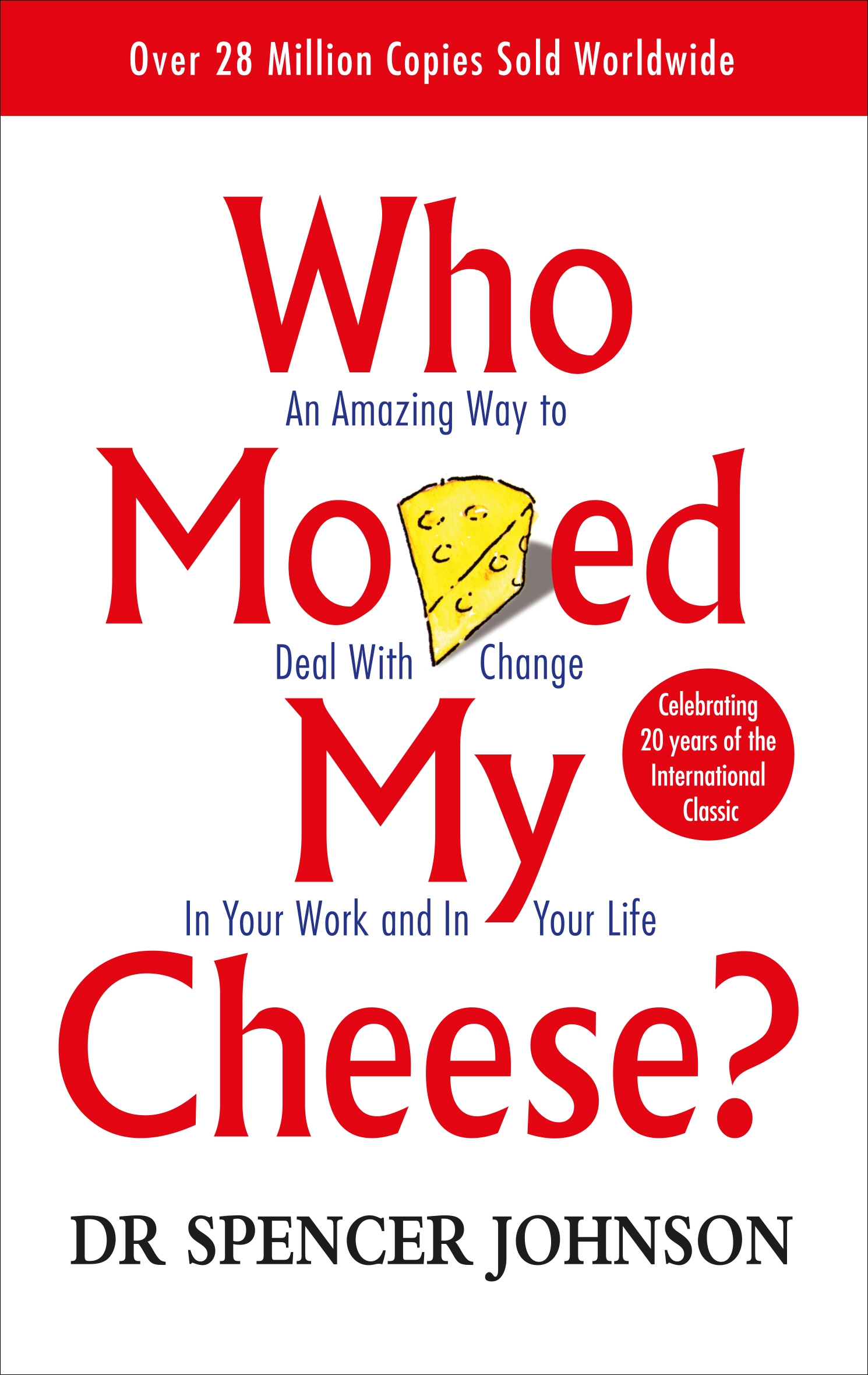
My Dad brought it home one day while I was in high school and, compulsive reader that I am, I read it in one sitting (it’s minuscule word-count certainly helped). The book describes a rat trained to run a maze each day, where he finds a piece of cheese at the end as his reward. However, one day he discovers that someone moved his cheese! It’s not where it usually is and he doesn’t know what to do! So, he has to start navigating the maze anew to find out where his cheese went–gaining new skills as he does so and expanding his network–till he gains new cheese! It is very bluntly obviously a parable for how you need to constantly adapt to the ever-changing job-market when you are laid-off or whatever. I told my English teacher about it the next day–a woman who had previously worked in the corporate world before quitting in disgust to become a high school teacher instead–and she just rolled her eyes and said, “Wow, so these Wall Street types are just openly acknowledging that we’re just rats in a maze now, huh?”
And I don’t remember much from high school anymore, but somehow that casual exchange has stayed with me over the decades, because it’s true: in only three short years, we went from angrily listening to “Despite all my rage/I’m still just rat in a cage” to cheerfully reading “Yes, we are all rats in cages, and here’s how you can be happy in it!”
Cause let’s be clear, it was the latter viewpoint that won out the day, as it always does. This insipid little book was still on the best-sellers lists when the Smashing Pumpkins broke up in 2000 and their ’90s hits began to pass into punchline status. Even when the Pumpkins (partially) reunited in 2007 and started churning out ever more sprawling rock operas, they never came anywhere close to recapturing their mid-’90s zenith again–all while the larger market economy continued to viciously insist that if you fail to adapt to the chronically unstable labor market you have only yourself to blame–that you are a rat in a cage and will like it—which became especially insidious when the global economy collapsed catastrophically in 2008 and left millions bereft and bankrupt amidst record-breaking mass layoffs, all because Wall Street in its short-sightedness insisted upon gambling on the housing market and soaking up all the wealth for themselves in a manner that put even Las Vegas to shame.
Even after a fitful and precarious economic recovery post-2008, the rhetoric of “adapt or die” has ramped up only more harshly since the debut of “AI” so-called in 2022, which soon resulted in the largest layoffs to ever occur during a surging stock market and record corporate profits. This was all of course the final and inevitable logic of Who Moved My Cheese?, a nightmare maze where not only the cheese ceaselessly moves, but vanishes entirely, leaving the mice to starve and die, to the gross indifference of the maze-builders who trapped them there in the first place.
Perhaps that’s why so many people have started pushing back hard against this rhetoric: recall that it was only last Spring that tech CEOS delivering pro-“AI” college commencement addresses were boo’ed off the stage across the country; it’s one thing when older people like me are suspicious of new technology, but when college students are turning on you, you know you’ve lost the plot. For that matter, when “free-market” conservative Utahans are protesting a proposed data center that threatens to consume more power than the entire state combined during a mega-drought, you know a very real rage is brewing. It turns out that a growing critical mass of human beings are no longer content to merely navigate the maze; when “the world is a vampire,” you don’t care about looking for the cheese in it, you want to smash it entirely.
This is as it should be; “O Babylon, O Babylon we bid thee farewell” used to be a hymn we sang quite literally. Likewise, Revelations 18:11 looks forward to a time when Babylon the great and powerful is overthrown, “And the merchants of the earth weep and mourn over her, because no one buys their cargo any more”, which is presented by John as an unalloyed good thing. This of course has been the very thing Silicon Valley has been most frustrated by, the refusal of the public to buy their wares anymore; this mass resistance has been an impulse towards Zion.
Perhaps relatedly, I haven’t seen anyone quote from Who Moved My Cheese? in a while now, whereas the Smashing Pumpkins have been an enjoying a bit of a renaissance lately, even if only from Gen Zers rediscovering their ’90s hits (it was in 2023 that Corgan finally threw in the towel, stopped trying to push his latest rock operas, and just played the hits on the “World Is a Vampire” tour). I see college students wearing Mellon Collie and the Infinite Sadness shirts on campus again. We are once again remembering that our status as rats is something we should rage against, not acquiesce to. We are children of God after all, and meant for far greater things than a cage or a maze.
I mentioned earlier that for however much he later devolved into self-parody, Arnold Schwarzenegger was genuinely terrifying as a killer AI in The Terminator–a terror that has only grown more frightening each year since 2022. Likewise, for however much Billy Corgan later became a parody of himself as well, there was indeed something genuinely terrifying about the way he sang “Despite all my rage/I’m still just a rat in a cage” in 1995–a rage that even endless overplay on the radio could never completely blunt—a rage that doesn’t feel strictly adolescent anymore, but only grows more real, not less, with each passing day.