
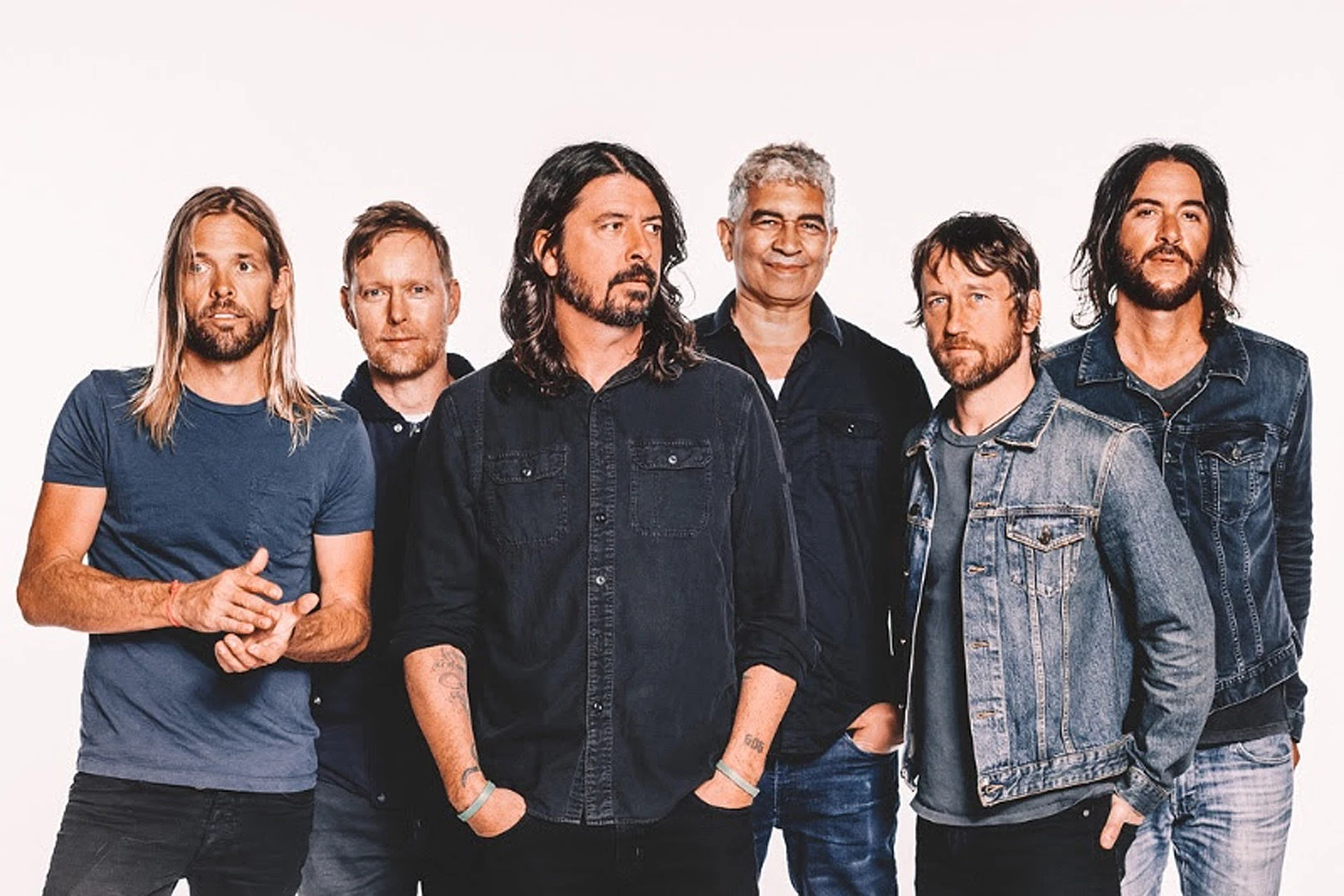
I was mindlessly scrolling through memes a week or two ago as one does, when I stumbled upon a band pic of the Foo Fighters (I think it’s the one up top here, though when I went to find the meme again, it had already vanished back into the ether, as all memes should and must), with a cutesy caption saying something to the effect of, “I don’t know why the guy in the back is the only one smiling, but I wish him nothing but the best!” or something like that.
Now like most memes, this caption was of course wildly overgeneralizing and inaccurate (go visit the search engine of your choice and you will of course pull up plenty of pics of the rest of the band smiling too), and not deserving of more than the one second of thought the meme was intended for. Nevertheless, I did find myself increasingly charmed by the fact that no matter which pic of the band I called up, no matter how serious or jocular the rest of the band was feeling during the photo shoot that particular day, that it was always Mr. Georg Albert Ruthenberg–AKA guitarist Pat Smear–who consistently had some sort of pleasant smile on his face.
Because if you are even passingly familiar with the story of Pat Smear’s life, you might assume he was the one who had the least to smile about of all.
He had started out his music career as a first-wave Punk rocker clear back in the 1970s you see, the son of a German Jewish father and an African- and Native-American mother in Los Angeles, where he and fellow high school expellee Jan Paul Beahm–AKA singer Darby Crash–formed The Germs, one of the foundational acts of Hardcore Punk, who in fact released one of the very first LPs of the genre, named (GI) (short for “Germs Incognito,” the pseudonym they had to use to book shows after they got banned from clubs for being too raucous), in 1979.
How new was the genre at time? The final track was over 9 minutes long–absolute anathema to almost all Hardcore acts that would follow immediately in their wake (such that it was considered genuinely genre-breaking when Husker Du finished Zen Arcade with a 14-minute long jam only a half-decade later). But then, who was there to tell them to trim it down or do otherwise? They were literally inventing the entire genre out of whole cloth in real time! There were no rules yet! Heck, it was Hardcore Punk, there weren’t supposed to be any rules in the first place!
We sometimes forget that those earliest Punk Rockers didn’t have any antecedents to follow yet; in fact, at least in America, the closest comp they had was The Doors, of all bands–which is likely where The Germs got the idea for a long closing-track in the first place. The Doors finished off their first LP with a 10-minute-long dirge, and so too would The Germs. In this, The Germs were not unusual: as much as those musty old “Classic” Rockers have been dismissed as a pompous and pretentious punchline in the decades since, it’s worth remembering that many first-wave Punk Rockers actually took direct inspiration from The Doors. Iggy Pop for example openly adopted Jim Morrison’s antagonistic stage persona after he saw them perform in Detroit, even modeling The Stooges’ first album cover on The Doors’; Jello Biafra of Dead Kennedys is on record as stating that he ran for San Francisco mayor in 1979 as a protest candidate in part to finally one-up Jim Morrison at something; and fellow Punk pioneers X covered The Door’s “Soul Kitchen” on their first album Los Angeles–which was produced by none other than Doors keyboardist Ray Manzareck! There’s a reason why Hardcore icon Henry Rollins narrated the VH1 documentary on The Doors back in 1997: unlike other “Classic” Rock dinosaurs like Led Zeppelin or Pink Floyd, the earliest Punks saw The Doors not as lumbering sell-outs to rebel against, but as self-immolating models to emulate. Hence again, because The Doors’ debut album had a 10-minute-long dirge at the end of their self-titled debut, so too did The Germs. And because Jim Morrison had a Dionysian Messiah complex, so too did Darby Crash. And because Jim Morrison refused to compromise and change the lyrics to “Light My Fire” on the Ed Sullivan Show, The Germs refused to compromise their artistic integrity too.
And because Jim Morrison died young in a hedonistic burnout, so too did Darby Crash, who committed suicide by intentional heroin overdose in 1980, only a year after their sole album debuted. Alas, Darby Crash forgot to also have a couple of #1 hits before he died like Morrison, leaving the other members of The Germs to languish in obscurity and poverty (him featuring in the 1981 documentary The Decline of Western Civilization may have helped cement The Germs’ notoriety, but that didn’t exactly help the survivors pay the bills). Pat Smear especially was left to bounce around a series of other short-lived bands and collaborations, none of which ever once threatened to recapture The Germs’ even modest levels of fame.
That would’ve been where Pat Smear’s story finally fizzled out, like so many other Punk rockers of the era, save that one of those many short-lived collaborations turned out to be with Courtney Love of Hole, who in turn recommended him to her husband Kurt Cobain, who by 1993 had finally conceded that he would need a second guitarist to flesh out Nirvana’s live sound now that they were playing arenas, and so invited him to join the band as a touring member. Pat Smear’s very first performance with Nirvana, in fact, was when they played “Heart Shaped Box” on Saturday Night Live; and though the camera of course focuses primarily on Cobain, you can definitely see Pat Smear jumping around stage-left if you keep your eyes open.
(You can much more clearly see him jumping around during their second number “R*pe Me“, but the infernal algorithm won’t let me embed the video.)
I can only imagine that for an aging Punk Rocker like Pat Smear, already in his 30s by then (positively antediluvian by Pop Music standards), it must have felt like winning the lottery to get the call up to the big leagues by no less than Nirvana themselves! He had perhaps reconciled himself to the fact that he had maxed out his meager ration of good luck by being a founding member of The Germs in the late-’70s, that he would never again be able to recreate the magic of that one, brief, anarchic moment in history. But then to suddenly get hired by the biggest Rock band in the world at the very height of their fame! To be offered that rarest of gifts: a second chance! He had languished in obscurity for over a decade by then, his prospects all but vanished, but now miraculously, things were coming back round his way.
Hence how much of a gut punch it must’ve been when Cobain stuck the shotgun in his mouth less than a year later. Pat Smear had already played for one legendary band leader who killed himself, but now two? How could the same thing happen to the same guy twice? Was he just giving off a vibe or something? Did he attract this?? How did he keep ending up in the orbits of troubled men who took their own lives? Did everyone have to pull a Jim Morrison? Most folks felt depressed by Cobain’s passing, but for Pat Smear it meant not only the loss of yet another friend but of his first steady paycheck since the Carter administration.
Nirvana’s drummer Dave Grohl was also understandably depressed by Kurt’s death, and formed Foo Fighters as a way to process his grief–when to his surprise a couple songs off his first record became bona fide radio hits, so now he had to scramble to form a band to perform them on tour. He reached out to his new friend Pat Smear to serve as Foo Fighters’ lead guitarist, and he accepted. Second chances as we just mentioned are vanishingly rare, especially in music, and third ones practically unheard of; but Pat Smear got one, and praise the Lord, this is the one that finally stuck.
Not that he remained a member of Foo Fighters for their entire existence; he took a hiatus from the band in 1997 purportedly due to their exhaustive touring schedule (despite Dave Grohl begging him to stay), and also so that he could participate in some Germs reunion projects of the time. But he did later rejoin them in 2005, and continued on comfortably as a Foo Fighter down to the present day–which means he was a member when drummer Taylor Hawkins (arguably the second most famous face of the band after Grohl himself) died of a drug overdose in 2022. I wonder how it made him feel as a now-graying, middle-aged-going-on-retirement-aged old man, to see all this drama unfold around him yet again, to realize that he was simply never going to outgrow or age out of these sorts of immense tragedies, no matter how long he lived, no matter how safe of a middle-of-the-road band he thought he was finally in. If anyone had ever earned the right to look morose in a band photo, it was Pat Smear. (All this, and we haven’t even touched on how he was a multi-racial man in a Hardcore scene that started out racially diverse—see for example Bad Brains—but quickly became overwhelmingly white and insular, rendering him an outsider among outsiders. Again, if anyone deserved to scowl in pictures, it was him.)
Yet I keep circling back to the fact that in almost every modern picture of the Foo Fighters you are liable to stumble upon, no matter in what configuration, Pat Smear is always the one most likely to be smiling cheerfully. All of his many tragedies have perhaps made him softer, rather than harder (cf Alma 62:41). Perhaps it’s because he most of all among his bandmates understands just how insanely lucky he is to still be a working musician; for that matter, maybe it’s because he alone fully understands just how much of a miracle it is to even be alive, and to never take life for granted again. For him, the old saw to “treasure every moment” isn’t just a cliche, but a very real injunction, great and terrible.
Brigham Young once taught this life is as important as any other life that we will live in eternity, and hence to value this world just as much as we do the next. Sometimes you have to remind yourself to have faith in this life as well. Besides, as Pat Smear could testify, there’s no need to try and rush out of this life anyways, as far too many people he has known have done; the next life will come plenty fast on its own.