
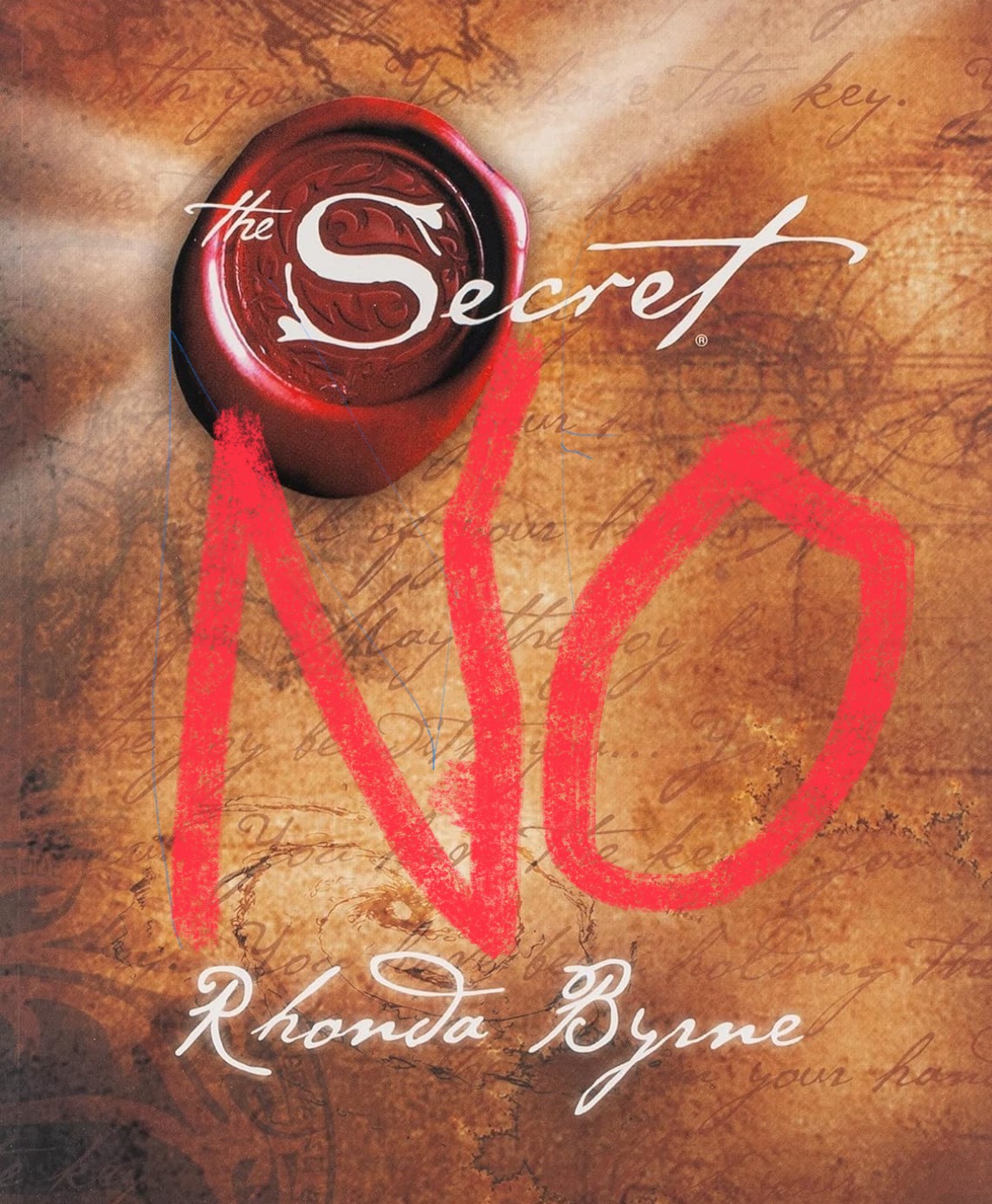
I was recently reminded of the existence of The Secret–the 2006 self-help book to end all self-help books–which certainly brought back some cringeworthy memories, long repressed just out of sheer embarrassment! I was a senior at BYUI at the height of that hoopla, which might have been the most impressionable age and most impressionable place to read that book. Rexburg, like Provo, fairly swarmed with Summer Sales recruiters who engaged in the exact same magical thinking and promises of quick-and-easy wealth as The Secret (with that same insidious insinuation that if you don’t get rich doing it, you have only yourself to blame), so everyone on campus was already familiar with its vocabulary.
I will totally cop to having bought into that ridiculous book for a hot minute. For in fairness, some of its early advice is genuinely useful: Make clear goals! Be pro-active! Have a positive attitude! Now, that’s what pretty much every self-help book recommends, but that didn’t make it any less true.
But the problem is when the book gets into its entire raison d’etre: the so-called “Law of Attraction,” this belief that if you practice daily affirmations and positive thinking, the universe will manifest for you your deepest and sincerest desires, as you invariably attract what you put out there. This idea was like catnip in Rexburg and Provo in particular, because we possessed a similar religious vocabulary of “seek and ye shall find, ask and it shall be given you,” that “if any of you lack wisdom, let him ask of God, who giveth to all men liberally” (the founding scripture of our faith), to “be not afraid, only believe.” We considered ourselves to be faithful Latter-day Saints; how could we not believe The Secret too?
Yet this also swiftly proved to be another example of how the Adversary will always generate a Satanic perversion of the real thing–the same way he made communism a perversion of the Law of Consecration, or fascism a perversion of divine unity–and that not subtly, but bluntly and blatantly. For the obvious corollary of the The Secret was that if you don’t get what you “manifest,” then it must be your own fault. King Benjamin in Mosiah 4 had sardonically called out those who gaze upon the beggar and say “The man has brought upon himself his misery; therefore I will stay my hand, and will not give unto him of my food, nor impart unto him of my substance that he may not suffer, for his punishments are just”; yet whereas King Benjamin condemned this self-serving logic, The Secret implicitly endorses it.
This was an especially galling argument to put out there in 2006, of all years; the Iraq War was still raging out of control, and the giant “Mission Accomplished” banner that President Bush raised on the aircraft carrier in 2003 had already devolved into a dark joke: had Bush not manifested victory in Iraq hard enough? Should he have written out more self-affirmations in the Oval Office? Had the thousands of troops killed overseas attracted their own deaths and therefore deserved to die? (Had the one young elder from Idaho I knew in San Juan, who had to leave his mission early cause his National Guard unit was deployed for the invasion, deserve to get thrown into a war-zone? Had he attracted that??) For that matter, had the millions of Iraqi civilians killed, bombed, and displaced by the war—and that after surviving decades of dictatorship—all guilty of not writing down enough positive affirmations? What are we even doing here?
Hell, what of all those killed in genocide—in the Irish Famine, in the Belgian Congo, Armenians in Turkey, Jews and Gypsies in Nazi Germany, Kurds in Iraq, people in Cambodia, East Timor, Rwanda, Bosnia, Sudan, Sierra Leone, Ukraine, Palestine, African slaves, the Aztecs, Incans, Mayans, all of Native America—did they all just not want it enough?! Did they attract mass extermination?! Hell, this book debuted only 5 years after 9/11: had those people attracted the planes that crashed into them?
Just last Spring, I had a student who missed a month of class cause her husband, a legal Green card holder, was denied re-entry into the United States after visiting his dying grandmother in Costa Rica, so she had to work double-shifts to afford immigration lawyers in both countries; do you dare tell her that she has only herself to blame for failing to engage in enough positive affirmations? And that’s the thing: If you think about The Secret even slightly, its vicious and victim-blaming logic all falls apart.
Yet the plain fact of the matter is we didn’t think hard about this book in 2006, perhaps cause in a post-9/11 world gone mad like ours, we wanted to still feel like we could control our own destinies in spite of all the chaos spiraling out of control around us, so we yearned to forget the one lesson we all learned in childhood: that just because you want something to happen, doesn’t make it happen (“learning loving someone don’t make them love you” was even a line from a Jack Johnson song popular among Rexburg students of this exact same era, yet so many of us forgot the whole point of the tune the moment we read The Secret). Hence, when I graduated college in 2007 only to find my ex-girlfriend got engaged to someone else, and my job-lead fell through at the dawn of the Great Recession, and I didn’t get into my first choice for grad school—despite all my written positive affirmations—I very quickly recalled what I should’ve known all along, that wanting something badly enough doesn’t make it happen, and I was embarrassed that I’d ever taken that ridiculous book seriously even briefly, and so swiftly pushed it out of my mind entirely.
This was especially cringe, because I was an RM for Pete’s sake! I had on my mission met real-life sexual assault survivors, impoverished immigrants, alcoholics, heroin addicts, and folks who had lost loved ones to car accidents, brain aneurisms, and that same Iraq war overseas; and I would’ve blushed to even think that these peoples’ problem was that they had failed to harness the power of positive thinking! I even served in Latin America, the land of si Dios quiere–“if God wants”–the frank acknowledgment that all of our manifestations and positive thinking are futile before the inviolable will of God Almighty. Hell, my own mother died of cancer only two days after my mission homecoming, despite all my most earnest and passionate prayers for her life—wrote a book about it and everything—so I for sure should’ve known better! We tend to make merry about the naivety of recently-returned missionaries, but somehow I was more emotionally mature as a fresh-faced RM than as a senior at BYUI. (Whether The Secret was a cause or a symptom of that backsliding is up for debate.)
The popularity of The Secret among Latter-day Saints was especially infuriating in retrospect, because The Book of Mormon, the purported keystone of our religion, is the narrative of a people who regularly pursued a “wealth-mindset” and blamed the poor for their own poverty (cf. Jacob 2:13-19 and Mosiah 4:16-20), and were destroyed from off the face of the earth because of it. We even teach this to our Primary children as “the Pride cycle,” so you’d think we’d be the least susceptible to toxic thinking like this, but instead it’s the opposite. Heck, our Church is named for Jesus Christ, he who prayed most desperately in the Garden of Gethsemane that this cup might pass from him, but still allowed himself to be tortured to death in the most aggravating and humiliating manner possible on Golgotha’s hill, because “not my will, but thine, be done”. Hence, you’d think that not just our church, but all of Christianity in general, would be immune to magical thinking that promises easy wealth from God the vending machine, but that demographic is where The Secret sold the most. (As Dietrich Bonhoeffer—the Lutheran minister executed by the Gestapo for speaking out against the Holocaust—argued in his most famous book, we are all still far too much in the thrall of cheap grace.)
But I try not to be too hard on all those who propelled The Secret to the top of the Best-Sellers Lists back in 2006, because as the sheer number of dogeared copies that flooded the thrift stores only a few years later indicated, I was far from the only one who was swiftly forced to recall what we should’ve known all along.