
Just why did LCD Soundsystem come back with a new album in 2017?
They’d already had their picture-perfect story-book ending in 2012, you see; their final sold-out show at Madison Square Garden had been documented for all posterity in the award-winning concert-film Shut Up and Play the Hits. (The last encore was, naturally, “New York, I Love You But You’re Bringing Me Down.”) Band-leader James Murphy, the ultra-rare music-nerd to actually make a legit career as a real recording artist, had released a trilogy of near-perfect albums between 2005 and 2010, so he made the even rarer decision to go out on top, on his own terms, rather than just slowly fade into irrelevance. It was the Indie-Rock equivalent of Bill Watterson ending Calvin and Hobbes after only a decade, leaving astronomical amounts of money on the table, rather than even risk ruining the magic. Murphy’s decision to end LCD Soundsystem when he did was honestly super heart-warming.
Hence the profoundly mixed feelings among fans when american dream was announced in 2017, a full half-decade later. Not that there weren’t hints that he’d grown a little restless in his early retirement: He had for example dropped a surprise Christmas song for free download in late-2015 under the LCD monicker. But that could just be dismissed as a one-off lark; this new release was a full-length double-album of all-new material! This absolutely upset the integrity of the trilogy, and rendered that magical last show moot and void! A great many fans took to online forums to express their anger and frustration that Murphy had here fatally ruined and betrayed the emotional impact of that final 2012 concert.
Of course, other fans then responded that it’s really weird to get mad at your favorite band for finally releasing new music again. Yet when James Murphy addressed the fracas on the band’s website, he revealed that his sympathies were actually kinda with the angry fans, that he too had deeply mixed feelings about undermining the magic of that final show.
Yet still he barreled ahead and released a fourth album—and he has not released a fifth in the nearly full decade since then. LCD Soundsystem meanwhile has settled into exactly the sort of endlessly-touring legacy act that Murphy was specifically trying to avoid in 2012. Don’t get me wrong, rent in New York City continues to spiral out of control and a man’s gotta eat, I don’t begrudge him working the 2000s Indie nostalgia circuit at all (it still beats a day job). But he could’ve just returned to touring anyways without releasing a new album in 2017, which he has clearly shown very little interest in doing again. (Yes, yes, he is supposedly recording a long-delayed fifth album as we speak, but my word, it can’t possibly be all that urgent or essential if it’s been nearly a full decade since the last one!)
So what was it about american dream that he felt so compelled to record in 2017, and thereby risk the wrath and disappointment of his biggest fans? Because it sure didn’t feel like it needed to exist. Don’t get me wrong, it received plenty of perfectly good reviews at the time and finished the year on numerous publications’ Best-Of lists, but it wasn’t a bold new reinvention or anything; if you’ve heard their first three albums, you’ve definitely heard this one too. None of the songs are even bad per se (in fact “Call the Police” is quite affecting), but there’s also no instant-gratification or potential hits like “Daft Punk Is Playing At My House” or “All My Friends” or “Drunk Girls” from his original trilogy. So why did he feel like this album had to be made?
The answer, of course, is that he was grieving.
The legendary David Bowie had befriended the LCD Soundsystem frontman before his passing, which for a massive music-nerd like James Murphy must have been staggering, an honor beyond riches. (He had previously sported the Ziggy Stardust makeup in the “All My Friends” video, so you know for sure he was a fan.) Bowie had often taken other fledging artists under his wing—Iggy Pop, Lou Reed, Trent Reznor, even fellow 2000s Indie Rockers Arcade Fire and TV on the Radio—over the course of his long and storied career, so to join such rarified ranks must’ve been for Murphy a dream come true.
And hence all the more of a gut punch when Bowie died of cancer in January of 2016.
Bowie recall had kept his terminal diagnosis carefully hidden from the broader public, such that it genuinely caught the world off guard when when he passed away—this, despite the fact that his final album Blackstar was explicitly curated as a funeral. As I had once upon a time summarized before: “the title is an allusion to an obscure old Elvis Presley SONG about a Cowboy knowing when his time has come; second single ‘LAZARUS’ alludes to the Bible’s most famous dead-beggar, even beating you over the head with the opening line, ‘Look up here, I’m in heaven;’ ‘GIRL LOVES ME’ asks ‘where the f*** did Monday go’ as he braces for the proverbial end of his week; penultimate track ‘DOLLAR DAYS’ expresses regret for ‘those English evergreens’ he knows he may never see again; and album closer ‘I CAN’T GIVE EVERYTHING AWAY’ finds the famously forward-looking Bowie gazing back on his life at last, as the finishing harmonica line recalls 1977’s ‘NEW CAREER IN A NEW TOWN’–implying that he knows he is about to move on to a new place as well…”
Overall, Blackstar was Bowie’s monument to his own impending demise, a carefully curated exhibit of his own mortality. It was on “black screen” then, the brooding 12-minute long opus that concludes Side D of american dream, that Murphy finally processed his own grief over the passing of his mentor and friend.
”You couldn’t make our wedding day/Too sick to travel,” he opens, acknowledging Bowie’s worsening health in the lead up to his passing. He tells him “You fell between a friend/And a father,” playing with the double meaning of both “You were almost like a father to me” and “You fell down—were cut down—in between being both a friend and a father to me,” taken from us too soon.
The lyrics entire are filled with regrets for time lost, in words that will feel familiar to anyone who has lost a friend before they were ready: “I owe you dinner, man/I owe you something.” He expresses his gratitude to Bowie for how “You talked to me/Like I was inside,” yet also acknowledges his own failures to reach out more often with, “I’m bad with people things/But I should have tried more.” He admits that, “I meant to get to you/On the turning/Things sneak up on me/Like a landslide…” in allusion to the famed Fleetwood Mac song about life flying by too quickly.
Indeed, the song entire could’ve been about any number of friends who have passed away; the liner notes themselves dedicate the album “to david, mark, and the growing list of our dead.” It’s in the final verse, then, that Murphy makes his strongest allusions to Bowie in particular, who once starred in the 1976 film The Man Who Fell To Earth, about a space alien who makes the long journey to earth incognito to try and solve the water crisis on his own planet, only to find himself paralyzed into inaction by spending his days watching too many television screens—or as Murphy frames it, “Been watching images/From the station/Earth one from satellites/All streaming.”
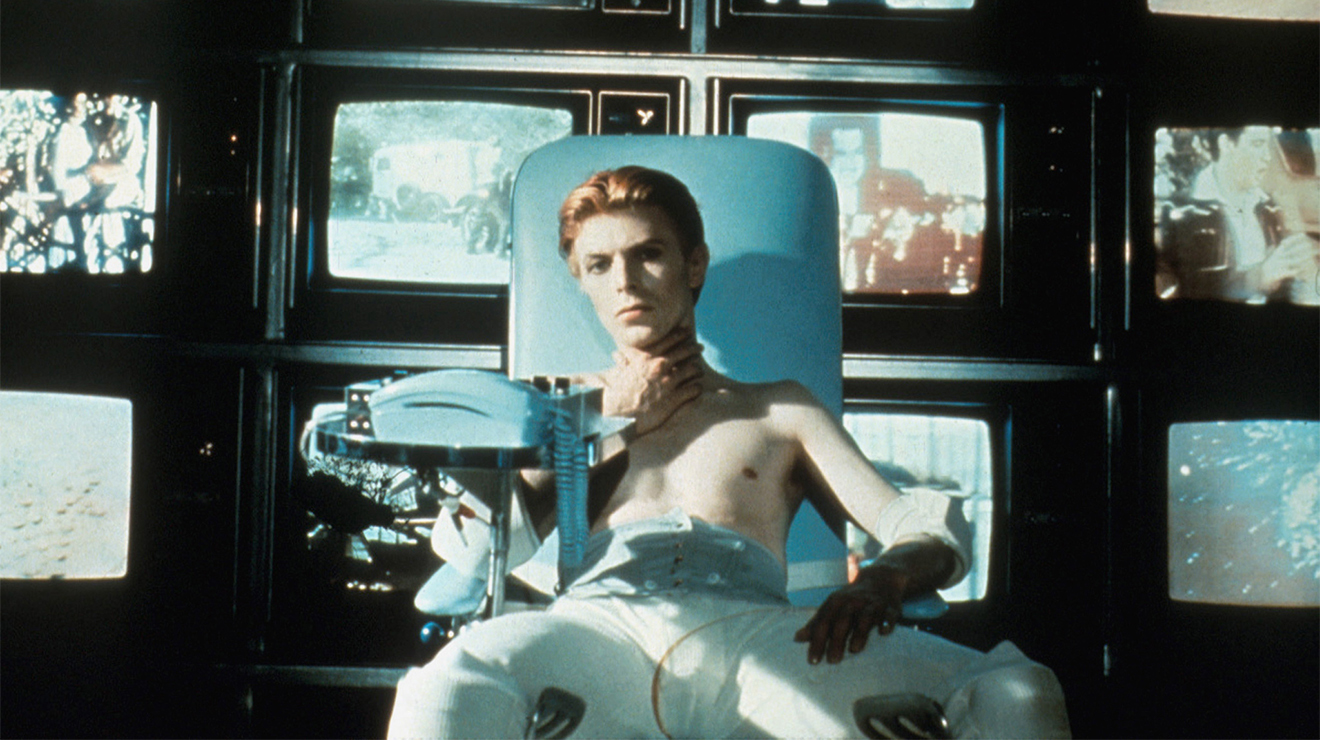
But now all those televisions of the “Star Man” have fallen dark; the Blackstar has transmuted into a black screen. Yet somehow all those absences on the TV screens just make Bowie feel all the more present: “You could be anywhere/On the black screen…” he repeats, over and over, in the song’s finale, until his voice fades away into the absence as well—to there rejoin his friend. (Perhaps that’s why he’s delayed for so long adding a new song to his oeuvre; part of him, I suspect, wanted to ensure his last note remains with his dead.)
*****
Murphy is a solidly Irish name, and my first book was on the theme of the dead in Irish and Latin American Literature, and today is the Mexican dia de los muertos, so it feels apropos, to me at least, to feature an Irish song of mourning on the Day of the Dead. What both the Irish and the Latin Americans share in common, I once argued in grad school, is the self-same conviction that our dead are still with us, that we can feel them nearby—yes, even on the black screens.
Of course, we as Latter-day Saints are supposed to feel the same; from the Temple veils we’re supposed to wear on our bodies at all times to the funeral shroud laid over our sacraments to the full name of the Church itself (for its always the Last Day for someone), our entire faith is supposed to be imbued with the sense that not only is death always near, but that the dead are always with us, and that we will be rejoining them in death, just as they will be rejoining us in life and resurrection. I’ve attended two funerals this year alone, one LDS and one Protestant, and the theme of the resurrection of the just featured in both.
But that doesn’t mean we don’t still grieve in the meantime. When my mom died of cancer two days after my mission (subject of my second book), I was perhaps in the best place possible spiritually to handle it, ironically; my conviction that her passing was not the end, that we would meet again, was then at its absolute firmest, and my belief that this was all an Abrahamic test of my faith at its strongest. Didn’t matter, I still grieved.
In this there was no contradiction; it is literally the first line of our baptismal covenants (per Mosiah 18:10) to “mourn with those that mourn, and comfort those that stand in need of comfort.” Such clearly establishes that we are not only allowed but required to mourn our dead. All due respect to the late Boyd K. Packer, but funerals are for mourning, not preaching the gospel. Actually scratch that: mourning with others is how we preach the gospel–it is in fact how we live it.