
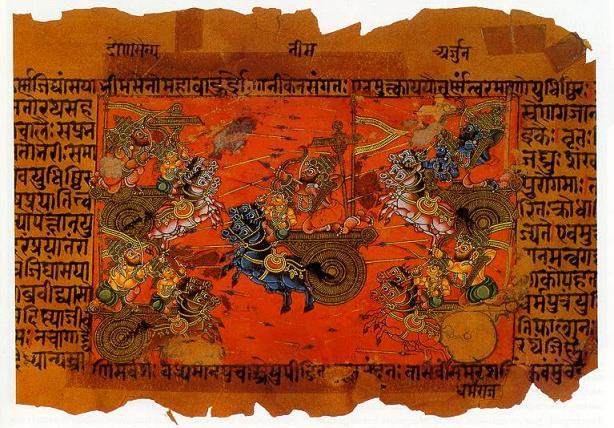
It took me 2 years and 2 months, but I finally finished the Mahabarata Epic from ancient India—traditionally attributed to an ancient Brahma named Veda Vyasa, but apparently compiled by numerous scribes over many centuries in the first-millennium BC—commonly classified the longest epic poem in the world[1]I hear tell that the Epic of Manas from Kyrgyzstan is even longer, but only comparatively short excerpts are currently available in English, and was apparently transcribed from numerous oral … Continue reading. It is roughly 8,800 pages and 100,000 verses long–that is, about ten times longer than the Iliad and the Odyssey combined.
The story of how I, a non-Indian, non-Hindu, non-Sanskrit-speaking Mormon white guy from America who has never been to India in my life, and whose total knowledge of Hinduism came from a visiting the Krishna Temple in Spanish Fork, Utah while taking a World Religions course at BYU 20-odd years ago[2]I still have the textbook on my bookshelf, btw. came to read the Mahabharata in its entirety is likely only of interest to myself, although it at least has a logical explanation for it.
I currently teach at a junior college in Edison, New Jersey, which has its own Little India[3]There’s also a Little Pakistan here, though that of necessity must be a topic for another day., complete with a local Hindu Temple as well and a dude with a Hindi last name currently serving as mayor.[4]Samip Joshi, for the curious. When I was first interviewing here and I mentioned my competency in Chinese as proof that I could work effectively with the large Asian population mentioned on their website, the Dean asked me blandly, “How’s your Urdu?”[5]Yes, yes, I’m fully aware now that Urdu and Hindi are mutually intelligible, they just have different writing systems; that’s just one of many things I’ve learned from teaching in this corner … Continue reading My basic Mandarin that has served me so well in classrooms across the western U.S. was suddenly of only marginal use here in New Jersey.
The majority of the Desi[6]Catch-all term for the numerous ethnicities that make up all of what is now India and Pakistan. students at my college are either from the Indian states of Punjab, which is majority Sikh, or Gujarat, which like most if India is majority Hindu. This at least put the Mahabharata on my radar[7]In fact, even though it is not their religion, the Sikhs I’ve learned are still familiar with the Mahabharata, albeit they tend to treat it as more a national epic than a religious one. That is … Continue reading.
But that’s not what finally got me to pull the trigger on such a massive reading commitment. There are indeed a lot of Indian-Americans at my college, but they are by no means the majority; indeed, there is no majority at this college, we are in the greater New York City metropolitan area, we have students from literally all over the world here.[8]It’s actually a very inspiring portrait of what a post-white-majority America could look like, but that must also remain a topic for another day. There’s at least a dozen other countries whose literature I would need to familiarize myself with if I wanted to better connect with my students’ ancestry, and there are only so many hours in a day, and India, world’s largest nation though it may be, did not have an inherently stronger claim for my attention over, say, the entirety of Latin America, Africa, the Middle-east, China, Haiti, Ukraine, Afghanistan, Iran, and many more.[9]You know, what the rapist calls the “shithole” countries.
No, what finally tipped the scales in favor of the Mahabharata for me was the simple fact that when I first got hired here, I confided to my department chair that though I recognized that our bread and butter here is composition classes, I would still like to teach at least one literature course; to which he confided right back that if I wanted to teach one, then I should do an ancient World Lit survey course, because for whatever reason, those always seem to run.
Here I need to emphasize that I actually like teaching composition, especially to diverse and underprivileged junior college students; at the risk of sounding schmaltzy, I find it personally meaningful to help working-class students caught in multi-generational poverty traps gain even a toe-hold in the ever-treacherous American Dream. In a mass-culture such as ours where “it’s academic” is often just a synonym for “it’s irrelevant,”[10]Hence the old joke, “In academia, the fights are so vicious because the stakes are so low.” I feel like I just might be doing one of the only things in Academia where the work does actually matter, that really does (to use a fraught term) have “real world applicability.”
Nevertheless, I still spent 10 years in college to get an English PhD specifically in hopes of teaching a literature course someday; and even though my dissertation was on Irish and Latin American Modernism, I do in fact enjoy reading the Epic of Gilgamesh, the Odyssey, the Aeneid, and Dante’s Inferno for their own sake, so I threw together a syllabus that explained how all four of these foundational texts converse with and are even fan-fictions of each other.[11]Given how many of our students these days actively read and write and de-stigmatize fan-fic, this seemed to be a winning approach.
The students seemed to enjoy the class the first couple times I taught it; but when I solicited feedback at the end of the semester on how I might improve the class, one girl noted that, though she enjoyed it over all, when she enrolled in a course called “World Literature,” she thought she would actually be reading World Literature, as in from around the world, not just the upper Mediterranean.
Immediately recognizing the justice of her critique, and even ashamed of my own shallow Eurocentrism[12]I had even studied Postcolonialism in grad school, for Pete’s sake!, I swiftly expanded the survey course to include the Tao Te Ching from ancient China (which immediately became a student favorite), the Arabian Nights from the Islamic Golden Age (my Muslim students especially enjoyed those selections), the Sunjata epic from sub-Saharan Africa (my Black students intuitively understood the ancient roots of Hip-Hop in that one), and finally the Bhagavad Gita from ancient India.
Though I thought for sure that that widely read work of scripture, which has inspired everyone from Mahatma Ghandi in modern India to Martin Luther King, Jr. stateside, and even influenced popular artists as diverse as the Beatles, Nirvana, and Alice Coltrane, would prove popular with students as well, here I ultimately found my instincts had failed me. Part of the problem was simply that, although Indian students often crowded my required composition courses, not one of them evinced the slightest interest in taking an elective from me[13]Likely because as either immigrants or first-generation children of immigrants, they didn’t want to waste their scarce tuition dollars on anything not relevant to their majors, and none of them … Continue reading The students who did enroll typically had zero Hindu background, and were very at sea with very basic concepts that I wrongly thought were reasonably well known in pop-culture, like reincarnation and karma. I ended up having to spend significant classroom time explaining the very bare-bones basics of Hindu religion that I had once learned in a BYU class circa 2005.
But I didn’t give up, at least not initially! I mean, even if none of them were taking my elective classrs, there was still a very large Indian contingent in our student body, so I thought if nothing else, it would be useful for my lit students to better understand some of their classmates, if nothing else. I stubbornly persevered forward with the Gita, even though semester after semester, it always proved to be the least popular text on the syllabus.
In fairness though, I came to realize that the problem wasn’t just that a bunch of students raised in the Abrahamic Monotheistic tradition[14]I.e. Judaism, Christianity, and Islam. were wholly unfamiliar with the reincarnation religions of the Indian subcontinent, but that the Gita itself is not actually a self-contained narrative: it is a very brief excerpt from the very long Mahabharata epic. The Gita opens, you see, on the eve of a great battle that is in essence a royal family feud. Brothers will be fighting brothers, cousins against cousins. Prince Arjuna, the epic’s central figure, is aghast at this utter waste of human life, and complains of this awful war to his charioteer Krishna—who is in fact the protector god Vishnu in disguise, and uses Arjuna’s complaints to preach to him true religion and the many paths to Nirvana, Liberation, and Enlightenment. The extended conversation between Arjuna and Krishna is what makes up the bulk of the Gita, and which in turn had a far-reaching influence on the Indian independence movement from the British Empire centuries later. This was the text that converted George Harrison of the Beatles to Hinduism, is what convinced Mahatma Ghandi and Martin Luther King, Jr. alike of the efficacy of non-violent protests, and which is still preached by Hindu monks across the English speaking world today[15]The same way LDS missionaries preach with the Book of Mormon today; indeed, I was once sold a copy of the Gita by a Hindu monk at the University of Utah, in a delicious bit of irony.
However, because the Gita is so hyper-focused on just this one divine conversation, it never provides any context for why this battle is happening, nor what the root causes of the war are, nor even who all the major players are. Chapter 1 of the Gita even opens with a long list of names of who all the major warriors are present that my students always complained only left them confused; even after I repeatedly told them to just ignore this list of names cause the only two people you really need to know about are Arjuna and Krishna/Vishnu, they still (quite reasonably, I started to realize) felt like if the Gita thinks these people are important, then they needed to know why. And the Gita was simply never going to explain that to them, because that information was all located in the entire rest of the Mahabharata.
So finally, with a sincere desire to be able to better explain the larger narrative context of the Gita to my World Lit students, I started reading the entire Mahabharata epic in the summer of 2024.
I was helped along by the fact that it was the Kindle version I purchased[16]Only $1.99 on Amazon at the time!, so I could read the entire thing on my phone; and moreover that although the entire 8,800-odd pages are split into these absolutely massive volumes called Parvas, each Parva itself is subdivided into dozens, in some cases hundreds, of very brief Sections that one can finish in only a few short minutes. The Mahabharata Epic, then, became my near constant companion in all of the little interstitial moments of modern life—waiting in line, waiting at the bus stop, sitting in a reception room, bored in a meeting, even while trying to get my kids to sleep at night with the lights were off—which is largely how I came to consume the ancient world’s longest epic.
Maybe that was exactly my problem: I’m aware that the Bhagavad Gita in Sanskrit literally means The Heavenly Song, and that quite literally, because is meant to actually be sung aloud like a hymn. The Mahabharata entire is supposed to be sung in performance. Me reading it on my kindle app would be the equivalent of reading the lyrics to Wagner’s Ring Cycle on my phone, I would simply not be getting the sheer music of it, arguably even missing the whole point.
But I also don’t have time to watch hours upon hours of performance[17]Does any such recording even exist??, especially not in Sanskrit, a language that, revered though of might still be, is still as dead as Latin is in the West. And as much as I would love to learn every new languages, well, I am no Hugh Nibley, and my small children don’t really give me the time to study ancient languages anyways, so this old English translation read on an app would sadly have to suffice.
The supreme irony is that at some point early on in my reading, I finally threw in the towel and dropped the Bhagavad Gita from my syllabus; I know how to read the room, and virtually none of my students had ever gotten into it. So why did I keep on persevering through this absolutely massive epic, that no one had assigned me but me, that no one would be impressed by than myself?
As in so many things, a mixture of motivations both respectable and less so. Part of it was to see for myself and satisfy my own curiosity as to where exactly the Bhagavad Gita fits into the much larger story; if my students didn’t particularly care, I still did.
But part of it too was sheer mule stubbornness and sunk-cost fallacy; by the time I finally dropped the Gita from my syllabus, I was roughly one-third the way through, which represented literally thousands of pages read, so why stop there? I’d started this, and my mother didn’t raise no quitter, so by golly I was going to finish this.
And of course part of it was sheer egotistical vanity: I’d already read all the other insanely long books that people are supposedly impressed by—Moby Dick, War and Peace, Les Miserables, Infinite Jest, Paradise Lost, Don Quixote, Ulysses, Finnegans Wake, The USA Trilogy, The Recognitions, Homer’s Iliad and the Odyssey, Virgil’s Aeneid, Dante’s Divine Comedy, The Complete Works of Shakespeare, The Complete Works of Hugh Nibley, etc., etc.—so why not the longest text of all? Why not finally summit the literary Mt. Everest, which is also heavily associated with India?
And just like the real life Mt. Everest, even though I really did reach the end, and read every word on every page, the Mahabharata ultimately defeated me. By coincidence[18]or is it?, towards the final end of the Mahabharata, I had checked out what I thought would be a fun, light read[19]I swear I do those too! from the library, which for some impish reason turned out to be that old 1996 major Into Thin Air by Jon Krakauer[20]I didn’t connect the dots till later that he was also the author of that shallow Under the Banner of Heaven book, cut me some slack., about an ascent up Everest that, although they successfully reached the summit, left eight dead when a freak storm rolled in, leaving him and the other survivors severely traumatized. Indeed, even before that sudden storm rolled in and killed most of his climbing party, Krakauer is upfront about the fact that he experienced no great epiphany or exultant feeling of triumph when he finally fulfilled his lifelong dream and stood on the roof of the world, but only felt an awareness of his immense, oxygen-deprived exhaustion after hiking up over 29,000 feet. He did not enjoy the view, to put it mildly.
Obviously my reading of the Mahabharata was nowhere near as dramatic or even remotely life threatening; nevertheless, in its own small way, it almost felt too on the nose to finish both books in the same week, because I similarly felt that I had summited something that ultimately defeated me, that no one was ever perhaps intended to finish in the first place (the fact that the final three Parvas are only a few pages long each seems to indicate that even the ancient compilers of this epic finally got sick and tired of it by the end as well). A shudder ran down my spine when I finally hit the long-awaited “100% complete” on my Kindle app, and it was not a shudder of peace or of triumph. The sheer size and scale of the text gave me no stunning new vistas of the world around me like I had low-key hoped for, but only made me aware of my own immense exhaustion.
Here’s a brief list of the recurrent issues that I, an utterly untrained amateur in studying ancient Vedic literature, ran into throughout my reading:
- The giant list of names that so confounded my students in the opening chapter of the Bhagavad Gita never, ever gets clarified by the rest of the Epic; in fact, the confusion only grows exponentially (there is a good reason why only the Gita gets excerpted out).
- The endless, and I mean endless, sucking up to rich people. I thought if I read “O ye tiger among men” one more time, I might build a Time Machine so I could go back and punch one of these scribes in the face. Although there is genuine religious instruction sprinkled throughout the text[21]Indeed, it was nice to know that the BYU World Religions textbook actually got the religion mostly right, for the super-majority of the epic, it is only glorifying the deeds of famous kings in battle. I mentioned this off-handed one to an Indian-American student who visited office hours for unrelated reasons, and he confided right back that that often bugged him about the Epic too, and wishes he could explain that to his family. Although I suppose it’s comforting to know that sniveling simps constantly sucking up to rich people is not unique to us moderns, it did get wearisome to read for 8,000 pages.
- Repetitions: the revelation of Krishna to Arjuna in the Gita, when he throws off his human form to Arjuna and reveals himself as the god Vishnu, is one of the great theophanies in world literature, stunning in its poetry, and up there with the Transfiguration on the Mount or even Joseph Smith’s First Vision; by the hundredth[22]not an exaggeration description of a divine revelation of deity, the trope has begun to wear thin.
- The text constantly wants to have it both ways, wherein asceticism and charity to the poor is the highest, best path to Emancipation and Enlightenment, but also that every king is good and right to seek for power and wealth (this of course is related to the aforementioned endless sucking up to the rich, similar to the sheer number of Christian preachers over the centuries who have bent over backwards to reassure their wealthiest patrons that Christ did not actually mean it when he told the rich young man to sell all that he has and give it to the poor).
- The text also seemingly wants to have it both ways with warfare, constantly preaching the divine mandate to harm no creature, no matter how small, but also constantly glorying in the military prowess of kings and warriors, hyperbolically cataloging the numbers of the slaughtered (and yes, yes, I’m keenly aware that Krishna in the Gita explains that since we are all manifestations of the same divine power, that individuality is an illusion—that we are all waves on the same ocean, as it was once explained to me—then no one truly dies, that therefore war and death loses all its horrors, that all that is left is to perform our duties whatever they may be to the utmost, and hence the warrior is fully justified in fighting to his utmost ability, which is one many paths to nirvana. It still strikes me as a little too convenient, as yet another way to let the rich and powerful off the hook).
- The frequent misogyny, while definitely not unique to the subcontinent, was also irksome (pro-tip to my fellow dudes: if you have to constantly tell women that they are naturally submissive, then they are not naturally submissive, are they).
- Relatedly, I was often keenly aware that I’m not the epic’s intended audience; not one because I’m not Indian or Hindu or fluent in the dead language of Sanskrit, but also because I’m not a king, and large swaths of the latter Parvas are dedicated to instructing monarchs how to be more effective rulers (pro-tip to the rich and powerful: if you have to constantly preach that submission to kings is natural, then it is not actually natural, is it). The idea that if everyone is the same manifestation of the same divinity does not lead anyone to the logical conclusion that therefore democracy or rule by the masses is the proper order of government, which didn’t occur till modern, post colonial India.
- And of course the language barrier: every time I encountered a line that seemed reminiscent of some gospel principle, I had to wonder if it was actually similar, or if it was just translated by some Victorian Englishman raised in a Christian tradition, and hence he was either consciously or unconsciously slanting the text to better match his own understanding.[23]As TS Eliot once wrote, poetry is whatever cannot be translated. This is simply another way of confessing my own gross ignorance and incompetence for studying such a massive epic.
And yet there is also poetry, real poetry threading its way through this immensely massive epic! Almost every time I would start to get bored by yet another overwrought description of yet another celestial combat of some sort[24]I’m reminded of how Nibley finally freed up the time to start studying Egyptian in earnest when he was sitting there reading the Icelandic Sagas–to honor his ancestry–when in the … Continue reading, when some evocative metaphor or simile would jump out at me, and I would rush to highlight it; because all the best poetry, it wasn’t the subject matter itself, but the way it was said, that stood out to me. It wasn’t often, mind you, but still just frequently enough to keep me enticed, and keep going, when I still had thousands of pages ahead of me.[25]It wasn’t all just “O ye tiger among men”!
And then there is the sheer size itself! I have read just enough long books in my life to confidently state that most books do not actually need to be that long: the build-up to the slaughter of the suitors in The Odyssey could easily be half as long; the two long epilogues to War and Peace could have been cut entirely; all the meditations on the meaning of Waterloo and French history in Les Miserables could have been left on the cutting-room floor; Don Quixote could’ve left out the digression on the Dos Amigos; Infinite Jest could have been at least a third shorter and still have lived up to its title–I could play this game all day–and there are literal thousands of pages of the Mahabarata that could’ve been cut and lost to history and it still would’ve been one of the longest epics ever written. Heck, I’m reasonably certain that most modern Indians who have actually read the Mahabarata have only ever read in truncated, greatest-hits form, and frankly, that’s the right approach!
Except that this epic really is a meditation on infinity. Seriously: eternity, infinity, and impossibly large numbers[26]Remember that it was ancient Hindu mathematicians who gave us the number 0, without which all advanced mathematics is impossible. are constantly cited throughout the epic entire. The absolute immensity of the oceans, the earth, the heavens, the gods, and the infinite recursion of reincarnation itself, is arguably the absolute focus of the Epic entire. How then, could it not at least attempt to invoke eternity, by trying to feel infinite? There is perhaps a good reason I shuddered when I finally at long finished the Epic: it was indeed a glimpse into the Eternity, which mortal minds are simply not prepared to comprehend. It made me briefly aware of how unprepared I still am to enter the next life, even though the next life is still coming, whether I’m ready or not. That is, it’s not just the Mahabharata itself that defeated me.
So those are my Disconnected Notes From a Complete Outsider on How I Came to Read The Mahabharata Epic. May there really be a next life, where I will finally be granted all eternity to study and master all these massive texts that there is simply not lifetime enough to finish–and may I prove worthy of that eternity–or, failing that (for all things must fail)[27]Moroni 7:46, may the Atonement make up all the rest that we all invariably fall infinitely short of.
References
| ↑1 | I hear tell that the Epic of Manas from Kyrgyzstan is even longer, but only comparatively short excerpts are currently available in English, and was apparently transcribed from numerous oral story-tellers by Russian folklorists during the Soviet era anyways, never officially written down in toto, so until I learn to speak Russian or Kyrgyzstani, the supermajority of Manas will remain inaccessible to me. |
|---|---|
| ↑2 | I still have the textbook on my bookshelf, btw. |
| ↑3 | There’s also a Little Pakistan here, though that of necessity must be a topic for another day. |
| ↑4 | Samip Joshi, for the curious. |
| ↑5 | Yes, yes, I’m fully aware now that Urdu and Hindi are mutually intelligible, they just have different writing systems; that’s just one of many things I’ve learned from teaching in this corner of New Jersey. |
| ↑6 | Catch-all term for the numerous ethnicities that make up all of what is now India and Pakistan. |
| ↑7 | In fact, even though it is not their religion, the Sikhs I’ve learned are still familiar with the Mahabharata, albeit they tend to treat it as more a national epic than a religious one. That is also ironic, because Punjab has a strong independence movement, one that was brutally suppressed by the Indian government back in the 1970s—including sending troops to raid their holiest temple—which radicalized the Sikh separatists and led to them assassinating two different presidents of India back to back (which I also had to learn about from my students). Whereas my Gujarati students are largely here for the usual American-dream economic-opportunity reasons, my Punjabi students largely arrived here as political refugees. |
| ↑8 | It’s actually a very inspiring portrait of what a post-white-majority America could look like, but that must also remain a topic for another day. |
| ↑9 | You know, what the rapist calls the “shithole” countries. |
| ↑10 | Hence the old joke, “In academia, the fights are so vicious because the stakes are so low.” |
| ↑11 | Given how many of our students these days actively read and write and de-stigmatize fan-fic, this seemed to be a winning approach. |
| ↑12 | I had even studied Postcolonialism in grad school, for Pete’s sake! |
| ↑13 | Likely because as either immigrants or first-generation children of immigrants, they didn’t want to waste their scarce tuition dollars on anything not relevant to their majors, and none of them were majoring in something as non-lucrative as English. |
| ↑14 | I.e. Judaism, Christianity, and Islam. |
| ↑15 | The same way LDS missionaries preach with the Book of Mormon today; indeed, I was once sold a copy of the Gita by a Hindu monk at the University of Utah, in a delicious bit of irony. |
| ↑16 | Only $1.99 on Amazon at the time! |
| ↑17 | Does any such recording even exist?? |
| ↑18 | or is it? |
| ↑19 | I swear I do those too! |
| ↑20 | I didn’t connect the dots till later that he was also the author of that shallow Under the Banner of Heaven book, cut me some slack. |
| ↑21 | Indeed, it was nice to know that the BYU World Religions textbook actually got the religion mostly right |
| ↑22 | not an exaggeration |
| ↑23 | As TS Eliot once wrote, poetry is whatever cannot be translated. |
| ↑24 | I’m reminded of how Nibley finally freed up the time to start studying Egyptian in earnest when he was sitting there reading the Icelandic Sagas–to honor his ancestry–when in the middle of yet another interminably battle description he finally heaved a sigh one day and said, “You might as well face it, these people aren’t that interesting.” |
| ↑25 | It wasn’t all just “O ye tiger among men”! |
| ↑26 | Remember that it was ancient Hindu mathematicians who gave us the number 0, without which all advanced mathematics is impossible. |
| ↑27 | Moroni 7:46 |