
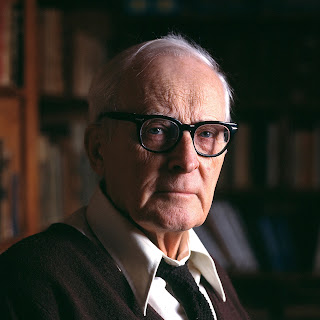
I’ve been re-reading the Complete Works of Hugh Nibley all this year–starting innocently enough with vol. 1 Old Testament and Related Studies, as an easy way to supplement my Old Testament study for the 2026 Sunday School curriculum–then promptly proceeded to vol. 2 Enoch the Prophet, since that too corresponded with the early “Come Follow Me” lessons on The Pearl of Great Price in January, along with all four volumes of his work on the Book of Abraham; and thus, before I knew it, I found myself kinda sorta committed to re-reading the whole kit-and-caboodle.
Hence, as this year starts to draw to a close–and in the storied tradition of music websites everywhere ranking the albums of influential Punk bands from worst to best–I thought I might proffer my own personal and provisional ranking of Mormonism’s most Punk Rock and provocative scholar.
#19 Apostles and Bishops in Early Christianity (vol. 15)
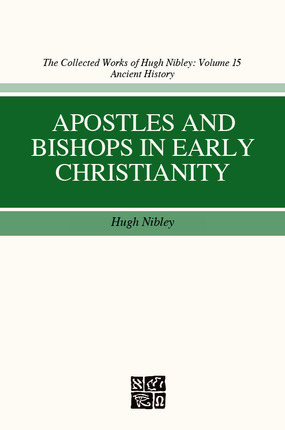
This slim volume (the shortest in the entire series) contains only the lecture notes for a one-off BYU class Nibley taught in the 1950s—wherein he spent an entire semester arguing that the pre-Nicaean Church did indeed possess two separate Priesthoods that correspond to our current division between the Aaronic and Melchizedek—and then he never bothered revisiting the topic again. The fact that these notes weren’t finally collected and published till Nibley was literally on his death-bed a half-century later tells you exactly how interesting even he found this lecture series. Though heavily footnoted, a couple key citations are (by the editors’ own admission) missing, so it’s not even useful as apologetics (it’s not like this was ever the wedge issue that was gonna persuade someone to join the Church, anyways). For completionists only.
#18 The Ancient State (vol. 10)
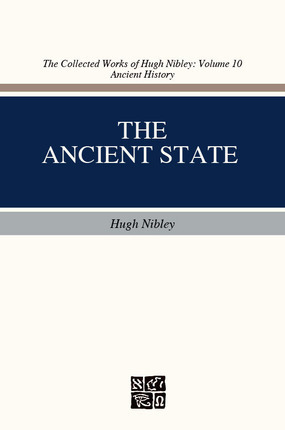
I swear I re-read this book earlier this calendar year, yet I can’t remember a word of it. I’d pull it off the shelf to remind myself, but I’m sure I would promptly forget again. It is a point of debate among Nibley stans whether his apologetics or his polemics were more important, but this book contains neither; it is merely a collection of secular research articles on ancient civilizations he published in peer-reviewed journals decades ago that have all long been superseded (sometimes by himself). Also for completionists only.
#17 Mormonism and Early Christianity (vol. 4)
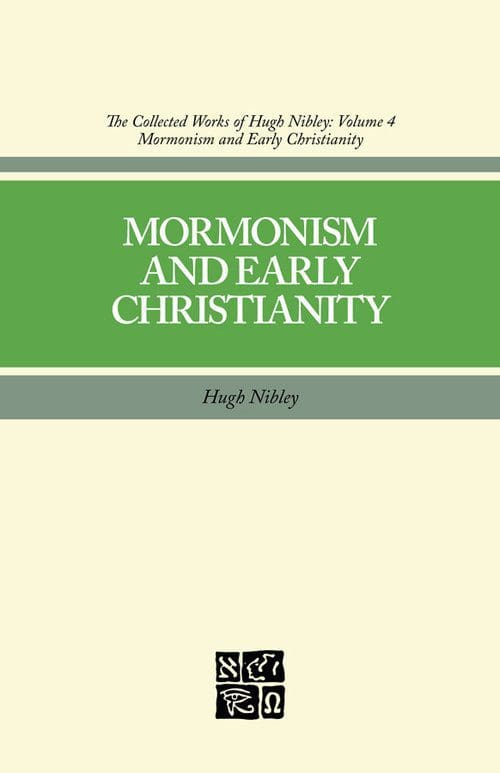
The downside of reading all 19 volumes of the Complete Works of Hugh Nibley in a row is that you start to note how often he repeats the same themes, arguments, and citations over and over and over again. This volume, for example—a collection of articles that trace the infiltration of rhetoric and philosophy into the early Church after the death of the apostles—isn’t poorly written per se, but it repeats information that already appears in the much more eloquent and energizing lecture series The World and the Prophets (appearing later on this list), and which would be better worth your time to read first instead.
All except for his parable of the eschatological man (which we’ve quoted in bulk here), which is absolutely appointment reading for any student of Nibley; indeed, it might be one of the profoundest things he’s ever written!
#16 Tinkling Cymbals and Sounding Brass (vol. 11)
Nibley first burst on to the scene in the late-1940s with his long-form rebuttal to Fawn Brodie’s No Man Knows My History, the still-most-widely-circulating biography of Joseph Smith (his riposte, naturally, was entitled No Ma’am, That’s Not History). This tract made him the Church’s go-to apologist for decades to come–much to his chagrin, one starts to suspect. For though he was obviously all fired up to write his still-definitive response to Brodie, you can kind of tell his heart wasn’t really into all the other entries in this door-stopping volume, that he was largely just going through the motions. I’ve heard anecdotally that these numerous Church-assigned responses to anti-Mormon lit wearied on him, because they took him away from the research he would’ve vastly preferred to be doing instead with his limited time on this earth—and after slogging through the rest of this volume, I believe it. (Besides, a testimony, as he well knew, comes by the Holy Ghost, not a Works Cited pages.) Read it for the Fawn Brodie rebuttal, but most everything else you can either skim or skip.
#15 Temple and Cosmos (vol. 12)
The first part of this volume–the Temple of the title–is almost required reading for anyone who has ever been baffled by the LDS Endowment ceremony (which I’m pretty sure is everyone, or at least should be). Not that Nibley ever explains the Endowment to everyone’s or even anyone’s satisfaction; only that he will give you at least a few new things to pay attention for when you go through the Temple next time, so that you do not just sit there baffled or bored again. However, the second part–the Cosmos section–is much less interesting, memorable, or timely (his pre-1978 defense of the Black Priesthood ban, for example, while certainly more progressive than many other General Authorities of the era we could name, has not exactly improved with time—though kudos to the editors for at least not pretending it doesn’t exist). Read for the Temple section, skim or skip the Cosmos one.
#14 Old Testament and Related Studies (vol. 1)
I mentioned up top that my almost-accidental re-read of the Complete Works began this year because I had started vol. 1 Old Testament and Related Studies back in January to compliment this year’s “Come, Follow Me” curriculum; but this collection charmed me so much in both style and content that I realized it was high time I re-visit the other volumes, too. That gushing response of mine is slightly ironic, because this volume is largely just a collection of his earliest preliminaries into the O.T. before he began his much meatier researches into the Books of Abraham and Enoch much later in his career, which you could definitely be forgiven for skipping ahead to read first instead. But it is fascinating to note how much of Nibley’s personal voice–his wit, his excitement, his persistent suspicion that there’s something of great import hidden in all these ancient documents if only we had the wherewithal to look–was present, fully-formed, right from the very first volume in this series.
#13 Eloquent Witness: Nibley on Himself, Others, and the Temple (vol. 17)
Notably the editors of this series waited till he was three years dead and cold in the ground before they released a collection on the topic that interested Nibley least of all: himself. This volume corrals together his one, brief autobiographical essay that already appears in his 1978 greatest hits collection On the Timely and the Timeless, alongside a couple other unused biographical sketches he drafted for some other unnamed projects (he resolutely refused to write a memoir). It also includes a bunch of unpolished interviews he no doubt sat for impatiently, the transcript to a BYUTV documentary on him that he also clearly cringed through, and some brief book reviews from the start of his career–back when he was still just Nibley the aspiring college professor, not Nibley the Big Important Scholar–and hence are only of historical rather than devotional interest.
I would have ranked this volume far lower down the list and marked it “for completionists only” as well, save that the final section of this book contains his very first engagements with the Book of Abraham, which are good for helping orient yourself before diving into the topic that would dominate the final 40 years of his life.
#12 An Approach to the Book of Abraham (vol. 18)
It is highly ironic that this was the penultimate volume published in the Complete Works, because this is the tome you should really read first in order to get the strongest handle on all his subsequent Book of Abraham research. The articles collected here, first published in the now-defunct Improvement Era in the late-60s/early-70s, were in response to the then-most-recent sallies against the Book of Abraham made in 1968, which Nibley notes were largely just a rehash of the same ones from 1912 (and which are the same critiques still levied against the text today). He really gets into the weeds of Egyptology and the nooks and crannies of the Joseph Smith papyri itself, to a degree that will frankly fly over the heads of most non-specialists (and perhaps even exasperate the patience of actual specialists), despite his attempts to keep things accessible to a broader audience.
Nevertheless, this volume is still vintage Nibley–not only for how he rips into the glib shallowness of most anti-Mormon arguments, but also for how he lays into the glib shallowness of the Saints ourselves, taking us to task for utterly neglecting the study of our own scriptures, leaving us to be caught flat-footed by critics, and deservedly so. He had put in the hard work to learn Egyptian from a much younger scholar while middle-aged himself, and was frustrated that absolutely no other Latter-day Saint had ever even tried to, leaving him to shoulder the burden of church Abraham studies alone.
#11 Abraham in Egypt (vol. 14)
This volume contains Nibley’s first book-length study into the Book of Abraham, initially published by Deseret Book in 1981 to great fanfare. He makes regular reference to his previous articles on the topic now collected in An Approach to the Book of Abraham (which, again, you should really read first before diving into this one). He here deploys the same strategy he used in his Book of Mormon apologetics of the 1950s and ’60s, wherein he puts the Pearl of Great Price text into conversation with other recently-recovered apocryphal books of Abraham—especially the Greek Testament of Abraham and the Slavonic Apocalypse of Abraham—both of which he argues have strong Egyptian flavors, and none of which were available in Joseph Smith’s time. From there, he seeks to synthesize together all these various Abraham apocrypha in order to demonstrate how many details the Pearl of Great Price version got right—including, incidentally, how all of these texts are in agreement that the true sin of Sodom wasn’t sexual sin but “pride, fulness of bread, and abundance of idleness was in her and in her daughters, neither did she strengthen the hand of the poor and needy” (Ezekiel 16:49)—and which utter lack of charity Abraham himself sought to resist.
If Nibley’s never able to keep his prose anywhere near as accessible as his Book of Mormon apologetics, well, 1) Egyptology really is just that much more esoteric and difficult of a field to master, and basically impossible to boil down for that mythical “general audience,” and 2) for a topic this hotly contested, it’s better to be over-detailed than under. This book also pairs well with his other major work on Abraham, which is…
#10 The Message of the Joseph Smith Papyri: An Egyptian Endowment (vol. 16)
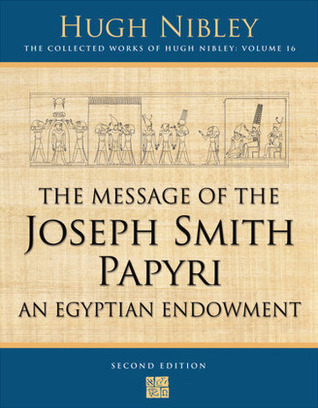
The most frequent charge levied against the Book of Abraham is that none of Joseph Smith’s commentary on the hypocephalus found in the Pearl of Great Price can possibly be accurate, because a hypocephalus was merely a “common” funerary amulet used in ancient Egypt. Laying aside for now that no two hypocephali are identical and no two scholars agree on any one of their translations (which he also establishes at excruciating length in his other studies), Nibley here tackles this charge head-on, by using one particular hypocephalus—Papyrus Louvre N. 3284, since it appears to correspond most closely to the surviving fragments of the Joseph Smith Papyri—as a jumping off point to discuss in depth the nature of Egyptian funerary rites. He makes the provocative argument that the ancient Egyptians participated in Temple endowment ceremonies of their own, ones intended to prepare the living to pass into the next life and inherit their glory.
He at no point makes any explicit comparison to the LDS Temple endowment ritual, letting the reader draw their own conclusions. He dumbs down nothing, but expects you to keep up; the Temple is a House of Learning, after all. Even more so than Temple and Cosmos, this is the book that will, if nothing else, help you to not be bored through your next Temple session.
#9 One Eternal Round (vol. 19)
This was purportedly Nibley’s magnum opus on the Book of Abraham that he spent all his twilight years laboring on, and hence served as the grand finale to the Complete Works in 2010. Per the Introduction, when fellow FARMS scholar Michael D. Rhodes finally agreed to finish this gargantuan work on his behalf in 2005, a 95-year-old Nibley passed away peacefully in his sleep only a few hours later, as though he sensed his life’s work was in good hands. Alas, Rhodes, who I’m sure is a fine fellow and an able scholar, simply does not have the same wit and style that Nibley had, so the prose never quite pops off the page as in his other works. Yet even if the prose were all Nibley’s, there’s still the issue that–in classic Nibley fashion–the book steadfastly refuses to offer the final word on anything.
And that’s generally a good thing! It’s more intellectually honest, and more spiritually honest! But it nonetheless serves as a strangely unsatisfying note to end his career on, an afterthought rather than a coda, an anticlimax rather than a culmination. Paul Valéry once said works of art are never finished, only abandoned, and we can say the same of Nibley’s never-ending tinkering with his research on Abraham, which only death itself could finally force him to abandon (at least in this life); even in his final book, we are still merely peaking over his shoulder in media res at whatever his latest research was, never seeing the end. But then, there is no end, for the course of the Lord is one eternal round…
#8 The Prophetic Book of Mormon (vol. 8)
This is the fourth and final book-length compilation of Nibley’s groundbreaking work into Book of Mormon apologetics, and the one with the coolest title, yet arguably the weakest of the tetralogy. It’s more of a mopping up of all Nibley’s other articles on the Book of Mormon that didn’t fit neatly into his first three volumes on the subject, and which serves more as a sort of fond farewell to the topic, before Book of Abraham studies took over the remainder of his life. Don’t get me wrong, the essays collected in here are for the most part eclectic and engaging and fun to read, but still not quite as essential or memorable as his first three Book of Mormon volumes–all except for the closing couple-odd essays, which might well be worth skipping ahead to read alone.
For as Nibley argues in this volume’s finale, the strongest case for the truthfulness of the keystone of our religion is whether or not it actually has something to say; and according to him, the pride cycle and pursuit of wealth in the Book of Mormon—which resulted in the complete annihilation of not just one but two pre-Columbian civilizations—has something dire to say to modern America indeed. We are next on the chopping block if we do not repent.
#7 Since Cumorah (vol. 7)
Nibley’s third book-length study into the Book of Mormon, first published in the 1960s. This time, he takes into account the then-recent discovery of the Nag Hammadi and other gnostic libraries, arguing that they offer tantalizing similarities to the keystone of our religion, and building off his similar comparatist studies with the Dead Sea Scrolls. This volume is where Nibley’s deep and abiding interest in pre-Nicaean Christianity finally connects together with his Book of Mormon studies. He also addresses the deutero-Isaiah controversy directly in this volume. However, it is recommended that you begin first with Lehi In the Desert and An Approach to the Book of Mormon (coming up next), to better familiarize yourself with Nibley’s M.O. before tackling this one.
#6 An Approach to the Book of Mormon (vol. 6)
The Correlation department has some serious sins to answer for! Case in point: this volume was the Melchizedek Priesthood manual that the First Presidency commissioned Hugh Nibley to write in 1957. The Church Education department initially rejected it, arguing it would fly over the heads of too many members, but President David O. McKay to his eternal credit overruled them, saying, “Let them reach.” Imagine if we still had Sunday School manuals like this today, rather than the impoverished ones we get instead! Imagine if we still had senior Church leaders who were willing to overrule CES (one thinks of that apocryphal quip from Gordon B. Hinckley, “I hope one day CES will join the Church”)! Oh, I can only dream!
This manual draws heavily from Nibley’s prior work in Lehi in the Desert, but also adds fresh insights gleaned from the then-recent discovery of the Dead Sea Scrolls in 1947. In his estimation, the Scrolls help confirm the historical plausibility of the Book of Mormon, since they establish just how ancient the practice really was of Hebrew sectarians escaping into the desert Lehi-like to live the gospel in its purity and await the advent of the Messiah, then leaving behind sacred records (including on metal plates!) buried carefully to come forth in a latter day. Though largely a work of apologia, he is also deeply concerned with what the Book of Mormon actually has to say to us moderns (an idea he more fully develops towards the end of The Prophetic Book of Mormon); hence this volume’s most famous line, “Wo unto the generation that understands this book!” Many an EQ instructor reportedly wrote him to ask if that line was perhaps missing a “doesn’t”; he assured them it did not.
#5 Lehi in the Desert/The World of the Jaredites/There Were Jaredites (vol. 5)
This was the collection that made Nibley Nibley. Written in clear, lucid prose (which he would never quite repeat again) in the early-1950s, Nibley in his very first study on The Book of Mormon opens by noting that the first 40 pages of the text takes place in the Arabian desert; and that since the Bedouin ways of the desert are notoriously unchanging, we have a strong “check” by which to judge the historicity of the opening chapters. Drawing upon his PhD in Middle-Eastern studies from Berkeley and his fluency in Arabic, Nibley argues with style and wit that 1 Nephi gets a hundred casual details right—even in the proper names themselves—about desert Arabian life that no outsider could have possibly guessed correctly in 1829.
With bravado, he repeats this same exercise with the Jaredites, arguing that their modes of mass migration, protection of kingship, and wars of total extermination, all mark them as originating in the ancient Steppes of Asia, who are likely the actual ancestors of most Native American tribes. (Incidentally, I feel like absolutely no one gives Nibley credit for the fact that he published The World of the Jaredites only a year before Watson and Crick discovered DNA; that is, when 21st century critics argue that the Book of Mormon is false because most Native American DNA comes from Asia, not the Middle-east, well, Nibley correctly argued the exact same thing over 70 years ago! This volume remains as relevant as ever.)
#4 Enoch the Prophet (vol. 2)
You never forget your first time, and this is the very first Nibley I read on my mission (in a pile of old Ensigns from the ‘70s, no less—which, wow, what happened!). As he would also do with the Book of Abraham, Nibley takes Moses ch. 6-7 of the Pearl of Great Price and treats it as a mini Book of Enoch, then demonstrates its similarities to all the other known apocryphal books of Enoch currently in circulation. Again, he emphasizes that these recently-rediscovered apocrypha were not available to even the most accomplished scholars on earth in 1830, let alone a rustic farmer from Vermont.
Yet as he also did with the Book of Mormon, Nibley argues that the greatest argument in favor of the Book of Enoch’s authenticity is if it actually has something to say; and in his portrayal of an ante-diluvian world filled to the brim with self-destructive tyrants actively wasting the planet’s resources for their own profit and gain in open defiance of the known laws of the universe–all but daring God to destroy them–Nibley makes Enoch and Noah terrifyingly relevant to our modern times.
#3 The World and the Prophets (vol. 3)
This was originally a series of short radio addresses entitled Time Vindicates the Prophets that Nibley delivered on KSL back in the 1950s; indeed, if you can find mp3s of these talks (they’re floating around there online, trust me on this), I highly recommend listening to them rather than reading them, because they are spectacular! His verve, his wit, his humor, his eloquence, his erudition, his energy, are on full display in these talks; Nibley here is firing on all cylinders, and puts modern podcasters to absolute shame.
Over the course of this 30-part lecture series, he cites Tertullian, Origen, St. Augustine, Clement of Alexandria, John Chrysostom, Justin Martyr, and numerous more of the early Church fathers (often translating them directly from the original Latin and Greek), to not only establish that the Great Apostasy really did happen, but to trace the exact steps by which the early Church was infiltrated by rhetoric, philosophy, and mysticism, all of which served as sorry replacements for the gift of revelation, which the earliest saints he argues correctly intuited had been lost with the passing of the apostles. Nibley is of course trying to establish here the necessity for the Restoration and of continuing revelation; but as ever, for Nibley the truest test of a prophet is if they actually have something to say. And in the breath-taking finale (which we have quoted in bulk before), he argues that ultimately, the message of the prophets is that it is not eternal misery mankind must prepare for, but for overwhelming and terrifying joy—the very thing we moderns most fear.
#2 Brother Brigham Challenges the Saints (vol. 13)
Nibley here applies this same test to Joseph Smith and Brigham Young, focusing far less on who they were than on what they had to say—and how much we as Church members have collectively ignored them, despite all our boasts to having a living prophet to lead us. It was in this collection that Nibley laid into his fellow Latter-day Saints the hardest, taking us to the cleaners for our utter and abject failures to live up to the promises of our own religion. He repeatedly and encyclopedically quotes Brigham Young, really driving home how constantly he admonished the Utah saints to live the Law of Consecration, to establish the United Order, to protect the environment, to seek not for riches but for wisdom, to reject war, to care for the poor, to in short lay aside the things of this world and seek for the things of a better (D&C 25:10). The fact that Utah is now home to some of the most deep-red conservative, anti-environmental, anti-intellectual, pro-war, homeless-hating, get-rich-quick-scheming, white-collar-criminal voters in America today is a bitter irony not lost on Nibley in the slightest. He hated speaking on politics, but like the prophet Jeremiah, “his word was in mine heart as a burning fire shut up in my bones, and I was weary with forbearing, and I could not stay.”
He makes no apologies for quoting Brigham Young on these unpopular topics at his employer of Brigham Young University, since (in his own words) the college’s only distinction is that it carries his name. He pulls no punches, offers no concessions, minces no words, but like his hero Brigham Young calls us to repentance plainly and bluntly; like Amulek in the Book of Mormon, he speaks not against our law, but in favor of it, to our condemnation; and like his Savior and ours, he repeatedly flips over the tables of the money changers to declare that our Father’s House is a house of prayer, but ye have made it a den of thieves. (In our current era of quarter-trillion dollar Church hedge funds, his words matter now more than ever.) I was tempted to slot this collection at #1, save that this refreshing volume would not exist without…
#1 Approaching Zion (vol. 9)
This is the book that Nibley deserves to be remembered for, long after all his older research has been superseded and consigned to museum pieces. If you have ever perchance rolled your eyes at why so many of the pieces we’ve published here at ShipsofHagoth relentlessly and monotonously cite Acts 2:44-45, 4 Nephi 1:3, D&C 42:30-39, D&C 49:20, Mosiah 4:16-20, Mathew 19:21-24, and about a million others[1]In, for example, essays on Star Trek, Ecotopia, The Avengers, Rage Against the Machine, Prince, Nephi Anderson, Woody Guthrie, Suicide, The Screwtape Letters, Bittersweet Symphony, Gang of Four, … Continue reading, know that it’s because Nibley first laid it all out for us here, in this book, in essay after essay, repeatedly and explicitly, clear as the moon and terrible as an army with banners. (“Zeal Without Knowledge” alone is worth the price of admission.) I’ve no joke read thousands of books in my life, but can count on two hands the number of books that have actually changed my life, and this is one of them.
As he never tires of reminding us, those of us who have been through the Temple endowment have already covenanted to keep the Law of Consecration; hence, says Nibley, there is no sense in quibbling further about what other political or economic system might work best instead, because we are now committed to the real thing. Whether or not the United Order is “feasible” in this life is entirely besides the point: It is we, and our fitness for the Kingdom, who are being tested by the Law of Consecration, not the other way around. Nibley, as this ranking entire has hopefully shown, clearly takes our holiest scriptures and Temple rituals seriously and believes them literally, and this is the final end-result of his scriptural literalism: he literally believes that God requires us to establish Zion, the United Order, where there will be neither rich nor poor, but we will have all things common, “and the poor of his people shall trust in it” (Isaiah 14:32). If we are to be saved, we must go forth and do likewise.
References
| ↑1 | In, for example, essays on Star Trek, Ecotopia, The Avengers, Rage Against the Machine, Prince, Nephi Anderson, Woody Guthrie, Suicide, The Screwtape Letters, Bittersweet Symphony, Gang of Four, Ursula K. LeGuin, Dead Kennedys, Run the Jewels, Daniel Tiger’s Neighborhood, Madonna, Attica Blues, Miles Davis and Billie Holiday, Pink Floyd, The Kinks, Star Trek: Deep Space Nine, Baseball, Deleuze and Guatarri, Baudrillard, and many more I’m sure we’ve missed, and more to come. |
|---|