

The more things change, the more they stay the same. A Republican president will start a pointless war inthe Middle-east which will eventually terminate in the death and misery of many souls[1]D&C 87:1, the guilty and the wicked will go unpunished because of their money[2]Helaman 7:5, your favorite movies will get remade as mere cash-grabs, and young people will start using slang that annoys you.
It is the prerogative of every rising generation, after all, to adopt slang that actively irritates their elders–the “groovies” and “far outs” of the Boomers, the “wickeds” and “gnarlys” of the Gen Xers, the “Yeets” and “baes” and “OMGs” of the millennials, the “rizz” and “glazes” and “no caps” of Gen Zers, and etc.–and by all reports, the school-aged children who make up “Gen Alpha” so-called have already gotten a head-start on this most esteemed and honored tradition.
For reals, I confess that it has been one of my low-key delights as a college instructor to observe how many of my Gen Z college freshmen get bent out of shape over Gen Alpha slang while still in their late-teens themselves. (Seriously, it’s hilarious to hear a Zoomer complain about how “kids these days are always on their tablets, and their slang doesn’t even make any sense!” Pot, meet kettle.)
The purported distinction for Gen Alpha, however, is in the sheer nonsensical nature of their grade-school slang. By way of comparison, that old Millennial/Gen Z standby “69” is a crude yet clear reference to a specific sex act, the verbal equivalent of drawing a dick in a textbook, and will still elicit a Pavlovian “Nice!” from Zillennials to this day; but “6-7” by contrast (the reported bane of every elementary school teacher over this past calendar year) is almost pure sound poetry, a lilting sing-song utterly bereft of meaning, wherein the whole joke is that it doesn’t actually mean anything at all. It sounds close enough to “69” to seem dirty, yet without actually being about “69”–nor anything else for that matter. It is the verbal equivalent of splattering a Jackson Pollock on a textbook.
Similarly, the Gen Alpha phrase “skibidi toilet” at least contains one real word in it; yet though “skibidi” at first glance sure seems to reference the scatological humor that small children have giggled over since time immemorial (both “scat” and “skib” even open with a similar sibilant fricative), upon closer inspection, it actually references nothing in particular at all. It merely looks like a real word without actually being a real word. Skibidi is Derrida’s différance–the Post-Structuralist founder’s famed example of something that looks identical to a real word without actually being a real word–in schoolyard slang form.
Previous generations’ forms of slang, you seen, were at least decipherable, if one were willing to put in the work to decode it: the “groovy” of the Boomers, for example, referenced the pleasures of listening to the grooves of a non-scratched vinyl LP record, back during that format’s hegemony; the “wicked” and “gnarly” of the Gen Xers was a defiant twisting of negative adjectives into positive descriptors, in gleeful reaction against the performative “Satanic panic” that dominated their elders during the Reagan years; Millennials in turn were the first generation to own key-pad cell-phones in college, so naturally innovated the abbreviations and text-speak of “OMG,” “ttyl,” “LOL,” “LMAO,” and “bae”, all of which have direct translations; and even Gen Z slang has some underlying logic to it (e.g. “rizz” is short for “chaRISma;” “no cap” means honest, straightforward, to not hide your facial expressions under the shade of your hat; “glaze” means to effusively compliment something that is already great, like adding glaze to a doughnut; and so on and so forth). The irritation among Gen Zers in particular, I can’t help but conjecture, is that the Gen Alphas coming up immediately behind them are no longer playing the game honestly, that these little twerps have abandoned the coded language prized by their older siblings, parents, grandparents, and even great-grandparents, to instead embrace the sheer, indecipherable anarchy and chaos of nonsense.
But then, this tendency towards sheer nonsense would not have been so alien to their great-great-grandparents! For back in 1916, you see–a solid century before Gen Alphas’ birth, amidst another entirely pointless war, global surges in authoritarian movements, and the utter breakdown of the international order–the German author Hugo Ball published “The Dada Manifesto” in Zürich, Switzerland, which inaugurated the entire European art movement known today as Dadaism.
And what was Dadaism, exactly? As Hugo Ball explained it, Dada is “An International word. Just a word, and the word a movement. Very easy to understand. Quite terribly simple. To make of it an artistic tendency must mean that one is anticipating complications. Dada psychology, dada Germany cum indigestion and fog paroxysm, dada literature, dada bourgeoisie, and yourselves, honoured poets, who are always writing with words but never writing the word itself, who are always writing around the actual point. Dada world war without end, dada revolution without beginning, dada, you friends and also-poets, esteemed sirs, manufacturers, and evangelists. Dada Tzara, dada Huelsenbeck, dada m’dada, dada m’dada dada mhm, dada dera dada, dada Hue, dada Tza.” The entire raison d’etre of Dada is that it is a nonsense word, that it means nothing. Like Skibidi and 6-7, the whole point of the word Dada is it has no point—just like everything else.
As the French-Romanian avant-garde artist Tristan Tzara wrote in a similar Dadaist manifesto in 1918, “The magic of a word—Dada—which has brought journalists to the gates of a world unforeseen, is of no importance to us,” further stating bluntly, “Dada Means Nothing.” Again, the lack of a point is itself the point.
Take for example the arguably best known of the Dadaist artists, the Franco-American Marcel Duchamp, who famously caused an uproar at a New York City art exhibition in 1917 when he submitted a sculpture called “Fountain,” which was nothing more than a porcelain urinal that he cheekily signed “R. Mutt 1917” (arguably, it was the Ur example of a “skibidi toilet”).
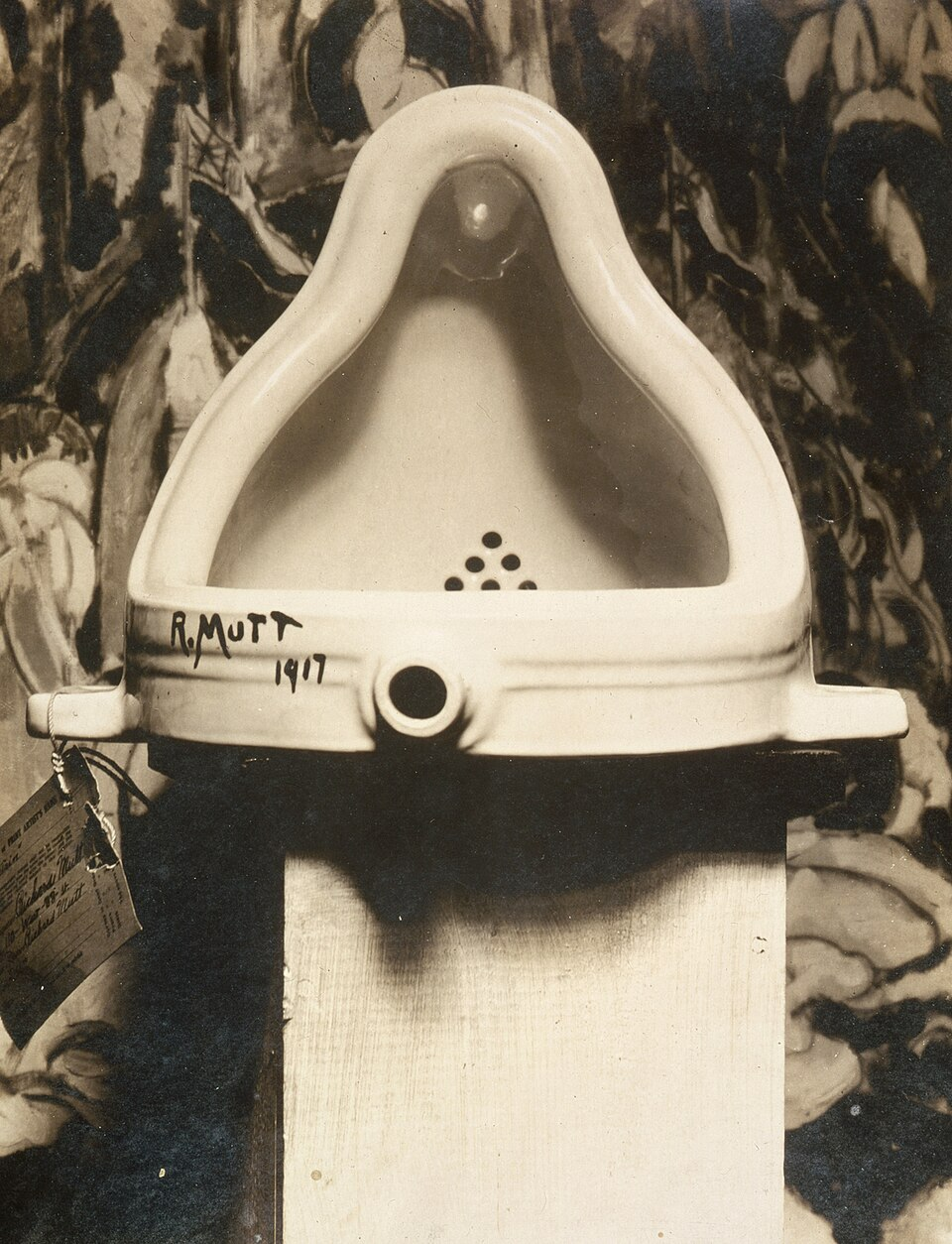
The sculpture was a juvenile prank that made a mockery of all artistic ambitions, civilized traditions, and the finer sensibilities; but then, so did the entire First World War, then still raging. “Fountain” was a form of revolt against a war-torn world gone mad, one that had pissed away all of its moral and intellectual credibility, that had ceased to make sense in any way, shape, or form, so the Dadaists refused to make any sort of sense either. In this, they were but satirizing and parodying the insane world-at-war they already lived in, where millions were slaughtered for no good reason at all, in a conflict that did not have the slightest reasonable justification. We now live in a very similar world, exactly a century later, one where all appeals to facts, logic, honesty, and even basic human decency repeatedly land on deaf ears in the halls of power; when there has not even been a shadow of an attempt by this dangerously unhinged administration to justify or rationalize the utterly pointless war on Iran, as there had been even during the equally pointless wars in Iraq, Afghanistan, and Vietnam; no wonder the Gen Alpha kids have embraced absurdity. They have correctly intuited that it is the only sane response to an obviously insane world, and they did so while still children themselves.
For of course it has been children who saw it coming first; of course in fairness, no prophetic gift was necessary to foresee the current war, though it sure required adulthood to convince yourself otherwise. Christ famously taught that we must become as little children if we are to inherit the kingdom of God, and it is here worth reflecting, then, that little children love absurdity and nonsense slang, just in general. It is not they that must become more like us adults, forever accommodating to and compromising with the evils of the world, but rather we who must become more like little children. It was the Pharisees, recall, who self-righteously demanded that Christ silence these unseemly children, to which he responded that if these kept silent, the very stones should cry out; and it was Christ, too, who entered Jerusalem on Palm Sunday by riding an ass, in the most comically hilarious parody of a triumphant King thinkable. The Savior, too, had the spirit of the Dadaists about him.