

The very first band to self-market themselves as “Punk” at the dawn of the ’70s wasn’t the Ramones, wasn’t the Sex Pistols, wasn’t the New York Dolls, wasn’t the MC5, wasn’t even The Stooges, but Suicide: a synth-Pop duo from New York City. Before it was a guitar genre or even an aesthetic, Punk was an attitude–an antagonistic, audience-bating attitude–and Suicide had it in spades: Avant-garde Jazz musician Martin Rev jerry-rigged together a primitive drum-machine to a broken organ he called “The Instrument” and blasted repetitive beats at ear-splitting volumes, all while vocalist Alan Vega caroused around the stage affecting his best Elvis-Presely-on-acid impression, as the duo did everything in their power to piss off everyone in attendance–and that back when it was still genuinely dangerous to do so.[1]Which they first learned to do from watching Iggy Pop of The Stooges—who in turn first learned it from watching Jim Morrison of The Doors in his final decline. Vega sang with a bike chain in hand for self-defense, and that not as affectation: They once opened for The Clash in the late-’70s when an audience member threw an axe at Alan Vega’s head, because they were apparently too antagonistic for actual anarchist Punks. Small wonder then, that despite predating all of their first-wave Punk peers by at least a few years, they didn’t get a record deal till well after all of them. Their self-titled first album was finally released by Red Star records in December of 1977.
Suicide is yet another example of a record better known for its influence than any sort of commercial success, though its influence is impressive: Bruce Springsteen of all people—and that at the height of his hit-making popularity—was a huge fan, and credited Suicide’s first record as the inspiration for his darkest and most cultish album, Nebraska. Ric Ocasek of The Cars—you know, the upbeat New Wavers behind feel-good hits like “Just What I Needed” and “Let the Good Times Roll”—was also somehow a massive fan, and personally volunteered to produce their second album in 1980[2]Though in terms of sequels to their iconic debut, I personally prefer their third album, the cheekily named Way of Life, which came out another eight years later in 1988. They would only release two … Continue reading, providing them access to professional-grade synthesizers for the first time. Elvis Costello, another popular New Waver, invited them to open for him at a show in Brussels; and when Suicide was boo’d off the stage, Costello in retaliation performed a very short and angry set that sparked a riot.[3]As preserved in Suicide’s 1978 live album, 21½ Minutes in Berlin/23 Minutes in Brussels.
Their underground cred eventually became such that by 2002, Indie-darlings LCD Soundsystem could name-check them in their dryly-funny debut track “Losing My Edge”—about an aging hipster desperately trying to burnish his underground cred—and trust that their listeners would get the joke. Even that 2024 Civil War movie sampled “Rocket USA” for some borrowed credibility. And of course the time would fail us to list the legions of other synth-Pop groups and Indie-bands that claim them as an influence as well.
Of the seven tracks that make up this short, half-hour record, the two that tend to get the most ink spilt about them are Side A opener “Ghost Rider” and Side B opener “Frankie Teardrop.” The first track is more tongue-in-cheek; initially, it merely seems to head off any accusation that their band-name is glorifying or endorsing the act of suicide in any way, by making clear that they are really just referencing their favorite comic book character Ghost Rider—seriously, the cheesy flaming-skull dude who fights evil-doers on a motorcycle[4]They even made a couple of silly Nicholas Cage movies about him back in the day.—and his popular early story-line “Satan Suicide.” For a brief moment at the start of the record, you can maybe convince yourself that perhaps this band isn’t so adversarial or confrontational at all, but actually quite innocent: that these two men are really just overgrown children (for of such is the kingdom of God) acting out for attention, excitedly telling you all about their favorite Marvel superhero, the way little boys tend to do. “Ghost rider, motorcycle hero,” Alan Vega opens with wide-eyed enthusiasm, “he’s a-lookin’ so cute/Sneakin’ ’round, ’round, ’round in a blue jumpsuit.”[5]Add it to your Halloween playlist!
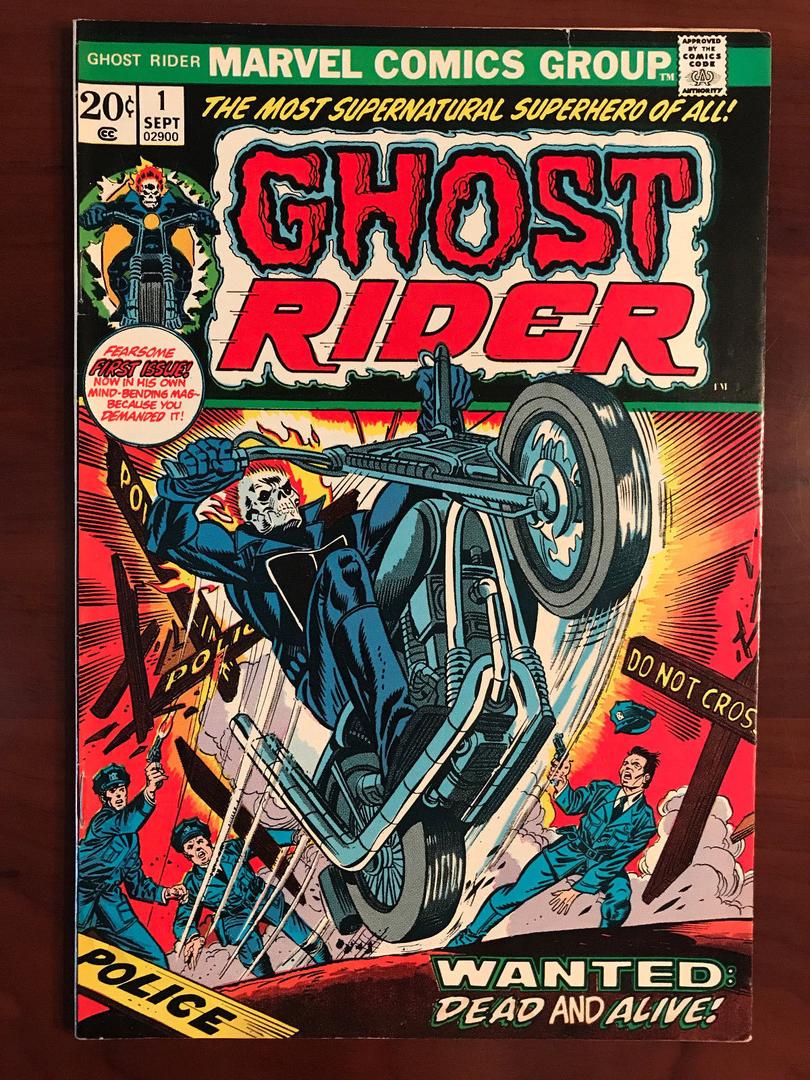
But before this short song can finish, Vega becomes forthright about the fact that this record isn’t about a comic book suicide at all, but a national one: “Hey, baby, baby, baby, he’s a-screamin’ the truth,” he croons, “America, America is killin’ it’s youth.” It’s not a line that requires a whole lot of explication, does it; we all instinctively understand exactly what he means. Between the ever-present threat of nuclear war, unabated climate change, carcinogens in our food, school shootings, medical bankruptcies, the spiraling cost of living, and a million other fill-in-the-blanks besides (many of which hadn’t even been invented yet in 1977), we’ve been collectively killing off our children for well over a half-century now, haven’t we. “Ghost Rider” sets the tone for the rest of the album; one could even argue that the rest of the record (maybe even the rest of their career) is just variations on that first track.
But by far the most over-discussed track on the album is “Frankie Teardrop,” the 10-minute long opus that dominates Side B. This was the track that obsessed Bruce Springsteen, that Henry Rollins called “the single most intense song I’ve ever heard in my life,” and that Lou Reed said he wished he’d written himself. The track is deceptively basic: over Martin Rev’s ominous, austere, and unrelenting beat, Alan Vega very simply and very severely narrates the tale of a young factory worker named Frankie, who’s take-home pay[6]in what will sound like an increasingly familiar story today just isn’t keeping up with the cost of living. He can’t afford groceries, he can’t cover rent, so on the verge of eviction and in a fit of desperation, he grabs a gun and kills his six-month-old baby in its crib, then his wife, then himself. Suicide finally lives down to its name.
But even that final gun-shot doesn’t break the merciless tension of the song, as Alan Vega then follows Frankie down to hell. He punctuates the track with inhuman bursts of screaming, yet still, like the tell-tale heart of Edgar Allan Poe, the unbearable tension of the beat never ceases. “We are all Frankies,” Vega warbles in the finale, “We are all lyin’ in hell…” (You can see why that audience in Belgium rioted.) Novelist Nick Hornby of High Fidelity fame once called it the sort of song you listen to “only once.” In contrast to the coy campiness of “Ghost Rider,” this is legit one of the most terrifying tracks I have ever heard.[7]Add it to your Halloween playlist too, I dare you.
But in my estimation, not nearly enough attention is paid to the track that immediately follows “Frankie Teardrop” and concludes the album: “Che.”
It is an obvious allusion to Ernesto “Che” Guevara Lynch, the famed Argentinian revolutionary and Fidel Castro’s right-hand man in the 1959 Cuban Revolution. Che had been radicalized while a medical volunteer in Guatemala, when a 1954 CIA coup replaced the country’s democratically-elected president with a mass-murdering dictator; naturally, Che dedicated the rest of his life to opposing U.S. imperialism. Che today remains a sort of Robin Hood figure across much of Latin America (not to mention a mainstay of many a college dorm-room poster state-side). His death at the hands of the CIA and the Bolivian military in 1968 elevated him to the status of martyr less than a decade before Suicide’s first record came out–but Alan Vega was having none of it. “And when he died/The whole world lied,” Vega rhymes simply, “They said he was a saint/But I know he ain’t.”
And not without reason. Even author John Lee Anderson in his obviously-sympathetic 2010 biography Che Guevara: A Revolutionary Life, makes no bones about the fact that Che’s sole concrete accomplishment was to overthrow one Cuban dictatorship only to replace it with another. Che was intensely idealistic and worked harder than most to accomplish his ideals, but ultimately became just as bloody and brutal a man as the people he resisted. It all came to naught in the end.
Within the context of Suicide’s first album, “Che” is an important note to end on, because up until then, Vega and Rev appear to be ideal candidates for Che’s brand of revolutionary fervor. After all, their opening track “Ghost Rider” literally declared “America is killing its youth,” second track “Rocket USA” announces America’s “doomsday,” and its centerpiece “Frankie Teardrop” explicitly narrates how an exploited young factory worker was driven to a double murder-suicide. The American economic system is failing, and obviously needs to be either radically reformed or overthrown entirely. But they don’t see in Che Guevara’s revolutionary communism the solution to these immense problems, either; they don’t appear to know what the real solution is, or if there even is a solution, they just know that Che’s ain’t it. There were even more exploited factory workers in the USSR than in the USA, after all. That red star[8]And yes, we know full well that red star was also the logo of the record label. It can be two things. on top of Suicide’s album cover was bitterly ironic. It’s an immensely melancholy note to end the album on.
It would be uncontroversial among most Latter-day Saints today to be anti-communist; most of us would matter-of-factly agree with Alan Vega’s and Martin Rev’s assessment of Che Guevara–if anything, would find their condemnation of Che still too weak. Especially since the days of David O. McKay and Ezra Taft Benson, to be LDS and communist has practically been a contradiction in terms; the Venn diagram of faithful Mormons and staunch anti-communists is largely a flat circle. Those of us old enough to remember the Cold War will recall being taught (rightfully, in my opinion) that Satan always produces a diabolic imitation of God’s plan, of which communism is a perfect example, because it is the evil mirror image of the Law of Consecration and the United Order, since the latter enshrines free agency, while the former destroys it.
Yet even as the vast majority of us LDS would agree with Suicide that Che’s solution ain’t it, far less often noted among the Saints is the fact that our current system ain’t it, either! We are not supposed to have any Frankie Teardrops at all, and America really is still killing its youth. But unlike Suicide, we actually have a clear solution! Or at least supposed to! It is enshrined as the highest covenant we make in our holiest temple ceremony, and is heartily endorsed by Acts 2:44-45, 4 Nephi 1:3, D&C 42:30-39, D&C 49:20, plus a host of other scriptures–not to mention by Joseph Smith and Brigham Young, who made sincere efforts to implement it in the American Midwest and Rocky Mountains respectively–namely, the aforementioned Law of Consecration, the United Order, the only acceptable economic system before God, the Celestial order itself.
And maybe that means we won’t actually get to enjoy it in its fullness till we reach the Celestial Kingdom, what do I know. Maybe all we can reasonably expect from our mortal probations amidst this vale of tears is pale reflections of the divine order awaiting us. But I still can’t help but feel how lovely it would be for us all to at least try to live a system of genuine egalitarianism and equality—that even if we’ll never fully achieve the same in this life, we could at least attempt to move in that direction, to better prepare ourselves to live it for real in the Millennial day!
Because if we don’t—if all we conclude is that Che’s way wasn’t the right way, but we have no intention of fixing our current system either, nor of ever implementing the United Order, that we consider the existence of endless Frankie Teardrops a perfectly acceptable way to run a society, that it’s probably all Frankie’s own fault for falling behind on rent anyways—that “The man has brought upon himself his misery; therefore I will stay my hand, and will not give unto him of my food, nor impart unto him of my substance that he may not suffer, for his punishments are just”—then we will be just as lost and forlorn as Suicide feels at the end of their first album. As King Benjamin said in Mosiah 4, “O man, whosoever doeth this the same hath great cause to repent; and except he repenteth of that which he hath done he perisheth forever, and hath no interest in the kingdom of God.” That is, we will have already committed spiritual suicide, and thus be “lyin’ in hell”, one of our own making.
References
| ↑1 | Which they first learned to do from watching Iggy Pop of The Stooges—who in turn first learned it from watching Jim Morrison of The Doors in his final decline. |
|---|---|
| ↑2 | Though in terms of sequels to their iconic debut, I personally prefer their third album, the cheekily named Way of Life, which came out another eight years later in 1988. They would only release two more studio albums over the next 15 years after that, and break up with Vega’s death in 2016. Suicide was not a prolific band. |
| ↑3 | As preserved in Suicide’s 1978 live album, 21½ Minutes in Berlin/23 Minutes in Brussels. |
| ↑4 | They even made a couple of silly Nicholas Cage movies about him back in the day. |
| ↑5 | Add it to your Halloween playlist! |
| ↑6 | in what will sound like an increasingly familiar story today |
| ↑7 | Add it to your Halloween playlist too, I dare you. |
| ↑8 | And yes, we know full well that red star was also the logo of the record label. It can be two things. |