
I still, after all these years, recall this one elder in my MTC group, who told us of the time his early-morning seminary teacher tried to teach her charges the importance of modest dress in young women, by projecting onto the screen a pair of photos—one of a smiling Molly Mormon-type girl in a tasteful knee-length skirt, buttoned-up shirt, light makeup, a Young Women’s medallion hanging around her neck, girlish barrettes in her long hair, in sensible shoes, and sporting only one pair of Hinkley-approved earrings; and the other of some sneering Punk Rock girl in combat boots, torn fishnet stockings, black mini-skirt, black half shirt, black lipstick, black nails, spiked hair, spiked collar, spiked bracelets, and tatted up with multiple piercings up and down her ears and face—and then she asked the class very piously and very confidently, “Now brethren, be honest, which of these two young ladies would you rather date?”
To which this young elder, glancing back and forth between the two photos, responded, “Seriously?”
***
1993’s “Rebel Girl”—whether the more polished single version produced by none other than Joan Jett, or the more raw, DIY versions that appear on their first split-album and Pussy Whipped respectively—is the signature song of those old Riot Grrrl pioneers from Olympia, WA Bikini Kill. This is the same fiery anti-corporate Punk band (apropos of this Black Friday) who, even after they famously inspired their friend Kurt Cobain to write “Smells Like Teen Spirit” and Nevermind, still righteously refused to pursue a major label at the height of the ‘90s Alt-Rock boom; who kept on sleeping in vans and fans’ living rooms even while they were playing festivals and getting written up in Rolling Stone; who openly ran their band like a collective rather than a business; and who notably, over 20 years later, sent a cease-and-desist letter to Hillary Clinton to prevent the use of “Rebel Girl” in a 2016 campaign ad, in protest of her corporate-friendly politics.
That is, even in our current “grab-that-bag” era wherein the very concept of “Not selling out” is considered hopelessly anachronistic and outdated—when high inflation has effectively priced out even wealthy artists from the luxury of having integrity—the members of Bikini Kill have steadfastly refused to ever sell-out. Moreover, in our present moment when a literal confirmed rapist can be elected president of the United States (and when a bare majority of self-identifying Christians, including Latter-day Saints, proudly vote for this same rapist over and over again), their unapologetically feminist music has been more relevant than ever. While they weren’t the first girl-fronted Punk band in general (that would either be The Avengers or Blondie), nor even the first one from the Pacific Northwest (that would be the criminally neglected Tina Bell of Bam Bam), they were arguably the ones who most wore their feminism on their sleeves. Indeed, they have for decades now been seen as undisputed Punk feminist icons, an inspiration to entire generations of Girl Punk bands across the 2000s, 2010s, and even 2020s, the subject of feature-length documentaries and retrospectives, their zines and recordings now archived at NYU library.
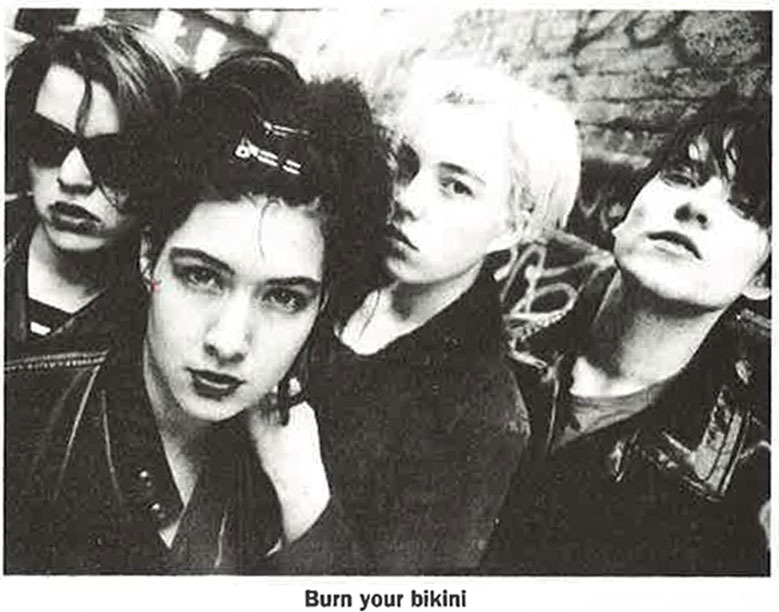
And at first blush, “Rebel Girl” in particular is everything that old seminary teacher mentioned up top might despise and fear. Especially in an era when young women are for the first time ever leaving organized religion in greater numbers than young men, this defiant anthem about a girl who has the revolution “in her hips,” who steadfastly refuses to be obedient or submissive to male authority, who openly embraces her sexuality, and is unapologetically pro-queer, would be exactly the sort of abrasive, “worldly” music this teacher might’ve felt was most calculated to seduce our young women away from the iron rod or whatever.
Yet at the same time, what is there actually revolutionary about this song? I don’t mean that rudely. But lyrically, all that really happens is that a young girl decides to make a new friend; in the time-honored tradition of new besties, they try on each other’s clothes; she defends her new friend from neighborhood insults; and they choose not to be ashamed of their sexual orientations. Maybe that last point was still pushing the envelope in 1993 (and still would be at the BYUs today), but otherwise this is a frankly heart-warming tale of female friendship—dare I say, even a not-too-distant cousin of Janice Kapp Perry’s “As Sisters In Zion.”
Heck, the members of Bikini Kill might even agree with that old seminary teacher more than either realized! For the band, too, opposed the sexualization of young women via revealing clothing in our broader male-centered culture (note that the caption to their 1993 band photo above reads “Burn Your Bikini”—that their entire band name was a call to kill your most objectifying clothing). Frontwoman Kathleen Hannah famously wore girlish knee-length skirts and kiddie barrettes in her long hair on stage (hey, just like that old seminary teacher preferred!), in order to defiantly reclaim her childhood from those larger cultural forces that pressure little girls to sexualize before their time. She may have sang about trying on the clothes of a rebel girl, but she rarely dressed like one. Seriously, the lyrics don’t exactly advocate the overthrow of the government or of the globalist market economy or what have you, but only for sincere female friendships. If there’s any legitimate critique to make at all of Bikini Kill, it’s that the “Rebel Girl” of their most famous song is engaging in only the mildest of rebellions.
But then, perhaps that was precisely it: as in Alma 37:6, the members of Bikini Kill intuitively understand that it is by small and simple things that great things are brought to pass; and in the very simple act of two girls choosing to befriend each other rather than compete against or pull each other down for male attention, the subjects of this song are already establishing an entirely new set of social relations in contrast to the hyper-competitiveness of the world at large. That would indeed be revolutionary. Indeed, at the risk of quoting a polygamist on a feminist Punk anthem, recall that Joseph Smith, Jr. said right from the organization of the Church that he intended to lay the foundations of an order that would revolutionize the world—and he also later declared in the Nauvoo period that “friendship is one of the grand fundamental principles of ‘Mormonism.'” These are not two disconnected thoughts: friendship is indeed how we will revolutionize the world. Does that sound naive to you? It didn’t sound naive to the Prophet, nor did it to the members of Bikini Kill, either.
Because if you truly base all of your social relations on friendship and sharing rather than on ruthless competition, that’s how you can lay the foundation for the United Order, the Law of Consecration, Acts 2:44-45, 4 Nephi 1:3, D&C 42:30-39, D&C 49:20, and a host of other scriptures we’ve cited far too often before. It is perhaps also worth recalling that, per that The First Fifty Years of Relief Society book that was published by the Church itself in 2016, there’s evidence that Joseph Smith intended women to be priests as well: e.g. when Joseph Smith reassured the Relief Society that “Respecting the female laying on of hands, he further remark’d, there could be no devil in it if God gave his sanction by healing” (pg. 55), or more radically, when he “said he was going to make of this [Relief] Society a kingdom of priests an [as] in Enoch’s day” (pg. 200)–not the Church in general mind you (as this volume carefully emphasizes and as many other male editors have attempted to revise it to mean over the years), but the Relief Society in particular. That is, it was the women who were intended to become a “Kingdom of priests”—again, not of priestesses, but priests. That is, Joseph was even more radical in his imaginings of a truly rhizomatic celestial order of equals eternally entangled with each other, than even the more open polygamists who came immediately after him could apparently imagine. The Rebel Girl of the Punk Song, in embracing friendship and solidarity, was actually expressing an impulse towards Zion.
That is, maybe that old seminary teacher shouldn’t have held up that Punk Rock Rebel Girl as a worldly artifice to avoid, but as a celestial ideal to embrace—and maybe that young elder in my MTC group wasn’t being out of line at all when he admitted who he’d rather pursue eternity with. Indeed, it is only through such rebel girls that we can hope to make “a kingdom of priests as in Enoch’s day,” of women and men together, all alike into God. “Rebel Girl/You are the Queen of my world” Bikini Kill declares at the chorus; and maybe she really will be the Heavenly Mother queen of all worlds.
And to those who might find it an odd fit at best to connect a hard-left, feminist, anti-corporate Punk band like Bikini Kill to the decidedly conservative, patriarchal LDS church, well, I would only remind us yet again, for the umpteenth time, that the resurrected Christ appeared to the women first; that in life he drank wine with the prostitutes and tax-collectors; showed compassion to the Samaritans and the adulteress; flipped over the tables of the money-changers and told the rich young man to sell all that he has and give it to the poor.