
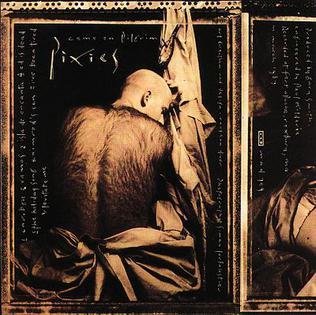
Part of the lore of the Pixies is that, shortly before he dropped out of U-Mass, posted an ad for a female bassist who enjoyed Peter, Paul, and Mary as much as Husker Du, and then formed the most hyper-influential alt-rock band of the late-’80s, frontman Charles Thompson IV–AKA Black Francis–AKA Frank Black–spent six months in a college exchange program down in Puerto Rico. His brief time on the island had a definite and traceable influence on his earliest song writing: there is first and foremost the quick little Spanish dittie “Isla de Encanta“–named for the slogan printed on all the island’s license plates–from their 1987 debut Come on, Pilgrim.
Then there is their only other Spanish number “Vamos”–both the slightly softer version on Come On, Pilgrim and the slightly feistier one on 1988’s Surfer Rosa–which opens with such accurate Puerto Rican slang as “bien chevere” and the more vulgar “Puñeta”, as well as mixing in such spot-on Spanglish as, “Estaba pensando sobreviviendo con mi sister en New Jersey.” (The fact that I currently reside in New Jersey, where I have numerous Puerto Rican students besides, only adds to the strangely personal resonance of this track.) His purportedly-psychotic roommate in Puerto Rico is the subject of Doolittle‘s shortest track “Crackity Jones“; and his time snorkeling with the fishies down in the Caribbean forms the basis of their arguably best-known song “Where Is My Mind” (nowadays most famous for featuring in the final scene of Fight Club).
I was both way too young and way too un-cool to have been aware of the Pixies during their initial late-’80s/early-’90s run. Years later in high school, I became peripherally aware that they were an important influence on more mainstream acts of my generation like Weezer (whose earliest hit “Undone – The Sweater Song” follows the Pixies’ standard soft-loud-soft dynamic—not to mention their slightly-unhinged sense of quirkiness—to a tee); Nirvana (to the point that Kurt Cobain fretted folks would call out their world-altering anthem “Smells Like Teen Spirit” as just a flagrant Pixies rip-off); and Smashing Pumpkins (who by contrast displayed zero qualms whatsoever about aping the guitar line for “Where Is My Mind” on “Today“). Yet these were still only rumors I had heard in the years before streaming and file-sharing. Like most fans, I only started to really delve into their discography in college and grad school–that is, after my mission.
I specify that because I served my mission in Puerto Rico. I have admittedly written about this way too much: in my PhD dissertation, in another book I’ve plugged far too shamelessly, in an essay on waiting for the San Juan Temple, in a St. Patrick’s Day post on Irish Rock in Puerto Rico, on meeting a Broadway producer down in PR, even in my very first essay on Low (whom I’ve also written way too much about). It’s been over 20 years since my mission homecoming, yet still that utterly unique, sui generis of a self-governing territory courses through my veins. Hence, as a fellow chubby, pasty white guy from the northern states who was also shocked awake by the Isla del Encanto around the age of 20, I was very much predisposed to hear how much of Puerto Rico permeates Charles Thompsons’ blood as well.

Not that Puerto Rico reciprocates their attention (though him calling the place a “stinkin’ island” on “Crackity Jones” surely didn’t help). I was there for two straight years and never heard a peep about the Pixies even once. The actual residents of the Isla del Encanto naturally prefer more home-grown genres like Salsa, Merengue, and Reggaton, as well as more local superstars like Tito Puente, Don Omar, Daddy Yankee, and Bad Bunny. If they are into Alt-Rock at all (and there are indeed a significant number of Hispanic Rockists), it is typically a fellow Boriqua like Robi Draco Rosa, or at most Mana from Mexico. The Pixies they pass by not even with hostility or suspicion, but mere indifference.
But then, that same sense of indifference and detachment also fit the band like a glove anyways. This was the band that first broke up in 1993 over fax machine, after all. A performatively ironic, Gen X detachment saturates everything they did, which was arguably their defining characteristic. Such is not to insinuate that the emotion in their music was somehow fake or insincere; to quote again the poet TS Eliot (who was as ironically detached an artist as anyone), “Poetry is not a turning loose of emotion, but an escape from emotion; it is not the expression of personality, but an escape from personality. But, of course, only those who have personality and emotions know what it means to want to escape from these things.” For Eliot, it is those hiding their emotions ironically who are in fact feeling them the most deeply. To quote also a recent essay of ours on Vivian Girls: to say “I love you” in quotes is still to say “I love you.”
“The gospel is a feeling,” said President Alvin R. Dyer in “The Testifying and Challenging Missionary”; and in fairness, so is everything else. Not the emotion, mind you, but the feeling that prompts all of our emotions in the first place–and I mean feeling on just the most basic, primal level of all. The light hitting the optic nerves of our eyes, the sound waves striking our ears, the olfactory sense in our nose, the taste buds on our tongues, the nerve-endings on our skin–the only thing we have to go off to trust that there is a world beyond our immediate senses are our literal, physical feelings. The Spirit is no different. It is often just as unreliable and prone to misinterpretation as our physical senses–we “see through a glass darkly”–especially when it conflicts with our most deeply held prejudices, but still that feeling is all we got. I suppose that’s what faith is, who knows.
In any case, I can tell you that when I was tracting the urbs of Puerto Rico as a young man barely out of high school, the constant sheen of sweat on my perpetually sun-burned skin and the glare of the tropical sun in my eyes through the waving palm fronds as my tired feet in worn shoes stomped across the broken concrete, all had the paradoxical effect of making me feel like I was in an unreal dream, and that I had never experienced anything more real in my entire life. (Perhaps that’s why getting hit by a car—arguably the most real thing that can happen to you—still felt so unreal to me in Puerto Rico.) Sometimes the feeling of reality around me was so overpowering that I had to emotionally detach, treat it all from an ironic remove, just to take it all in properly. Did I have faith in the existence of a next life? Sometimes it felt sufficient to feel like I had to have faith in the existence of this life, too.
For there is also, believe it or not, a faith of sorts in the music of the Pixies, even if only a parody one; whether in their widespread use of Biblical symbolism (e.g. the Book of Revelations allusions in “Monkey Gone to Heaven”—which also contains a New Jersey reference—as well the Isaiah account of the Fall of Lucifer in “The Holiday Song”), or just in the possibility of another world out there in general (e.g. the UFOs in “Motorway to Roswell” from Trompe Le Monde, whose album-art also features a Biblically accurate angel), this constant sense of another, potentially better world out there permeates the lyrics of the Pixies; and the fact that they’re lyrics are all delivered so goofily and ironically likely signifies that perhaps they feel those lyrics the most deeply of all. They share in that feeling that there are far more wondrous things in this universe to contemplate, of which the things of this life feel like one big ironical joke in comparison.
For one last intersection between the Pixies and my own time in Puerto Rico I feel worth highlighting is something that I suspect both the defenders and the critics of the LDS missionary program all too often miss: namely, what complete goofballs the average missionary is. The frequent pranks we played on each other, the inside jokes, the “loud laughter”, our casual acts of arson (burning shirts at a year out), the impromptu late-night wrestling matches in our apartments, the showboating on our bicycles and pick-up games of basketball with local kids that we defended as a species of street-contacting but were really just for fun, the pictures that had us sure no one from a photo-lab would ever join the Church, our overall immaturity and constant low-level mischievousness—LDS missionaries by and large are neither the painfully earnest naïfs of the South Park Book of Mormon musical nor the stalwart Spiritual giants of the Church’s official media, but first and foremost children (again, scarcely out of high school!), for of such is the kingdom of Heaven.
We have that old joke that “the Church must be true because otherwise the missionaries would’ve ruined it years ago,” but like most jokes it’s one of the sincerest things we say; indeed, I suspect the strongest argument of all for sending out literal teenagers to preach the gospel isn’t just that they have the energy and youthful vitality for those punishing door-knocking marathons or that they aren’t yet tied down to a family and career, but simply because teenagers still intuitively understand how to not take the things of this world seriously. It is us full-grown adults who take this life and ourselves way too seriously; we’ve had the goofiness beaten out of us, and spend the rest of our lives trying to regain that sense of insouciance we flaunted so effortlessly as children. GK Chesterton once argued that the most underrated characteristics of the Savior was His mirth; that is also what the best missionaries possess, too.
In order to take seriously the things of the next life, you must first cease to take serious the things of this one. And it was in this refusal to take this life seriously in the slightest that the Pixies most excelled, and made their ironic music most sacred.