
The Dark Knight looms so large over all Batman cinema nowadays that some movie-lovers have taken to contrarian stances as to what the actual best Caped Crusader flick is, viz: a buddy of mine has repeatedly affirmed that the old 1966 Adam West feature Batman: The Movie is in fact the most entertaining Batman film ever made. And it is indeed gloriously, hilariously, memorably campy! They simply don’t make movies this self-consciously silly anymore.
Indeed, I have of late observed a small but growing contingent of comic-book fans online bellyache about how every Batman flick since The Dark Knight has tried way too hard to either mimic or top its grim-dark approach, in a manner that has become rote and predictable.[1]Pop Quiz: between the Dark Knight trilogy and 2022’s The Batman, which one features a young Batman getting his start by battling organized crime, a largely corrupt police department save only … Continue reading At this point it would be kinda nice to swing back towards something campier and funnier and again–maybe not all the way back to Adam West or Joel Schumacher, but a nice median between the two.
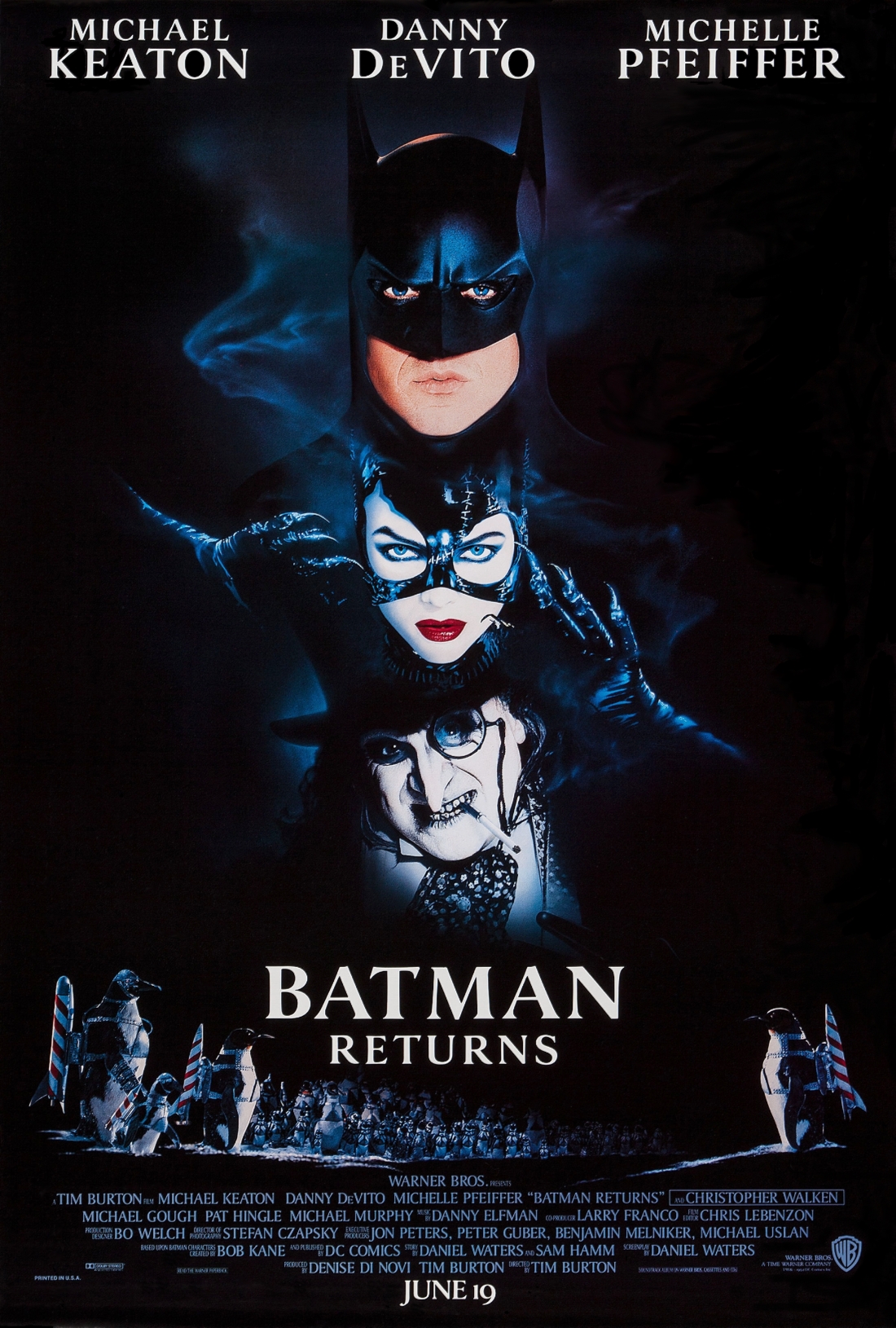
But then, I argue we already have a happy balance between Gothic Darkness and Campy Fun: the two Tim Burton films of 1989-1992. Of the two Burton films, Batman Returns remains my favorite–and that precisely because it is also a Christmas movie–that in fact, the flick was part and parcel of the storied tradition of Christmas Ghost Stories that was single-handedly revived by Tim Burton in the early-’90s. As I’ve written elsewhere, the English tradition of the Christmas ghost story had basically died out completely by the 1990s, the trace memory of which has now only been preserved fragmentarily via the continued popularity of Charles Dickens’ A Christmas Carol, Jame Joyce’s The Dead, the intro to Henry James’ The Turn of the Screw, and the chorus to Andy Williams’ “It’s The Most Wonderful Time of the Year” (“There’ll be scary ghost stories and tales of the glories…”). The English-world’s ghost-story proclivities had perhaps been siphoned off by Halloween and various Charlie Brown Christmas Specials and the like, who knows; in any case, like Jacob Marley, the tradition was dead as a doornail by the final decade of the 20th century.
Yet as befits a practice centered around the endless return of the dead, the Christmas Ghost Story tradition may have died, but has returned from the grave as well–and that, again, largely thanks to the efforts of director Tim Burton, who in the early ’90s released an unofficial trilogy of Christmas/Halloween movies that sought to marry back together the macabre with the Christmasy: 1990’s Edward Scissorshands, 1992’s Batman Returns, and most especially 1993’s The Nightmare Before Christmas.
Yet despite the fact that Batman Returns was by far the most financially successful of that little unofficial trilogy, it has largely been lost in the shuffle of the ensuing decades. By contrast, Nightmare has become more popular than ever, a full scale phenomenon, and Scissorhands still retains a strong cult following down to the present moment. Batman Returns however (like all ’90s Batman flicks) was ultimately overshadowed utterly by the billion-dollar behemoth that was The Dark Knight; whereas movie fans today still delight in debating whether, say, Die Hard is a Christmas movie (such that “Christmas doesn’t begin till Hans Gruber falls from Nakatomi Plaza” has become a seasons greetings), somehow Batman Returns never gets quite the same level of tongue-in-cheek treatment.
Hence why I recommended to my buddy that we watch Batman Returns one holiday season. Although he still stuck to his guns on the superiority of the Adam West Batmans, he also readily acknowledged the charms of this old Tim Burton sequel, with a blithe, “Memorable characters, nonsensical plot.” I took this as a compliment, because you can say the same of pretty much any Batman film.
Seriously, take for example The Dark Knight Rises–an ostensibly more “serious” flick–which has a very memorable and quotable villain in Bane (“You merely adopted the darkness, I was born into it,” “When Gotham is ashes, you have my permission to die,” etc.) residing at the center of a completely nonsensical plot that involves conquering Gotham City even though they still plan to blow it up anyways, because reasons? And Bruce Wayne gets sent to a Pakistani prison camp but flies back in time to save Gotham despite having been bankrupted earlier? The film has plot-holes the size of the Grand Canyon, and is when I first realized that Christopher Nolan was human. But then, in fairness, every Batman plot starts to fall apart the moment you think about. (At least Batman: The Movie is self-aware about it.)
And Batman Returns is no different! It is centered around a convoluted, overstuffed narrative involving a tertiary villain named Max Shrek—played by Christopher Walken playing himself—a conniving businessman who collaborates with Danny DeVito’s cartoonishly repulsive Penguin to run for mayor so he can set up a fraudulent power-plant that sucks up power from the city for some reason, both of whom are being investigated by Bruce Wayne in his dual role as both a high-powered CEO and as a masked vigilante–all while Michelle Pfeiffer’s Cat Woman comes out of left-field as an agent of sheer chaos throwing off everyone’s plans together (in this, she is arguably a forerunner to Heath Ledger’s Joker in The Dark Knight).
And you could be forgiven if your eyes glazed over that nonsensical plot summary, because it really is utterly irrelevant towards one’s enjoyment of the film—perhaps just as unnecessary as in the 1966 Batman: The Movie. It would be like critiquing the plot of The Rocky Horror Picture Show at this point. You watch this film to luxuriate in these fun, over-the-top characters chewing up scenery and vamping it up to 11, not because the plot makes a lick of sense. Arguing about the plot of Batman Returns is like arguing what the plot is to the Christmas decorations that fill the film: you’d be missing the point.
Yet it’s also important to emphasize that Batman Returns does not just happen to take place during the Christmas season, but in its aesthetics and back-stories, acknowledges what far too many of our Hallmark films and the like generally try to avoid dwelling too much upon: that the Christmas season is just as much a time for pain and sorrow, loneliness and solitude, as it is for reconciliation and joy.
Michelle Pfeiffer’s iconic turn as Cat Woman is the most obvious example of the same. She is introduced as a mousy and shy secretary named Selina Kyle, who is painfully bereft of almost any trace of self-confidence or self-respect. She comes home to her empty apartment at the end of every long work day with a pathetic, “Honey, I’m home; oh that’s right, I don’t have a husband,” where the only messages on her answering machine are from her hectoring mother and robo-calls for women’s perfume. After her murderous boss Max Shrek shoves her out a window for inadvertantly uncovering his dastardly plot to steal the city’s power (for, again, reasons), she is mysteriously licked back alive by a gang of alley-cats, reborn as a creature of feminist rage and vengeance. The only coherent reading here of her transformation I think (as though you needed one), is that this near-death experience has shocked her out of her debilitating fear; her worst nightmares coming true had the paradoxical effect of liberating her from all her fears once and for all. As Hugh Nibley opined in his 1955 parable of the eschatological man, such sudden encounters with our mortality can result in a radical revision of a person’s priorities and personalities, one wherein we lose all honest interest in status, decorum, and other vain things of the world.
And indeed, because Selina Kyle had been isolated and ignored all her entire life, she decides to strike back by making her marginalization everybody’s problem. Yet as sexy and vampy as Pfeiffer’s Cat Woman may be for the remainder of the feature, neither she nor the screen-writer’s ever lose track of the fundamental core of sadness and loneliness to her character–just like the Christmas season, which also has a very real and very nasty habit of really forcing you to face both how much and how little you’ve changed after yet another year of wasted potential and debilitating self-doubt. Really, it makes perfect sense why Selina Kyle would suffer her mental break during the Christmas season, of all seasons.[2]My wife, incidentally, suffered her first psychotic break during a Christmas season as well–specifically, during Christmas of 2020, when there was a whole mess of stressors all year long that … Continue reading Christmas can break your heart; it will break your heart; it should break your heart–and all of the contrived campiness of Batman Returns never even tries to cover up that fact, but in fact amplifies it everywhere.
In this, I am not trying to be cynical: the Gospel of Jesus Christ entire, which the Christmas season supposedly strives to memorialize, is likewise centered upon immense pain–the labor pains of Mary in the stable, the shadow of the cross still lying ominously across the Christ child’s future, and the infinite and eternal pains of the Atonement itself–not to mention the broken heart and contrite spirit that we are all supposed to come forward with if we are to accept the Atonement in the first place. If Michelle Pfeiffer’s Cat Woman seems like a fundamentally broken individual in the film, well, aren’t we all supposed to be, broken and contrite, before we can repent and be saved?
* * *
I wanted to also write about how Danny DeVito’s Penguin figures into this theme of Christmas heartbreak as well–how the film literally opens with his narcissistic rich parents dumping him into the sewer on Christmas Eve shortly after his birth; how much of his viciousness and cruelty is rooted in his obvious pain at his abandonment, no matter how he tries to hide it behind false bravado; or how, despite all of his irredeemably monstrous actions, when he does finally fall dead in the water in the finale, the zoo penguins still grant him a proper watery funeral, because even monsters merit our pity–but I actually want to talk a little more about Pfeiffer’s Cat Woman. Partly because, unlike Jack Nicholson’s Joker, her Catwoman was never superseded by the Dark Knight trilogy (nor by The Batman after it). Pfeiffer’s Catwoman remains definitive, and it’s worth interrogating why. It’s not just the outfit: Anne Hathaway, Halle Berry, and Zoe Kravitz all vamped it up in sexy cat-suits as well across the early 21st century, but never in a manner that came to fundamentally redefine the character in a way that Heath Ledger did with the Joker.
Rather, Pfeiffer’s portrayal still defines the character due to the open and righteous feminist rage she possesses. This is rare even for a mainstream Hollywood film today, wherein the very concept of a “strong feminine hero” is still treated as a sort of novelty (as though Ripley in Alien weren’t already 45 years old). Even if a woman-lead is presented as some sort of bad-ass action-star or superhero, the idea that she might also be struggling against patriarchy is at best gingerly danced around, or elided entirely. She might fight against individual sexist men who dare underestimate her in hand-to-hand combat, but never against entire systems of sexism and oppression. Both Anne Hathaway’s and Zoe Kravitz’s Catwomen were written as class-conscious, but they never seem to be gender-conscious, too. That, and they both still have rather traditional romances with the Dark Knight to boot, ones not fundamentally different from that of Eartha Kitt or Julie Newmar in 1966.
But Michelle Pfeiffer’s Catwoman has a truly complex relationship with the lead–and in a defiant act of personal agency, it is she that rejects him, not the other way around. Even conceding that Keaton’s Bruce Wayne/Batman is perhaps the only non-toxic man in Selina Kyle’s life, she still rejects his offer to come away with him, declaring in her climactic final scene, “Oh Bruce, I would love to come and live with you in your castle,” only to whip him away with a snarling, “I just couldn’t live with myself!” Having finally, for perhaps the first time in her life, laid full claim to her own personal agency, she is not about to abnegate it–no, not even for the promise of wedding bliss. This, needless to say, is about the polar opposite of virtually every woman’s role written in Hollywood or even across the vast majority of English literature, wherein the supreme end-goal of every woman is the Wedding altar.
One could perhaps still argue that Batman Returns still reinforces this dominant narrative by portraying her refusal of Bruce Wayne as an act of self-destruction, since she promptly goes on to kill Max Shrek and herself with a kiss and a cattle-prod. If only she had gone away with Bruce Wayne and left Max Shrek to the police, she would still be alive! Except that she is: the final shot of the film, famously, is Bruce Wayne spotting her shadow creeping away down the alley-way, and jumping from his limo to try and find her. When he finds only a street cat instead, he picks it up and returns to the car, to which Alfred wishes him a Merry Christmas.
“Good will towards men.”” deadpans back Bruce Wayne, “and women.” It is his own private acknowledgment of his own unconscious complicity in reinforcing the systems of patriarchy and oppression that keep women down. These moments of genuine male guilt are also rare in cinema, even today–and as the car drives away, Catwoman appears on the roof-top, before the film rolls to credits. She was the one who survived, she was the one who escaped all the men who sought to control her.
I dwell on these scenes from what is, again, a rather campy old ‘90s flick, because reportedly, for the first time ever, the Church is losing more women than men–and what apparently has Church HQ on high alert, these women tend to take their husbands and sons with them. Some LDS YouTuber whose name escapes me even recorded a video about it, begging more women to stay. Hence, goes the speculation, the reason for recent moves like lowering the mission age for sisters yet again, or introducing sleeveless Temple garments for women, and other assorted sops, is an attempt to throw them enough breadcrumbs to keep them active. Far be it from a dude like me to weigh in on this fraught topic. Yet I cannot help but ponder that it’s not strange that more women are leaving than men now, but rather that it took so long for it to happen in the first place: back during my long YSA years in the 2000s and 2010s, for example, I anecdotally knew a significant number of LDS young women who were, by any metric you could devise, conservative, orthodox, faithful, believing, Church-attending, Relief Society-participating, Priesthood-sustaining, Temple-recommend holding, modestly-dressed, returned missionaries, aspiring moms, wives, and home-makers, etc, etc. You know the type. They were as far from being sympathetic to, say, Ordain Women or Exponent II or the Sunstone Symposium or whatever, as one could reasonably expect.
Yet even amidst these most conservative of LDS young women, I’d regularly hear: “You Elders have something I wish I had: the Priesthood” (I heard that from a Sister missionary); or, “when I get to the other side, Heavenly Father and I are going to have a long talk about why women get the short end of the stick so often” (I heard that from an RM and Relief Society Instructor); or, “I wonder what Heavenly Mother is like? The Prophets and Apostles and God the Father and Jesus Christ are all men, I want so badly a feminine model I can look up to and emulate, to know what it looks like to be a divine woman” (I heard that one from about the most conservative, modest Midwest girl I’ve ever met). Again, these were hardly the target audience for Ordain Women or FeministMormonHousewives or Exponent II or what not, they were not liberal agitators out on the margins, no, these were the conservative ones, the faithful, believing ones! It they still feel this yearning, what of the rest?
And if, like Michelle Pfeiffer’s Catwomen, they all finally choose to reclaim their agency for perhaps the first time ever, how steadfastly will they refuse to relinquish it–this eternal prize, greater than wealth? The War in Heaven was fought over agency, we repeatedly and rightfully preach, and was fought fiercely; hence, we can logically conclude that God Himself honors our agency above all. It only makes sense that women, these daughters of God, would fight just as hard for it–and all of our folk-doctrines about celestial brainwashing must necessarily fall flat. Hence we must do far more to honor the agency of others–to give Good Will Towards all Men, “and women.”
References
| ↑1 | Pop Quiz: between the Dark Knight trilogy and 2022’s The Batman, which one features a young Batman getting his start by battling organized crime, a largely corrupt police department save only for a certain Lt. Jim Gordon, a convoluted plot to destroy Gotham City by the antagonist, a sociopathic murderous reimagining of a fundamentally ridiculous villain, a populist, class-conscious take on Catwoman, a confrontation between Batman and the main villain in a holding cell wherein the baddie gives some variation of the “we’re not so different you and I speech”, and a tease for the Joker at the end of the first film? |
|---|---|
| ↑2 | My wife, incidentally, suffered her first psychotic break during a Christmas season as well–specifically, during Christmas of 2020, when there was a whole mess of stressors all year long that finally triggered her hidden manic-depression. |