
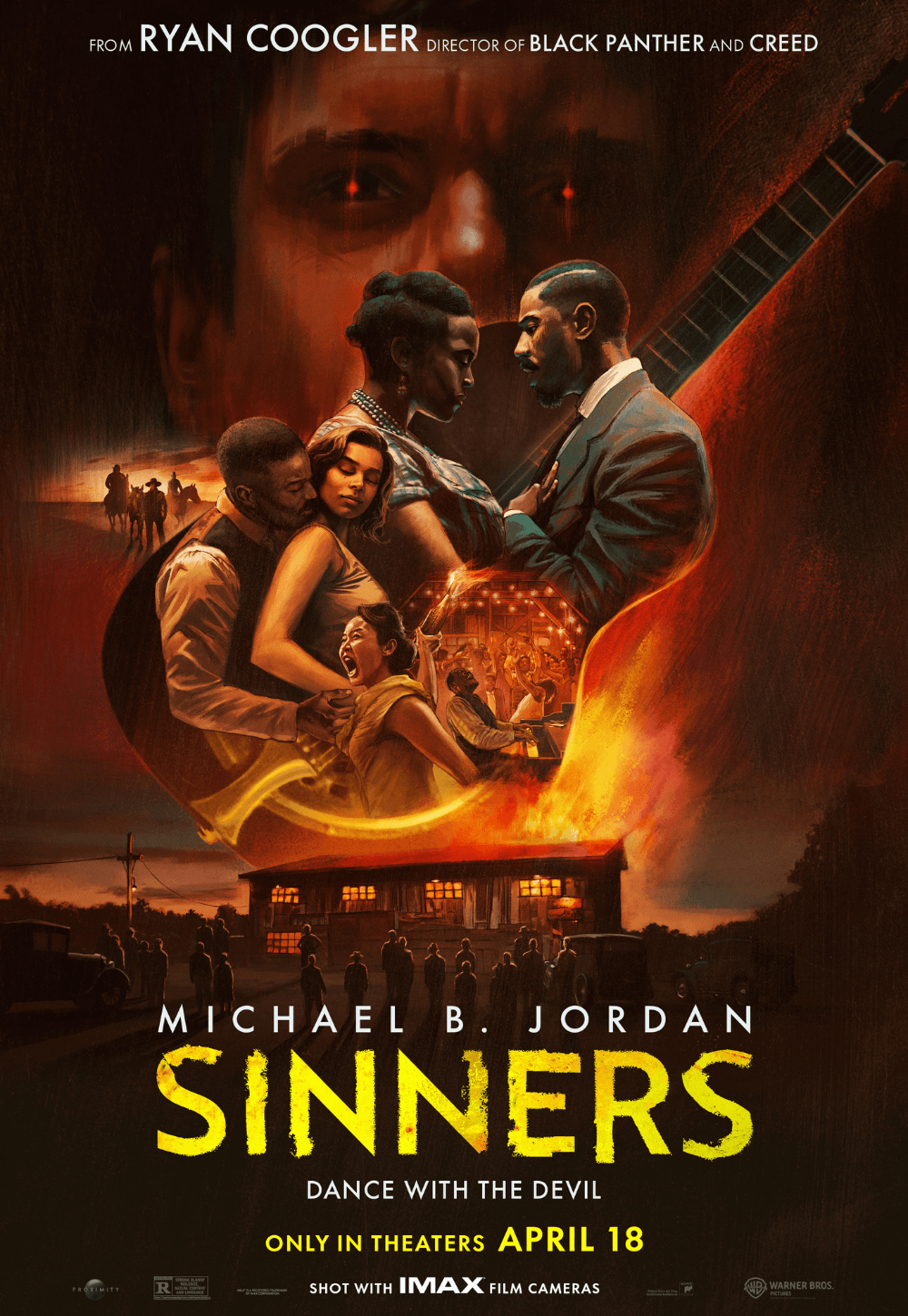
The nigh-universally acclaimed Horror film Sinners became the sleeper-hit of 2025, and should be of interest to those of us essaying to be Latter-day Saints, especially as concerns our doctrine of the spirit of Elijah. To first briefly summarize the plot: the narrative centers on a pair of black twins–WWI veterans in 1932 nick-named “Smoke” and “Stack”–returning home to Jim Crow Mississippi with some money stolen from Chicago gangsters, to open a juke Joint to serve the local Black community.
The opening night of the juke, however, attracts the attention of a coven of Irish vampires–who, while undeniably the antagonists (the second half of the film basically becomes a soft-remake of the 1996 vampire fight-flick “From Dusk Till Dawn”), are also intriguingly presented as the mirror image of these Black southerners: a despised, dehumanized, and exploited minority, constantly forced to make their deals with the devil just to survive, implicitly just as the twins did when they joined the military and worked for a Chicago gangland outfit. (Certainly when the Irish vampires sing “On the Rocky Road to Dublin” out in the fields, it is presented with the same pathos and soul as the Black performers in the juke.)
This intersection between the Irish and the African-American is by no means a random coincidence. The earliest recorded slave revolts in 1600s colonial history were between African slaves and Irish indentured servants in the Caribbean (the island of Montserrat still celebrates St. Patricks Day to this day). Indeed, when the lead Irish vampire invites the twins to join their coven by arguing that vampirism offers the only true path to emancipation and freedom for oppressed peoples like them, the film leaves ambiguous whether or not he was actually being entirely forthright–or whether Stack was right to let himself get turned after all.
Yet although the vampires have understandably gotten the lion’s share of the attention, the true beating heart of Sinners is the music itself. The twins you see had recruited for their juke joint a younger cousin and Blues prodigy named Sammie–a character clearly modeled on Robert Johnson, the hyper-influential Delta Blues musician whose small handful of mid-1930s recordings set the template for virtually all other forms of Blues and Rock for the remainder of the 20th century. Robert Johnson even became the first entrant to the “27 club,” dying abruptly of unknown causes at age 27, and that over 30 years before Jimi Hendrix, Jim Morrison, Janice Joplin, and Brian Jones would all join him at the exact same age. The legend subsequently arose that Johnson had sold his soul to the devil at the “Crossroads” (one of his earliest tunes, and later covered by Eric Clapton) to get that good at the guitar, and the devil later came to claim his due. Sinners plays with this legend, then, by making Sammie’s music what attracts the Irish vampires in the first place.
The film in fact is bookended by Sammie being called to repentance by his preacher father for his “devilish” Blues music–which is representative of the purported tension between Blues and Gospel music among Black southerners in this time period. Ryan Coogler, however, does not so much disavow that notion as play with it, by presenting the Blues–and all other forms of American Pop music that followed it–as not so much devilish per se, but as having been classified as such by the white-dominated epistemologies that sought to control and contain them in the first place. He accomplishes this effect by actually imbuing Sammie’s singing with genuine supernatural valences. The true centerpiece of the film–indeed, its most audacious, ambitious, and memorable scene–is when Sammie sings “I Lied To You” to get the party started at the juke joint, at which he is soon seamlessly joined on stage by a ’70s-era Rock ‘n Roller, an ’80s-era DJ on the turn-tables, a rapper, a traditional African percussionist, and a host of other musicians from diverse cultures across the globe both ancient and future, as all these various genres across time and space merge together in one, At-One, a perfect Atonement of the living and the dead. Certainly this is the scene that should be of most interest to those of us essaying to be Latter-day Saints.
Twice in the film, a female narrator explains: “There are legends of people, born with the gift of making music so true, it can pierce the veil between life and death. Conjuring spirits from the past, and the future. In Ancient Ireland, they were called Fili. In Choctaw land, they call them Firekeepers. And in West Africa, they’re called griots. This gift can bring healing to their communities but it also attracts evil.” That phrase “pierce the veil between life and death” should definitely ring some bells for us, since the entire raison d’etre of our faith is the conviction that the veil between this life and the next is at least being rent. “The veil o’er the earth is beginning to burst” reads the second verse of “The Spirit of God,” one of our most rousing restoration hymns. In the grand finale of our most sacred Temple rituals, we physically pass through a veil as well–indeed, the entirety of the Temple endowment is intended to prepare us for just that eventuality.
And another key part of our Temple rituals is the work we do for the dead, for which we cite Malachi 4:5-6, “Behold, I will send you Elijah the prophet before the coming of the great and dreadful day of the Lord: And he shall turn the heart of the fathers to the children, and the heart of the children to their fathers, lest I come and smite the earth with a curse”–amended by no less than the Angel Moroni to “otherwise the earth would be utterly wasted at his coming”–and cited by the resurrected Savior Himself in 3 Nephi 25. It is why we do our genealogy so obsessively: the conviction that we without our dead cannot be saved–nor can they be saved without us–and that not symbolically, but literally, and why our hearts must turn to our antecedents as they turn towards us.
That is, the juke joint in Sinners is a Temple, and Sammie’s blues rendition is an endowment ceremony–and just as Satan is attracted to Adam and Eve in Eden in order to corrupt them and offer them a spurious counterfeit of eternal life, so do the vampires come to the juke to tempt them and to try them as well–all while the Protestant preachers tell us the Song of Redeeming Love we encounter therein is sin as well, and so try to draw us away.
Is this reading a stretch? Well, do we not all yearn for eternity at our most primal level–a yearning made manifest in Temples both ancient and modern?