
It was towards the end of my most recent re-read of The Book of Mormon that I was overwhelmed with melancholy at the destruction of the Nephites, like I hadn’t felt since a young missionary, like I thought countless other re-reads would have numbed me to by now. What especially stood out to me this time wasn’t just the magnitude of their destruction, wasn’t just the depths of depravity they had sunk to, but how absolutely sure they were of their righteousness till the bitter, bitter end–the way “they began to bost in their own strength, and began to swear before the heavens that they would avenge themselves of the blood of their brethren who had been slain by their enemies. And they did swear by the heavens, and also by the throne of God, that they would go up to battle against their enemies, and would cut them off from the face of the land” (Mormon 3:9-10).
Doubtless they felt they had just cause to seek a “final solution” against their enemies; these Neo-Lamanites, after all, were the ones who apostatized and “willfully rebelled against the gospel of Christ” after the collapse of two solid centuries of United Order, the one established by no less than the resurrected Jesus Christ himself, were they not? I mean, the Nephites had also long stopped keeping the Law of Consecration themselves, too, but they were definitely still better people than all those who left the Church, right? Surely this same Christ in Heaven would defend and support his Saints, the ones who stayed true to his Church, in this their hour of distress, would he not?
I mean, their enemies were the same barbaric Lamanites who had taken “many prisoners…And the husbands and fathers of those women and children they have slain; and they feed the women upon the flesh of their husbands, and the children upon the flesh of their fathers; and no water, save a little, do they give them” (Moroni 9:8). If the Nephites had then retaliated by taking “many of the daughters of the Lamanites prisoners,” “depriving them of that which was most dear and precious above all things, which is chastity and virtue–” (that is, they raped them) “–And after they had done this thing, they did murder them in a most cruel manner, torturing their bodies even unto death; and after they have done this, they devour their flesh like unto wild beasts” (Moroni 9:9-10), well, they were only responding in kind, right? Eye for an eye, tooth for a tooth, and all that! Surely the Savior wasn’t being literal when he said to love your enemies and “turn the other cheek…”
Besides, what was this Mormon guy blathering on about anyways, as though we were the ones who needed to repent? Just shut up and do your job, old man; command the armies to victory, don’t harm morale like that, we’re at war. We can talk about repentance and reforming the Church and all that after the war’s over…
Of course, this is how every genocidal army thinks of itself, isn’t it. Even today, the perpetrators of genocide proceed with the stern conviction that God and Right are on their side. Seriously, sometimes I don’t need any greater confirmation of there truthfulness of The Book of Mormon than the fact that it demonstrates such keen psychological insight into the human condition, which Joseph Smith, Jr. was simply too young at 24 to understand.
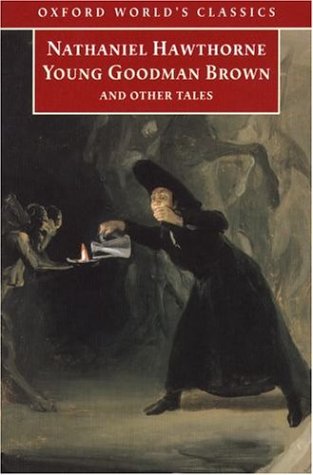
Perhaps by coincidence, I was also at the time re-reading Nathaniel Hawthorne’s classic short-story Young Goodman Brown for the first time since an undergrad myself (the October/November season of Halloween/Thanksgiving seemed like as good a time as any re-visit that old tale of Witches and Puritans in ye oulde Massachusetts Bay Colony). The main thrust of the narrative, as every aging English major will recall, is that at some unspecified point in the late-1600s, newly married Goodman Brown takes leave of his wife Faith in Salem village to make his appointment with some dark traveler in the woods; Hawthorne never explicitly identifies this traveler with the crooked staff as the Devil, but he also never needs to.
Young Goodman is initially recalcitrant to keep the appointment, and almost turns back to Salem then and there–and would that he had! But the Devil is has a smooth tongue, and casually convinces to keep following him. Over the course of their journey, Goodman Brown learns through incontrovertible proofs that not only his father and grandfather, but all of the pious old Puritans he knew and looked up to growing up in Salem village were all secret followers of the Devil as well, and all on their way to a witch’s coven deep in the dark woods. The kicker comes when he sees a pink ribbon–like the one his young wife wears in her hair–floating through the air. Having literally lost his Faith to the Devil, Goodman Brown laughs a resigned, demonic laugh and staggers forward a broken man towards the coven.
There he finds seemingly all of Salem present around the roaring bonfire, in a ceremony overseen by the dark traveler himself. Welcoming forward the initiates (which includes both Goodman and, to his horror, his wife Faith), the dark form invites them to witness the secret wickedness of everyone they ever once looked up to:
“There […] are all whom ye have reverenced from youth. Ye deemed them holier than yourselves, and shrank from your own sin, contrasting it with their lives of righteousness, and prayerful aspirations heavenward. Yet, here are they all, in my worshipping assembly! This night it shall be granted you to know their secret deeds; how hoary-bearded elders of the church have whispered wanton words to the young maids of their households; how many a woman, eager for widow’s weeds, has given her husband a drink at bed-time, and let him sleep his last sleep in her bosom; how beardless youth have made haste to inherit their father’s wealth; and how fair damsels–blush not, sweet ones–have dug little graves in the garden, and bidden me, the sole guest, to an infant’s funeral. By the sympathy of your human hearts for sin, ye shall scent out all the places–whether in church, bed-chamber, street, field, or forest–where crime has been committed, and shall exult to behold the whole earth one stain of guilt, one mighty blood-spot. Far more than this! It shall be yours to penetrate, in every bosom, the deep mystery of sin, the fountain of all wicked arts, and which inexhaustibly supplies more evil impulses than human power–than my power at its utmost!–can make manifest in deeds. And now, my children, look upon each other.”
What is important to emphasize here, is the specific power that the devil is offering to the initiates: “By the sympathy of your human hearts for sin, ye shall scent out all the places […] where crime has been committed, and shall exult to behold the whole earth one stain of guilt, one mighty blood-spot.” That is, they will be able to detect sin in every secret place, and know that every human being is a sinner. Suddenly you can understand why the devil’s offer is so tempting!
And what’s equally important to emphasize, is that the devil wins in the end of this story. Yes, yes, Young Goodman Brown yells at his wife to “Look up to Heaven, and resist the Wicked One!”, and almost in the very moment he does so, “when he found himself amid calm night and solitude, listening to a roar of the wind, which died heavily away through the forest. He staggered against the rock, and felt it chill and damp, while a hanging twig, that had been all on fire, besprinkled his cheek with the coldest dew.” The story at this point almost seems to be moving towards a happy climax: no matter how fiery and terrifying the devil may be, he will always flee in the moment you resist him, seems to be the moral here.
Save that’s not what happens at all. The next morning, Young Goodman Brown staggers back into Salem village, “staring around him like a bewildered man. The good old minister was taking a walk along the graveyard, to get an appetite for breakfast and meditate his sermon, and bestowed a blessing, as he passed, on Goodman Brown. He shrank from the venerable saint, as if to avoid an anathema. Old Deacon Gookin was at domestic worship, and the holy words of his prayer were heard through the open window. ‘What God doth the wizard pray to?’ quoth Goodman Brown. Goody Cloyse, that excellent old Christian, stood in the early sunshine, at her own lattice, catechising a little girl, who had brought her a pint of morning’s milk. Goodman Brown snatched away the child, as from the grasp of the fiend himself.” For the rest of his miserable life, Goodman Brown assumes that everyone around him is a secret sinner, as bad or worse as himself, a closet devil-worshiper, hypocrite, and liar.
Which was exactly what the Devil was offering him at the bonfire, wasn’t it. Brown was basically lost from the moment he ever entered the forest in the first place.
Whether the rest of Salem village actually is or not a secret sinner—whether it was all just a hallucination or dream—is almost irrelevant to the narrator: “Had Goodman Brown fallen asleep in the forest, and only dreamed a wild dream of a witch-meeting? Be it so, if you will. But, alas! it was a dream of evil omen for young Goodman Brown.” Goodman Brown continues to judge, and judge harshly, all of the townsfolk around him, considering himself the sole righteous man in their miserable midst; “Judge not,” commanded the Savior in the Sermon on the Mount, and it’s the one commandment of His we’ve all most uniformly failed to keep. His judgementalism poisoned Brown’s soul, as the devil intended, such that when he died, “they carved no hopeful verse upon his tombstone; for his dying hour was gloom.”
And this is how the Nephites all die at the end of The Book of Mormon, too, isn’t it: as a people convinced of their own righteousness against all the overwhelming sinners in their midst, while almost-impressively evading the painfully obvious fact that they had all become de facto followers of the devil as well, judging viciously everyone but themselves. And just like Young Goodman Brown, there was no hopeful verse carved into the final record of the Nephites, but only Mormon crying out from his soul rent with anguish, “O ye fair ones, how could ye have rejected that Jesus, who stood with open arms to receive you…”