
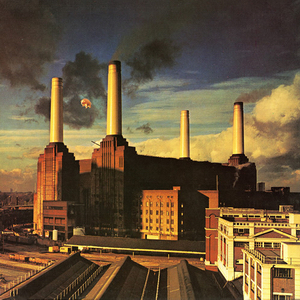
1977’s Animals is emphatically not one of Pink Floyd’s best works. It possesses neither the wild psychedelic audacity of their late-‘60s Syd Barrett era, nor the grandiose ambition of all their other ‘70s releases. It is the mostly-forgotten middle-child of their commercial apex—wedged in between the all-time best sellers Dark Side of the Moon, Wish You Were Here, and The Wall—largely just coasting by on those better records’ accomplishments. It’s iconic cover art of a pig flying over a factory is better known nowadays than any of its actual music, which is ironic, both because the sleepy songs never really take flight themselves, and because the album entire feels blandly factory-assembled. (When Johnny Rotten of the Sex Pistols sported a hand-made “I Hate Pink Floyd” t-shirt in 1977, this was likely the sort of music he was rebelling against.)
Almost the textbook definition of something that probably looked better on paper than in execution, the production entire feels rather perfunctory, as though they made a concept album about George Orwell‘s Animal Farm less because it inspired them musically or made them want to raise a warning voice against the rising tide of authoritarianism, than simply cause it seemed as good an idea for an album as any, so they might as well get on with it. The fact that Side A is dominated almost entirely by the 17-minute track “Dogs”–an extended jam devoid of any real variation or innovation or even just a build-up to a climax, and which could’ve easily been half as long–sure seems to betray that they had no new musical ideas at the time, so they just stretched out what few songs they did have till they hit standard LP length and called it a day.
The equally bland “Pigs” and “Sheep” that take up most of Side B (whose only saving graces are that they’re both shorter than “Dogs”) will not disabuse you of that notion. There’s a bit of a climax at the end of “Sheep” when, well, the sheep finally rise up, kill the dogs and overthrow the pigs, but it won’t exactly get your blood pumping for a revolution, nor does it make up for how the album never really revs its engines before then. The pay-off feels unearned.
If Animals hadn’t been immediately followed by The Wall, I suspect it would have marked the beginning of Pink Floyd’s creative decline. One could perhaps argue, I suppose, that the album’s boredom is performative–for police states are not just cruel and vicious, but also monotonously dull to live under–however I suspect that gives the album entirely too much credit. Animals is not even necessarily bad, per se; no, worse, it’s forgettable.
Except for “Pigs on the Wing” parts 1 and 2, the mercifully brief, minute-and-a-half acoustic ballads that open and close the LP and justify its entire existence. In contrast to the forced pretentiousness that bogs down the rest of the album, the two “Pigs on the Wing” tracks are personal, simple, intimate, and heart-felt. They are yet another prime example of how the political is personal and the personal is political, by gently reminding the listener that the way we treat each other on an individual level inevitably determines how we end up treating each other on a mass level.
“If you didn’t care/what happened to me/And I didn’t care/for you,” Roger Waters sings on part 1’s only verse, “We would zigzag our way through the boredom and pain/Occasionally glancing up through the rain/Wondering which of the buggers to blame/And watching, for pigs on the wing.” That “zigzag/boredom and pain” line is apparently an allusion to the famously-cynical 19th-century German philosopher Arthur Schopenhauer, who once claimed that “Life swings like a pendulum backward and forward between pain and boredom.” (One could again, I suppose, argue that if this album is boring, it is so in the Schopenhauer sense of the word, but again, that likely gives this tossed-off LP too much credit.) What Roger Waters here emphasizes however, and that I think is worth emphasizing, is that the whole reason why our lives constantly swing back and forth between “boredom and pain” overall is because we so consistently fail to care for each other in the first place.
The Orwellian police state that the rest of the album goes on to describe is, implicitly, the natural result of a society of human beings where people no longer care for each other; totalitarianism is the logical end-point of refusing to love one another–for if we don’t take care for each other, the state will, and it will do so with the same callous disregard that we have been showing each other all along. There’s that old saying, “You’re not stuck in traffic, you are traffic;” similarly, we don’t just live in a police state, we are a police state–or at least, our viciousness, callousness, and cruelty one towards another make us live in the conditions of a police state long before an official one becomes a fait accompli. Hugh Nibley once argued that the great tragedy of the Nephites isn’t just what became of them, but what they had finally become–rapists and murderers “without civilization” and “whose delight is in so much abomination” (Moroni 9:11-12)–and we today are no different. That is, we are the “buggers” who are to blame for all of these “pigs on a wing.”
In this sense, Roger Waters, despite the rest of the album’s shortcomings (this was definitely his brain-child, and presages the depths of pretentiousness he’d plumb in The Wall), wasn’t too far off from the gospel itself. It is why Christ gave as his new commandment “Love one another”–why in fact he said that the two great commandments are to “Love God and love thy neighbor” in the first place, that upon these hang all the law and prophets. A society wherein you don’t care about your neighbors is one wherein you also don’t care if they get kidnapped by ICE, or are deported to a prison camp, or get banned from existing or are exterminated entirely. The whole explicit point of the Parable of the Good Samaritan, recall, is that everyone is our neighbor–otherwise, no one is.
Hence why, after the Pigs and Dogs are finally overthrown by the Sheep, Roger Waters concludes with a reprise of “Pigs on the Wing” wherein he affirms simply, sincerely, without irony and almost with relief, “You know that I care/What happens to you/And I know that you care/For me too.” For the way to finally overcome totalitarian tendencies–both in the state and in ourselves–is to sincerely love and care for each other, without hypocrisy and without guile. It wasn’t any sort of revolutionary-mindedness that drove the Sheep to finally overthrow their oppressors, but the simple solidarity that comes from caring for one another that liberated them in the end. It is the only thing that will liberate us, too.
Don’t get me wrong, I’m not naive: fascists and authoritarians have never once been defeated by the power of friendship and love, and only in the rarest of cases has such an approach even been effective at changing authoritarians just on an individual level; the sheep in solidarity still had to “[fall] on [the] neck” of their oppressors “with a scream” to overcome them. But that still does not excuse us from having to cultivate that love within ourselves; otherwise, even if/when the Pigs and Dogs are finally overthrown for real, we will not be able to build up a new society in their place worth having.
This care for one another is also how we will not be overcome in the first place. Christ prophesied that in the last days “the love of many shall wax cold”–that is, we will all start to quit caring for each other en masse, leading directly to all of our modern atrocities of prison camps, censorship, and genocides–“but whosoever shall not be overcome, the same shall be saved.”