

I’m mad at how long it took me to learn about Tina Bell, posthumously referred to as the “Godmother of Grunge” and the “Queen of Grunge,” and that not hyperbolically: her band Bam Bam in early-80s Seattle hired an excited young fan named Kurt Cobain to be their roadie; her drummer Matt Cameron went on to play for both Soundgarden and Pearl Jam; and Bam Bam’s first record, the 1984 Villains (Also Wear White) EP, predates all other canonical “Grunge” releases by at least a year or more.
And the way she sneers the word “white” on that record was likely an intentional provocation: She was after all an outspoken young Black woman performing in a Punk scene that was already overwhelmingly white, and that in a part of the country that is still overwhelmingly white (which isn’t an accident. Oregon territory passed a series of Black Exclusion Laws between 1844 and 1857 that prevented Black people from settling in the Pacific Northwest, the last of which didn’t get repealed till 1926–and take it from a Pacific Northwest native who grew up far from the cities: however leftist the Puget Sound and Willamette River basin may be today, many of the more rural residents of Washington and Oregon not-so-secretly wish those laws were still in effect). This tiny 5”2 young woman regularly risked her physical safety singing before sometimes-hostile and racist crowds, all to help midwife the entire Seattle sound that would take over world less than a decade later. You don’t get much more Punk Rock than that.

Which makes me even madder at how scarce her music is now! That three-song Villains (Also Wear White) EP, decades out of print, only finally got uploaded to Bandcamp (with the obligatory “bonus” demo tracks) in 2021; their sole full-length album of sorts, Bam Bam House Demos ’84, was only released in 2019 (and that only after the heroic, long-suffering persistence of her bassist Scott Ledgerwood; no idea where her guitarist/ex-husband Tommy Martin was in all this), and at present can only be found on streaming platforms and a couple scattered YouTube channels; and the song for their sole music video “Ground Zero” is only available on YouTube, in VHS-quality audio. They’re not even the first band called Bam Bam that comes up in a google search anymore.
Tina Bell herself gave up on music in 1990 after trying to re-jumpstart her career in Europe (as white hardcore bands like Integrity have successfully done), only to get swept up in some Dutch mass-deportations targeting immigrants of color specifically. She died in 2012 at a Las Vegas assisted living center, only 55 years of age—depressed, alcoholic, alone, and forgotten. Reportedly, her body wasn’t discovered till she’d already been dead a couple weeks, and those stupid, lazy hospice workers threw out all her old journals, lyric sheets, poetry, Bam Bam memorabilia, and other priceless artifacts, without even bothering to notify next-of-kin first.
Which is even more infuriating, because there was apparently a long-awaited Bam Bam reunion tour in the works at the time; and her son, Oscar-winning documentarian T.J. Martin, was trying to finance a movie about her life and influence (so there was definitely a loved one available to pick up her stuff!); but all that fell to the wayside with her premature death. She finally got some long-overdue crumbs of recognition in the immediate aftermath of George Floyd and America’s way-too-brief reckoning with race—e.g. a 2021 tribute show in Seattle organized by a Bad Brains cover band (another influential group of Black Punk pioneers often elided from history); a CBS Mornings piece and Seattle Times article that same year; a chapter in a 2023 book on Girls in Punk by Jen B. Larson—but it’s all been too little, too late. T.J. Martin is still purportedly trying to get that documentary made (and I definitely understand the stubborn impulse to memorialize one’s prematurely dead mother), but it remains unproduced. As has been the case for as long as America has existed, from the days of slavery clear on down to the present moment, a Black person did all the hard work, only to be shunted aside and forgotten by all the white men who reaped the benefits. (But then, what else can you expect from a country that elected a literal white rapist over a black woman just last year?)
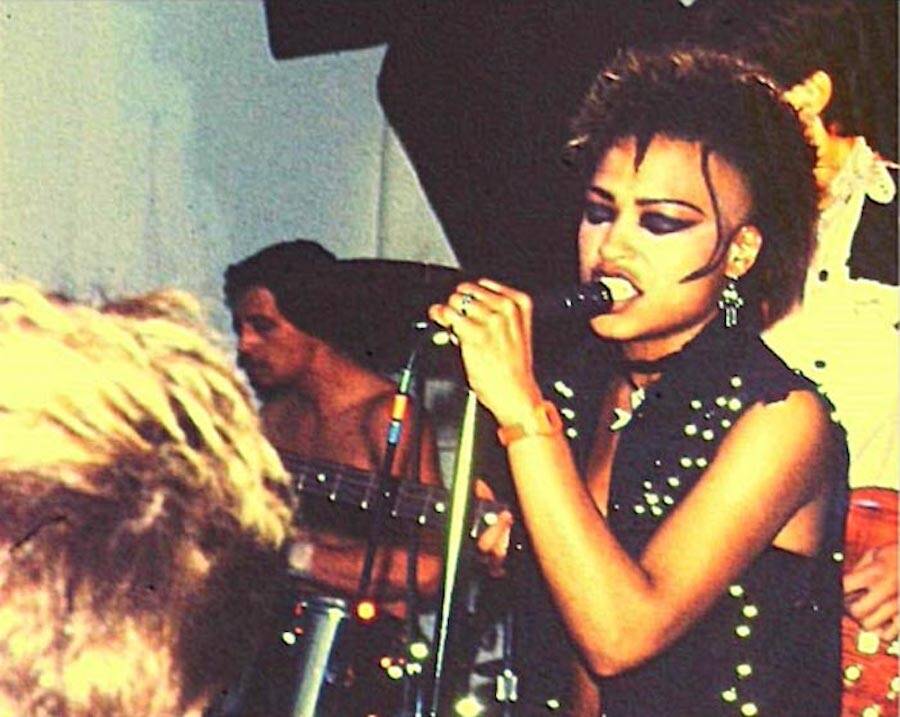
This is all a travesty, because if you have any sort of Punk or Alternative leanings whatsoever, Bam Bam is fantastic. Tina Bell—as ironically named a lead-singer as any—had an absolutely powerhouse voice, her songs make me want to break through a brick wall, and the band around her could freakin’ shred. There should be an entire Bam Bam discography to explore—or at a bare minimum, a full compilation CD for easy purchase like Minor Threat’s Complete Discography or The Avengers’ Pink Album—not these lo-fi demos and YouTube ephemera! Even other short-lived ‘80s Grunge acts like Green River (the precursor to both Mudhoney and Pearl Jam) still see their scant EPs get reissued by Sup Pop and the like; and (white) Riot Grrrl pioneers like Bikini Kill have all their old zines and posters housed in university libraries at NYU and Yale nowadays; all while Bam Bam continues to languish in obscurity, their brief 2021 resurgence already forgotten by the fickle internet, their memorabilia lost in a Nevada landfill.
And I unironically love all these bands I’ve just mentioned, by the way! I’m not trying to denigrate any of them, on the contrary: I just want Tina Bell to be spoken of in the same breathless, reverent tones. Yet even ignoring for now questions of influence and history, her music is simply fun! Bam Bam is a thrill to listen to! It’s been too long since I last discovered a band I love listening to this much, and remain frustrated at how difficult it is to do so. She deserved better; we all deserved better.

And it is here that I revisit our well-worn theme of disappearance. How many other fantastic bands out there would I absolutely love to listen to, but will likely never hear in this life? How many great books and poetry for that matter are out there, which would blow my mind if I ever knew they existed, but have been lost to history entirely? Not just in ancient history, but Modern as well—I mean, Tina Bell formed Bam Bam the same year I was born, less than three hours from where I lived, yet still that band near completely vanished before I was old enough to get into music. Or even leaving aside great art, how many civilizations, cultures, or just wonderful individual people, have been erased from memory, whom I would have loved to learn about otherwise? How many other “holy men [and women] that ye know not of” are out there?
As we have also written elsewhere: “How many pop stars are still listened to thirty, fifty, a hundred years later? (Show me Rolling Stone’s or Pitchfork’s Top 100 songs of the 1920s, for example.) How many movies have already disintegrated and disappeared, how many famous actors forgotten? How many Nobel Prize winners can you name? How many famous athletes can you name from before, say, your grandparents’ generation? How many great novels, epics, and poems have been lost to us, or only get read by specialists nowadays? (For that matter, how many other Great Gatsbys never get rediscovered?) How many captains of industry disappear from memory the moment they pass way–or are at best remembered indifferently? (Does anyone even know or care how Rockefeller or Carnegie or Howard Hughes made their fortunes anymore)? How many prime ministers and presidents (including Church presidents!) never get to fully implement their agendas—or if they do, see it promptly dismantled by their successors? (How quickly will we return to calling ourselves “Mormons” once Russell M. Nelson passes on?) How many websites have already gone defunct? How many bloody wars don’t even have a Wikipedia page? How many soldiers died in vain to gratify the vain ambition of some now-unremembered General? How many mighty empires have fallen? How many nations have, Nephite-and-Jaredite-like, been utterly erased from history?”
We often note that Nauvoo once rivaled Chicago as the largest city in Illinois, but has almost completely disappeared back into the prairie grass just within the short span of the existence of the United States. Heck, the keystone of our religion is the record of two civilizations that were completely erased from off the face of the earth–which has typically been the rule, not the exception, throughout human history. To again quote Joseph Addison (another great writer who has been almost completely forgotten), “look into the Bulk of our Species, they are such as are not likely to be remembered a Moment after their Disappearance. They leave behind them no Traces of Their Existence, but are forgotten as tho’ they had never been.” These are the moments that most make me hope (“wherefore man must hope”) that there really is an eternity awaiting us after the brevity of our mortal probations, when we will at last be able to discover and recover all the beautiful things we’ve lost–when we will find that the “restoration of all things” does not just refer to the recovery of lost ordinances and lines of scripture, but really does entail the restoration of all things—when all the memorabilia and heirlooms thrown in the land fill, the old 45s and out-of-print books we would’ve loved if only we’d known, all of our lost loved ones including our own dear mothers, will at last be restored to us.