
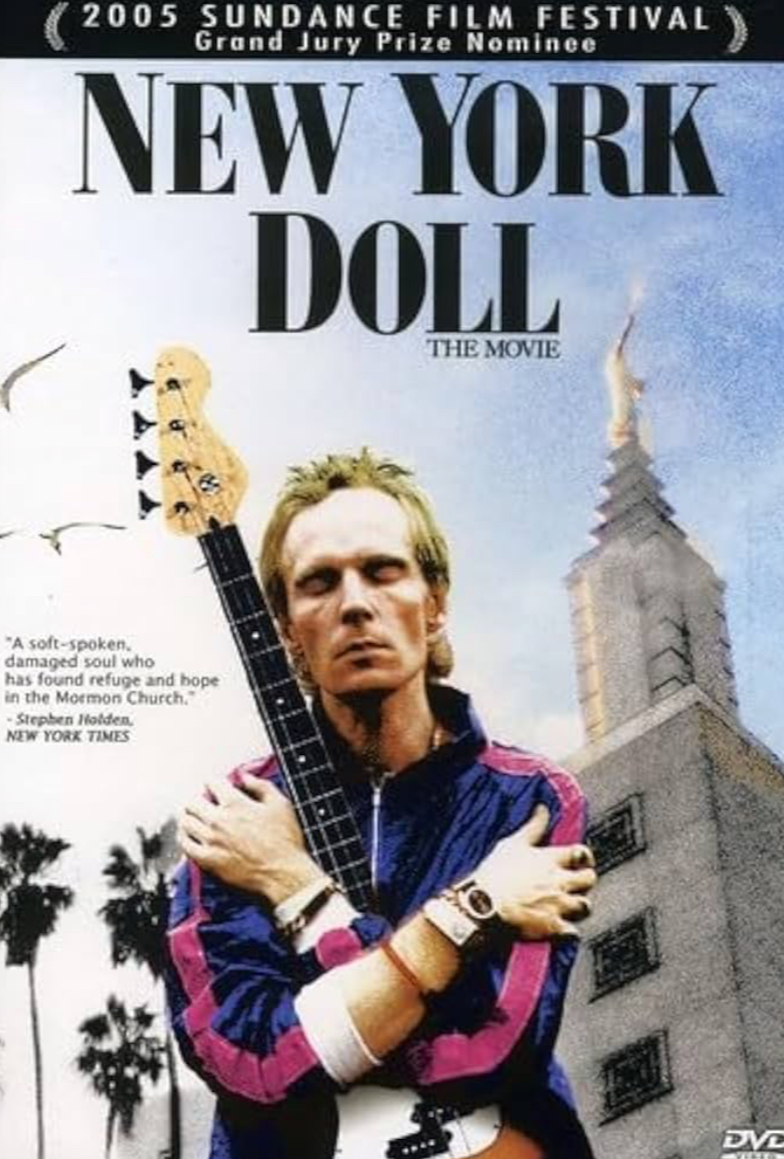
David Johansen–best known as the lead singer for the short-lived yet hyper-influential ’70s band the New York Dolls, the ’80s one-hit-wonder Buster Poindexter, and the Ghost of Christmas Past in Scrooged, of all things–passed away earlier this year at the age of 75. He was the last surviving member of the original New York Dolls line-up.
This year, incidentally, also marks the 20th anniversary of the debut of New York Doll at Sundance, arguably the high-point of the 2000s “Mormon film renaissance” so-called. The film in question is a documentary that, among other things, features the decades-delayed 2004 reunion show between Johansen and his fellow surviving New York Dolls, guitarist Sylvain Sylvain and bassist Arthur “Killer” Kane.
Arthur Kane, in fact, is the primary focus of the documentary. Though he had a far less notable post-Dolls career than Johansen after their 1976 breakup, he arguably had the more compelling personal story–or at least the most unique one: after bouncing back and forth between New York and L.A. for years trying and failing to get another band or a film career going, he suddenly converted to the Church of Jesus Christ of Latter-day Saints in the early-’90s, and got a steady job at the Family History Center of the Los Angeles Temple. So much of the film’s charm, in fact, comes from the constant juxtaposition of the two halves of Arthur’s life: the Punk rocker and the Temple worker. For example, director Greg Whiteley scores interviews with such early alt-Rock luminaries as Iggy Pop, Mick Jones of The Clash, Bob Geldof, Chrissie Hynde, and even Morrisey (who helped orchestrate the New York Dolls reunion show in the first place), but then turns around and also interviews Arthur’s clean-cut and mild-mannered ward Bishop, his home-teacher, and some of the sweet old ladies he worked with at the L.A. temple.
Since Whiteley is LDS himself (he was, serendipitously, the home-teacher in question), it is no surprise that he treats the Mormons in the film with kindness, gentleness, and good-humor. When for example he zooms in on Arthur offering the opening prayer backstage just before the New York Dolls’ big reunion show in London, it comes off as very sweet, sincere, and guileless. There isn’t a mocking bone in the film’s body. Yet intriguingly, Whiteley is also equally charitable and flattering in his portrayal of all the old Punk Rockers in Arthur’s orbit. Whiteley obviously has deep affection for this scene as well, and treats all this Punk Rock royalty with sincere respect.
This is an important point to emphasize, because if New York Doll had been, say, an evangelical production, I suspect the focus of this film would have been more on some lost soul who had forsaken his old, degenerate ways–all of the drugs, sex, cross-dressing, and self-destruction that the Dolls in particular were renowned for–to instead find Jesus, repent of his sins, choose God over Mammon, and so on and so forth. This hypothetical film would have been a didactic sermon, a repudiation, an invitation to forsake the temptations of this wicked world and come unto Christ. Heck, if this had been an official CES-produced Seminary video, I suspect that that is exactly the direction they would have gone as well.
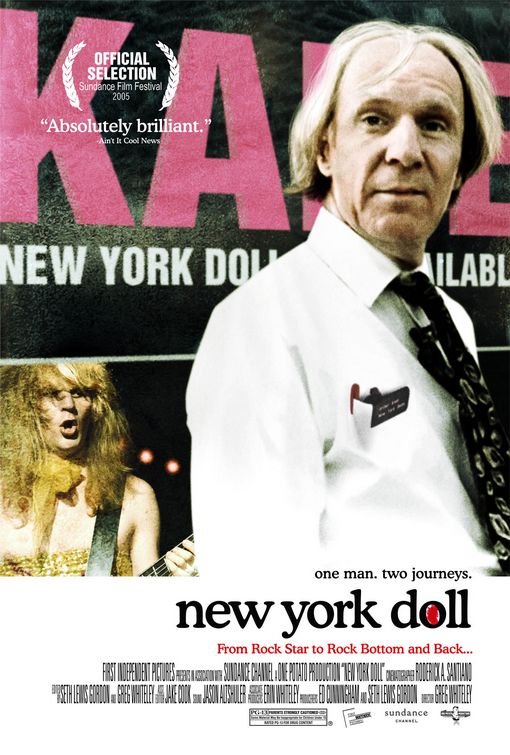
But Whiteley in New York Doll does not present any sort of contradiction or tension whatsoever between Kane’s Punk life and his LDS one. In fact, the New York Dolls reunion show is explicitly presented as the happy fulfillment of an earnest prayer, after Arthur reads from Mormon 9:21, “Behold, I say unto you that whoso believeth in Christ, doubting nothing, whatsoever he shall ask the Father in the name of Christ it shall be granted him; and this promise is unto all, even unto the ends of the earth.” As recounted earlier in the film, Arthur had been obsessively hoping and yearning for a New York Dolls reunion through nearly 30 years of near non-stop frustration, poverty, and heartbreak; he had gotten just the briefest taste of the big-time as a troubled young man, only to see the rug pulled out from under him, leaving him bitter and resentful ever since. His later conversion to the LDS Church had only alleviated this resentment, not abolished it. In this big 2004 reunion show then, he had finally been granted the sincerest desire and prayer of his heart, and the film presents it as an unabashedly heart-warming and faith-promoting story! In this documentary, Arthur Kane is not forced to choose between the Punk life or the Gospel, because both sides of his life converge together as one, At-One, in sincere Atonement.
But then, maybe they were already At-One to begin with! I have discussed numerous times before how the Youth of Zion, especially in Utah, have long had strong Punk Rock affinities; I once upon a time noted on this very site how, “the same state [of Utah] that produced the Tabernacle Choir, the Osmonds, Penatonix, Michael McLean, EFY albums, David Archuletta, and a deep-seated fandom for American Idol, is likewise claimed as home by some of the most impassioned Indie and Punk aficionados anywhere west of Brooklyn.” I speculated that “Part of it may simply be that, even ensconced safely behind the Zion Curtain, Mormon youth have had an almost intuitive grasp of their innate outsiderdom, separate from the American mainstream (despite all the Church’s century-long attempts to normalize us to the country). Punk and Indie likewise takes an almost perverse pride in its marginality, and can perhaps provide to LDS youth a model for how to thrive on the cultural margins.” Arthur Kane, too, perhaps sensed in the Sister missionaries he met some kindred spirits, more than either of them may have realized at the time.
For that matter, despite all of the New York Dolls’ well-documented hedonism and drug-abuse, there was also always something sincerely innocent, joyous, and childlike about the music itself. Fun, upbeat tracks like “Personality Crisis,” “Looking For A Kiss,” “Trash,” “Jet Boy,” “Stranded in the Jungle,” and “There’s Gonna Be A Showdown“–which are, respectively, about heartache, sharing a kiss with your date, a breakup, flying around in a jet-pack, escaping a Tarzan-like cartoon jungle, and having a neighborhood dance-off–all have the most guileless, childlike charm about them; but then, as ever, we must all become little children anyways, for of such is the Kingdom of God. (I even dare say that their trademark cross-dressing had more in common with children playing dress-up than any sort of fetish.)
In all their actual music, the New York Dolls drew closer to our Primary children than to any of the raunchier Hair Metal bands that ripped off their look less than a decade later. Indeed, if you had no clue who the New York Dolls were or what they even looked like and were to judge them strictly on their songs, it might come as no surprise at all that their bassist eventually became a Mormon! He was already childlike to begin with.
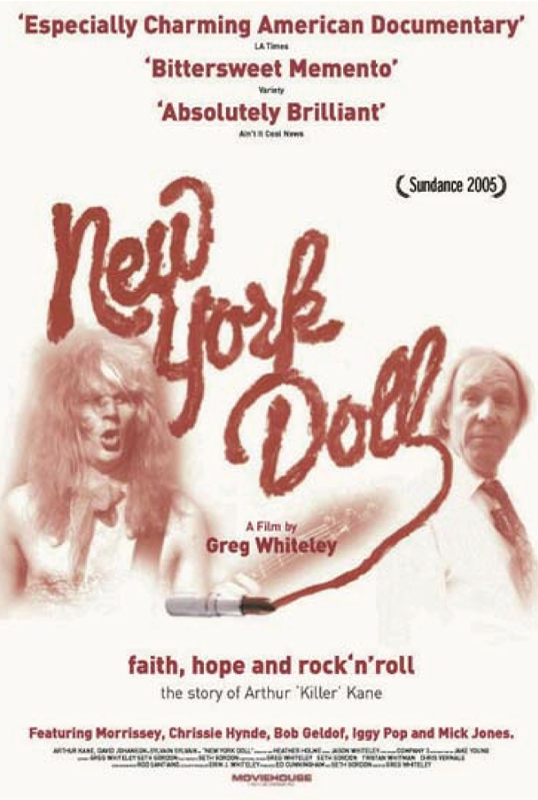
Hence why New York Doll was almost too perfect a match between Church and Rock. It married together two completely different scenes scrounging around on the cultural margins of America–i.e. Mormonism and Punk–that, despite surface level antipathies, have nevertheless exerted an absolutely astronomical influence upon our mass-culture far out of proportion of their comparatively small numbers. Moreover, both groups arose out of a severe dissatisfaction with and protest against this fallen world, and a strong sense that there are better things we should be doing with our far-more-limited-than-we-care-to-confess time upon this earth than seek after the ambitions and vanities of men. Indeed Pitchfork, in a retrospective of the Dolls’ very first album just earlier this year, related the following decade-old interview with David Johansen, wherein he waxed prophetic on that very theme:
In 2015, following a handful of Dolls reunion shows, Mojo reporter Alan Light asked Johansen if he felt “a kind of justice” in selling out large venues decades after the band’s “commercial disappointment.” Johansen might have focused on the Dolls’ undeniable clout, or counted the punk and hair metal bands they’d inspired. He might have heaped the blame on a dim audience, or heroin, or Malcolm McLaren. But he just rejected the construct of success altogether. “This is the frigging psychosis of the times,” he said. “We were certainly not shooting for commercial success; we were in the ground floor of this revolution that was going on, and it was the opposite of commercial.” He continued: “People can’t wrap their head around that, [it’s] an idea that’s alien to most people. People are so into getting and spending that I don’t even know if, when they’re on their deathbed, they realize that they’ve been shoveling shit for the man for the last 70 years. But there’s a lot more to life than that.” Johansen, who died earlier this year at 75, spurned the shovel, and New York Dolls flamed out before commercial success was even on the horizon. How very punk rock.
We, too, are supposed “spurn the shovel” so to speak, to seek “not for riches but for wisdom,” to “Lay aside the things of this world, and seek for the things of a better.” From this perspective, it’s not a wonder at all that a New York Doll joined the Church, but that more of them didn’t: they were already on the same wave-length of some of our most stirring scriptures.
And speaking of our far-more-limited-than-we-care-to-confess time upon this earth: the coup de grace of the film is the sad revelation at the end that Arthur Kane passed away from undiagnosed leukemia only a few weeks after the New York Dolls’ triumphant reunion show in London. It is a true gut-punch, a twist of the knife, and his passing is mourned by both his band-mates (in the DVD bonus features, Johansen performs an acoustic cover of “Come, Come Ye Saints” in his honor) and his co-workers at the Los Angeles temple. In this, the Church and the Punk Rockers also ironically draw closest together: part of what made the early Punk Rockers so ferocious, after all, was their bitter conviction that the world was about to end in a nuclear holocaust anyways. The term LDS, meanwhile, is short for Latter-day Saints, which expresses a similar conviction that this is all going to be over much sooner than we realize. In either case, whatever you’re going to do, do it now, because there is always less time than you think.