
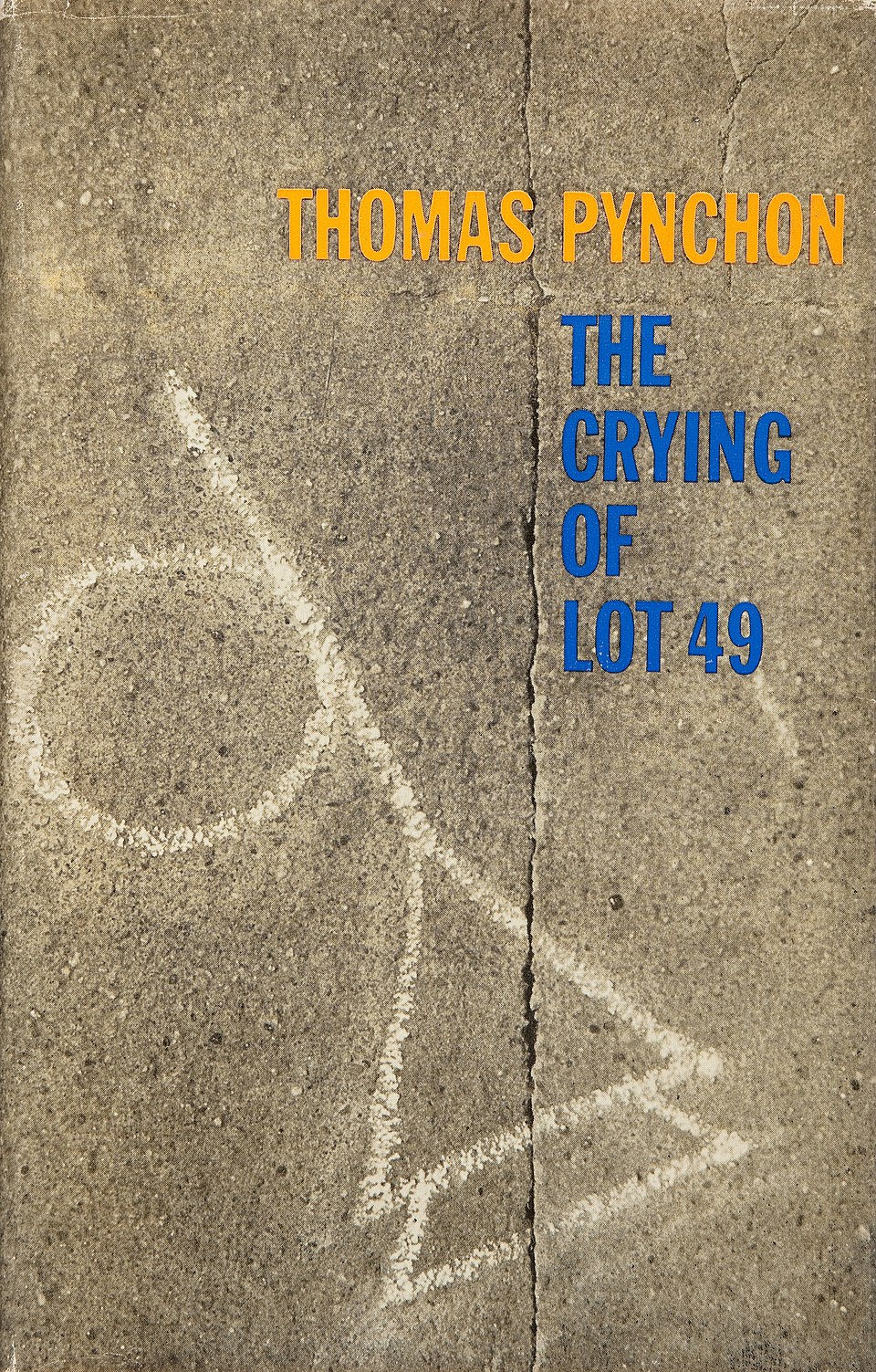
It took me for the longest time to realize I don’t actually enjoy Thomas Pynchon.
I had forced myself through Gravity’s Rainbow, Against the Day, Bleeding Edge, and I was halfway through his debut V., before I finally confessed to myself that every single book of his I’d picked up was a chore for me. Why had I spent so much of my limited time on this earth trying to enjoy his works? Then I realized it was because of the exception that proved the rule: his 1966 novella The Crying of Lot 49.
It is his only novella. He never wrote anything near that short again; Pynchon himself appears to have a low opinion of the book, writing in 1984 that he hadn’t maintained a “positive or professional direction” with The Crying of Lot 49, “which was marketed as a ‘novel’, and in which I seem to have forgotten most of what I thought I’d learned up until then”.
Yet all that indicates to me is that sometimes author’s are the absolute worst evaluators of their own work. Similarly, Arthur Conan Doyle thought his Sherlock Holmes stories would be forgotten while his more “literary” works would endure; Shakespeare didn’t even bother collecting his plays into a collected works (his friends did that posthumasly) because he believed that his reputation would be secured by his long-poems; and Pynchon apparently thinks that Crying of Lot 49 was a slight little lark that paled compared to his long novels.
But he’s wrong: Crying of Lot 49 remains his most popular work not because it’s short (modern readers still read, say, Infinite Jest and War and Peace and Pride and Prejudice just fine), but because it perfectly distills all of his obsessions into one place: paranoia, conspiracy theories, historical esoterica, sexual fetishes, epistemological instability, juvenile humor, and so forth. I was absolutely floored by this novella the first time I read it in college, and so naturally assumed that long doses of Pynchon must be even better that short ones! Hence I subjected myself to so many other of his long novels, before I finally admitted that I was never going to repeat the high of Crying–that none of his other novels came anywhere close, frankly.
And I thought about all the times a short poem has captured my imagination more than whole series of novels; or how an EP has moved me more than entire double-albums; or how when I was a new missionary, and would talk investigator’s ears off for an hour at a time, before I learned to my embarrassment that a quick 10-minute discussion, getting out of the way of the Spirit, did more to touch someone’s heart than multiplying words—