
Even today, over seventy years later, it is difficult to overstate just how absolutely massive Ralph Ellison’s Invisible Man was when it was first published in 1952. Winner of the National Book Award, an immediate best-seller, and perhaps the quintessential African-American novel of the 1950s (maybe even of the entire 20th century), the novel is still regularly stocked in bookstores, checked out from libraries, and assigned in college classrooms, long after so many of its other high “literary” peers of the era have been forgotten.
Claudia Rankine reenacted its famed Preface in 2014’s Citizen, and Barack Obama (long before his political career), modeled his 1995 memoir Dreams of My Father on the book. It is rare for a novelist (even the famous ones!) to have a breakout hit with their debut; even rarer for that debut to become instantly canonized as one of the greatest American novels of all time.
Which perhaps goes a long ways towards explaining why he never published a second novel in his lifetime. When you set the bar that staggeringly high for yourself right out the gate, the pressure you put on yourself to exceed it must be absolutely oppressive!
And it’s not like he didn’t try! He spent something like the last 40 years of his life obsessively writing, revising, rearranging, and rewriting a magnum opus that would somehow justify all the youthful promise and potential of his debut. (But then, as we’ve discussed before, isn’t that the mortal condition in a nut shell? Aren’t we all constantly aching to live up to our divine potential, yet endlessly falling miserably short of the same? Is that not why we need the Atonement?)
He published in the interim various essay- and story-collections to satisfy his publisher and his readers, but the completion of that second novel continually eluded him. Paul Valery famously said that a work of art is never finished, only abandoned, but Ellison could never quite bring himself to abandon it. When he finally died of natural causes in 1994, he left behind over 2,000 pages of disorganized and unfinished manuscript. His friend and biographer John F. Callahan was bequeathed the arduous task of somehow sorting through this massive pile of papers and fashioning a coherent novel.
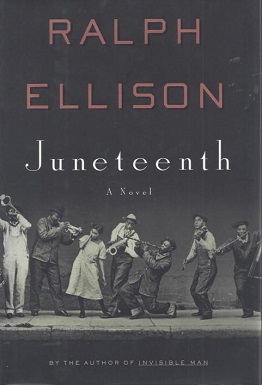
It took him five years more, but Callahan was at least able to finally finish it: Juneteenth—named for the auspicious Summer day in 1865 when Federal troops marched into Texas and finished abolishing slavery in these United States—was published by Random House in 1999, to the great rejoicing of Ellison scholars and lit mag book reviewers, and apparently no one else. Pristine hardbacks of Juneteenth quickly gathered dust in college libraries, all while dog-eared copies of Invisible Man continued to fly off the shelves and be rediscovered by yet another generation. C’est la vie.
I checked out just such an untouched copy of Juneteenth earlier this year. I had of course been blown away by Invisible Man when I was a young college student (in the same era when I had consumed many a dorm-room staple like Slaughterhouse Five, Catch-22, and Catcher in the Rye); yet despite having taken a class from a bona fide Ellison scholar in grad school, I had somehow never read the long-delayed follow up. This past year however, which has seen yet another resurgence in white supremacism, seemed as good a time as any to finally tackle it.
And having finally finished it myself, I can confidently say that I better understand now both why he could never finish it but also never abandon it, either: because wow, what a Cracker Jack premise! The sort you don’t just shunt aside! A race-baiting Senator from New England, who has been actively impeding Civil Rights legislation every chance he gets, is giving a rousing speech on the senate floor in Washington, D.C., when a young black assailant in the front row stands up, pulls out a revolver, and shoots him at point blank range.
The shooting itself is shocking enough; what is everyone’s further shock then is, after the wounded senator arrives at the hospital, the only person he asks to visit him isn’t his wife or his aides or his colleagues, but an old black preacher who’d been in town to warn him, and whose congregation had been snubbed by the senator’s office. It quickly turns out that the senator is in fact the black preacher’s adopted son, who had raised him alone in Depression-era Oklahoma, took him on the road as an itinerant revivalist preacher, and taught him everything he knows about oratory and how to work a crowd. The remainder of this (still very much unfinished) novel is the extended private conversation between this aging black preacher and his white prodigal son in the hospital room, as they reminisce in stream-of-conscious format on their complicated relationship–which is in turn metaphoric and metonymic for the complex relationship between black and white Americans more broadly.
And that’s a really cool idea for a novel! You don’t just scrap a premise like that when it comes to you! I’m willing to bet that there were innumerable times over the decades when Ellison, in his great frustration and despair at ever being able to finish, was tempted to throw the whole manuscript in the fire and be free of it; but then he would revisit those incredible opening chapters and couldn’t bring himself to do it.
But I also get why he could never find a way to finish it, either—because the story of race relations in this country isn’t finished, either. White Americans of course by and large like to pretend otherwise: that the civil rights movement was something somehow definitively completed and over and done with and in the past now, a victory completed—as shown by the passage of MLK Day and Obama’s election and the Juneteenth holiday most recently—this, despite the numerous race riots of the 2010s and the George Floyd ones of 2020 and the election of an anti-diversity white rapist over a black woman most recently. If Juneteenth ends on an unsatisfying and ambiguous note, well, that’s the way America entire has been feeling lately. It’s the spiritual dissatisfaction that comes from refusing to repent—and no one likes to be called to repent. No wonder the novel flopped.