
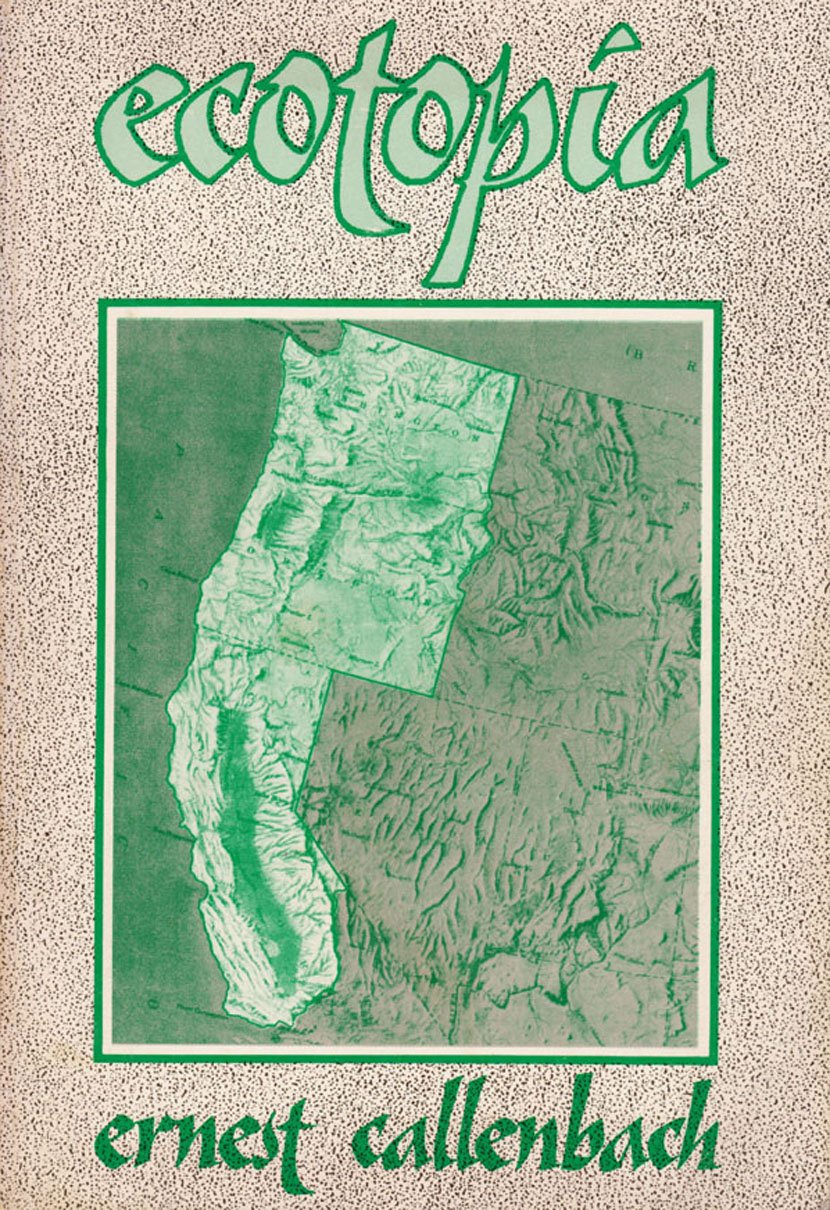
Despite the fact that he was at the time an editor at UC-Berkeley Press where he presumably had at least some institutional clout, Ernest Callenback still either chose or was forced to self-publish his best-known novel Ecotopia: The Notebooks and Reports of William Weston on his own private Banyan Tree imprint in 1975. Such an obscure beginning is usually a kiss of death for a book, as the super majority of self-published tomes are consigned to an everlasting obscurity (but then in fairness, such is the common fate of almost all mainstream publications too; when someone once told TS Eliot that most editors are just failed writers, the poet replied, “So are most writers”).
Yet Ecotopia was one of those wondrous exceptions, and is nowadays considered an important precursor to and godfather of the entire subgenre now known as “Solar Punk.” In contrast to its more dystopic brethren of Cyberpunk or Steampunk or even Dieselpunk, Solar Punk in general tends to imagine a world wherein humanity has actually learned to live in sustainable, environmentally-conscious harmony with the natural world around us—a vision even more direly important now than it was in the ‘70s.
In our present era of widespread and out-of-control wildfires, heat-domes, chronic-droughts, desertification, and overall climate crisis across the globe (one certainly not helped in the slightest by the rapid and rabid expansion of AI data-centers doubling and tripling our energy consumption nationwide and worldwide), I have found myself increasingly drawn to Solar Punk and utopic literature in general, for the simple reason that dystopic fiction has clearly failed to wake us up from our complacency and impel us to positive action. As the last election reminded us yet again, it is not enough to give people something to vote against—not even when the alternative is certain catastrophe—you must also give them something to work towards. Hence my greater attraction as of late to genuine literary utopias.
Believe it or not, Utopias in fiction used to be far more common in America. This site has recently published an extended exegesis on Added Upon by Nephi Anderson, that 1898 classic of Mormon literature that features in its fourth and final part an in-depth description of the utopic City of Zion during Christ’s rule in the Millennium. That article contextualized how Anderson was writing during a positive glut of utopic literature in the late 19th-century America, including but not limited to Edward Bellamy’s 1888 best-seller Looking Backward, William Morris’s News From Nowhere (1892), William Dean Howell’s A Traveler from Altruria (1894), Walter Browne’s 2894, or The Fossil Man (1894), and Samuel Butler’s Erewhon (1872) (from which Frank Herbert coined the term Butlerian Jihad in the Dune books, incidentally) (and also, weirdly, gave the name for an overpriced grocery chain in southern California).
For that matter, all of these late-1800s texts worked within the same long-range literary tradition as Sir Thomas More’s Utopia (1516), Tommaso Campanella’s City of the Sun (1602), and Sir Francis Bacon’s New Atlantis (1626)–all three of which, incidentally, were discussed at length by Hugh Nibley in his essay The Utopians from his 1989 masterwork Approaching Zion. What all of these fictional utopias share in common, from the Renaissance to the late-Victorian, is a breathless excitement to explain in careful detail what an actual functioning utopia could conceivably look like in our current and fallen world.
Save for this one caveat: those older Renaissance utopias displayed little hope that such an ideal society could ever be established en masse across the entire earth, settling instead for cordoning off their utopias on some distant, isolated, inaccessible island. It is never governmental envoys on fact-finding missions that encounter these hidden utopias, but always shipwrecked sailors blown far off course, whom the utopians only reluctantly assist out of a sense of compassion and common humanity, due to their well-founded suspicions of outsiders. In these older Renaissance texts, Zion merely bids farewell to Babylon, not overcomes it. That’s a job reserved solely for the next life.
These late-Victorians that Anderson belonged to, by contrast, were products of a more progressive era, possibly the last one when we still felt it collectively possible to create heaven on earth in this life. Technology and scientific knowledge was already advancing at breakneck speeds even then, the whole wide world was becoming interconnected via railroads and shipping lanes, the last empty spots on the map were being carefully catalogued by cartographers, and all of humanity was becoming connected together in a mass culture for possibly the first time ever; so was it really such a stretch to imagine that we might be build utopia in this life as well?
That dream was of course successively demolished by the First World War, the rise of such demonic perversions of Zion as fascism and communism, and the reveal of Hiroshima and the Holocaust at the end of WWII. By the second half of the 20th century, it not only felt impossible but darkly comical, even grotesquely irresponsible, to imagine a better world. Hence in direct mirror image of the previous century, post-war fiction became absolutely saturated with dystopias, to the point of cliche, clear down to the present moment.
In that regard, no wonder Callenbach in 1975 couldn’t have found a publisher for Ecotopia even if he’d tried: in that post-modern, nuclear era, an actual utopia in fiction couldn’t have felt like anything other than a laughably hopeless anachronism, woefully out of synch with the times. You could maybe get away with writing an “ambiguous” utopia in the ‘70s (as Ursula K. Le Guin had done just a year earlier with The Dispossessed), not a straightforward one. Heck, Ecotopia was in many ways a retro throwback even for those late-1800s writers, because he once again no longer bothered trying to imagine a transnational utopia, but only a heavily isolated, separated, and inaccessible one, as in the Renaissance tradition of More, Campanella, and Bacon.
Ecotopia you see takes place in a near future wherein Washington, Oregon, and northern California have successfully seceded from the United States (ironically, these peace-loving hippies achieved this by seizing control of some nuclear weapons during a major economic crisis), closed their borders, cut off all trade and ended diplomatic relations with the U.S. Now, there is some precedence for this vision: the Cascadia separatist movement does indeed have its own Wikipedia page, and I even saw a slight uptick in secessionist chatter on social media after the first Trump election, though having been born and raised thereabouts myself, I can confirm that there is absolutely no groundswell of popular support for an independent Cascadia (at least not when compared to all the Confederate flags still waving in the former slave states). The concept of Cascadia, in my experience, is largely just the province of alternative-history aficionados and post-apocalyptic table-top gamers.
Callenbach however does not name this new country Cascadia, but Ecotopia, due to how its founding Mothers promptly established an environmentally conscious and ecologically sustainable society that, if it isn’t quite a true utopia yet, is at least still trending in that direction. Callenbach had been a huge admirer Edward Abbey, and so sought to write a similar pro-environmental polemic to Desert Solitaire—except fictional this time.
The William Weston of the subtitle is a New York based reporter who, at the behest of the U.S. President who is putting out feelers for re-establishing contact with Ecotopia (and maybe even determine if it might be possible to invade and re-annex them militarily), travels west under press credentials to become the first U.S. citizen in nearly 20 years to visit the Bay Area and Pacific Northwest. He is the first-person narrator and resident skeptic who is of course slowly but surely won over by the grand ways of the kind-hearted Ecotopians, to the point that by the end of the novel, he quits his job in New York to emigrate to Ecotopia fully, telling his old editor that he’s found his home.
Not that it’s a seamless transition for him: he is contacted fairly early on by some Ecotopian dissidents—largely former businessmen who lost their fortunes when this new government converted to anarcho-syndicalist principles—who declare their willingness to collaborate with the U.S. military if they choose to invade. There’s also a running joke early in the novel that, despite the reputations of all these free-spirited hippie women, Weston just can’t seem to get laid (he learns the hard way that being sexually uninhibited is not the same as being sexually available to everyone; unlike our current administration run by rapists, consent reigns supreme in Ecotopia). But finally, after being able to see the stars at night in the middle of San Francisco; after beholding the beauty of their restored forests and farmlands; after marveling at how, despite their intense ecological principles, they are still very technologically savvy; and especially after learning about their 20 hour work weeks (something that both Tommaso Campanella and Brigham Young openly advocated for), his skepticism is ultimately won over. (It also helps that he does indeed fall in love with an Ecotopian woman.) In the words of our old hymn, he bids Babylon farewell.
I attended college and grad school in both Utah and Idaho, so I can already hear oh so many of my fellow congregants snickering and rolling their eyes at this overwrought description, of how plainly obvious of a Blue state wish-fulfillment fantasy this all is. No wonder it was self-published! I suppose I could point out how the Ecotopian state described here is also highly decentralized in favor of small, self-governing communities (the major cities like San Francisco and Seattle are treated more like mere vestiges of a rapidly vanishing order), ones with a strong local hunting culture where manly men kill their own free-range game in the wilderness rather than factory-farm it, which implies that this novel is as much a Libertarian wet-dream as it is a liberal one.
But perhaps the better comp is Brigham Young himself, who after he led the colonization of Utah and Idaho, established the towns of Ordersville and Brigham City as model communities to prove that the United Order really was feasible—that per Acts 2:44-45, 4 Nephi 1:3, D&C 42:30-39, D&C 49:20, and many other scriptures besides, we really can have a perfect society of “neither rich nor poor,” where we have “all things common,” for “it is not meet that one man should possess that which is above another, wherefore the world lieth in sin”—and that not in the next life, but in this one, that in fact no other economy on earth is acceptable before the Almighty.
We could cite too how we all covenanted to keep this United Order via the Law of Consecration, in the holiest rituals of our Temples; that we too are supposed to “bid Babylon farewell,” not live in it (the phrase “be in the world but not of the world” appears nowhere in scripture, bye the way—it is what Nibley called a “para-scripture); that the kingdom of Deseret which Brigham Young envisioned was identical in scope, scale, and beauty to the Cascadia that Ernest Callenbach describes in Ecotopia—including the fact that Young seeking to break free of the United States as well; that Young likewise pleaded with the Saints to preserve the purity of their fresh mountain air and water with astonishing foresight (as Nibley once noted, twenty years after Brigham Young personally made sure every campfire was put out in Provo canyon after Pioneer Day celebrations, Mark Twain in Roughing It was gleefully setting Lake Tahoe on fire, naively rejoicing in the seeming inexhaustible resources of the West); that per the Tenth Article of Faith, the Earth is to receive its paradisiacal glory, which we must prepare ourselves to live in, for it will not be the same economy as our present fallen world.
All of which to say, is that if Ernest Callenbach’s Ecotopia perhaps feels unoriginal, it’s because there’s nothing original at all about our common, collective yearning for Zion. This yearning is our common inheritance dating back to the pre-existence, and which we all intuitively know will and must come again. The only real question is not whether a United Order utopia is workable, but whether we will be prepared to live it when it comes—which the vast majority of us, quite frankly, are not.