
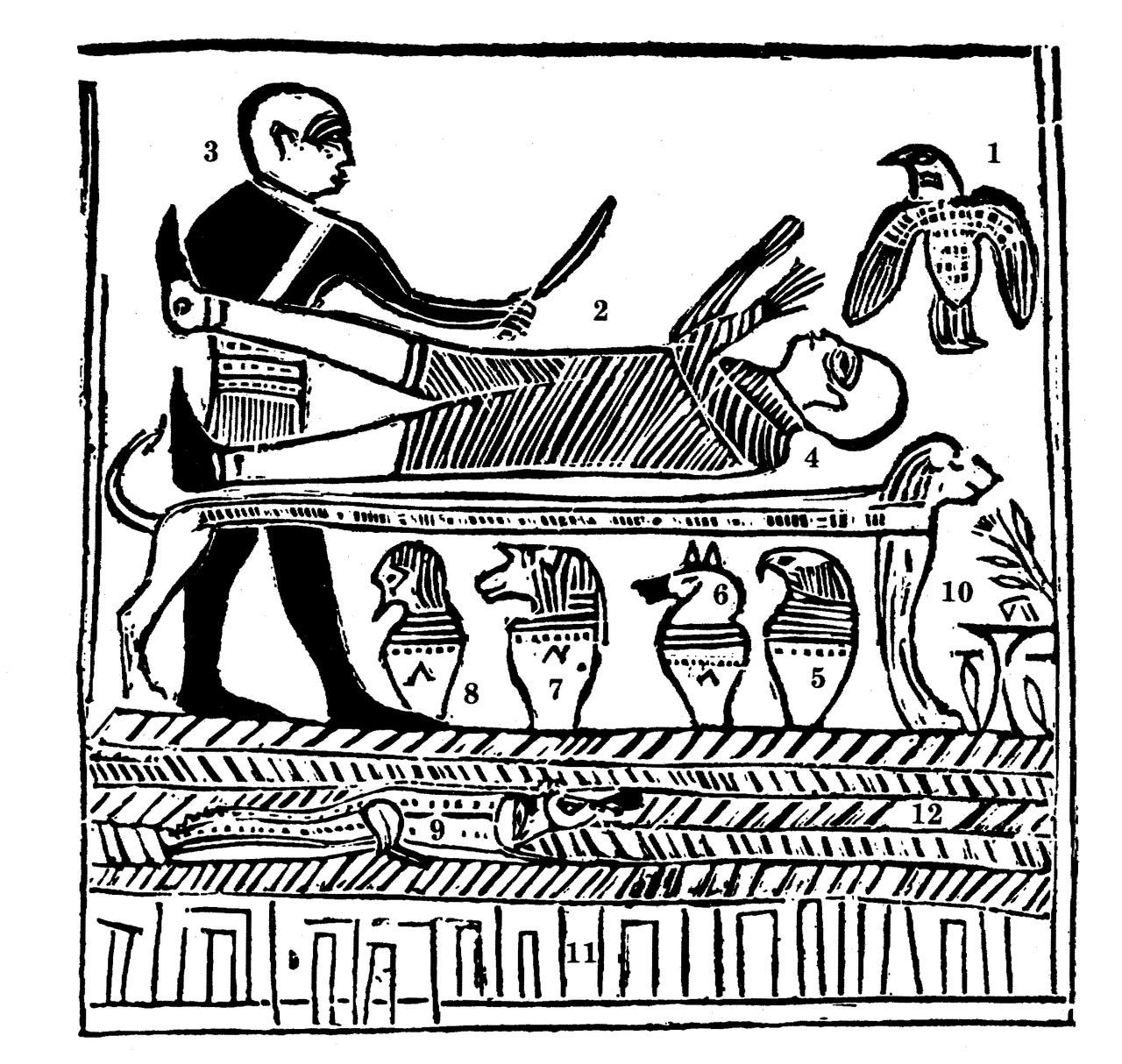
In Abraham chapter 1 of the Pearl of Great Price, the eponymous patriarch beholds three young virgins killed as human sacrifices by the idolatrous priests of Pharaoh in Egypt. He is clearly shocked and disgusted by this triple-murder, and considers these virgins to be martyrs—”[for] they would not bow down to worship gods of wood or of stone”–and the Priests who carried out this heinous act he openly calls “evil”. Abraham then almost suffers the same fate, because he had been boldly preaching against human sacrifice himself–“[they] hearkened not unto my voice, but endeavored to take away my life by the hand of the priest of Elkenah”–and is only saved last-minute by an angel miraculously sent by Jehovah.
I rehearse the opening verses of the Book of Abraham because they clearly establish that, at least in an LDS context, Abraham considered the wide-spread practice of human sacrifice in the ancient world to be among the most heinous of sins–the surest sign of the evil fruits of idolatry–and so spent his entire century long mortal ministry preaching against it in particular. We must have this context in mind, then, to fully understand just how fully a gut-punch it was for Abraham when he was commanded by the Almighty to sacrifice his own son Isaac.
That is, this wasn’t just a test of Abraham’s faithfulness, of his willingness to give up something he valued for something he valued more or whatever it is we normally tell each other and tell ourselves in Sunday School lessons; no, this was a fundamental betrayal of everything Abraham had preached his entire century-long life, of everything he thought he understood about God or believed the Gospel to be.
I’ve been trying to think of an even remotely modern equivalent. The best I’ve been able to come up with is if, say, Neil A. Anderson–he who recently gave an entire General Conference talk on the evils of abortion, to the degree that he praised a woman who raised her husband’s adulterous love-child rather than abort it, all of which he delivered with the self-satisfied confidence of the completely orthodox, confident that this was “a moral, not a political issue”–if this same Elder Anderson was then suddenly commanded by God Himself to perform an abortion on his own wife. It’s not just that such an act would strike him as heinous as killing a live, born child would have been to Abraham; it’s that such a command would have also struck him as a complete betrayal of everything he had taught, preached, and matter-of-factly assumed he understood about the Gospel of Jesus Christ all his long life.
I need to tread carefully here, because my purpose is not to delve into the abortion debate whatsoever (although I will say that, unlike Anderson, I do not detect any meaningful distinction between the political and the moral); mine is simply an attempt at a possible analogy for what Abraham must have gone through at the binding of Isaac. I do not doubt that maybe you could come up with a better one.
Hopefully this inadequate analogy can help to explain why this episode of sacral history is so insanely difficult, why so many folks throughout history have felt compelled to solve it. I’ve read at least one Jewish source, for example, who claims Abraham never actually intended to sacrifice Isaac at all, but was only acting out this binding as an elaborate object lesson, to illustrate for one last final time the evils of human sacrifice. I’ve also heard it argued before that Abraham was not just submitting his will to that of God in this moment, but expressing his faith in the Resurrection, that Isaac–the promised covenant child, through whom all of Abraham’s posterity would bless the world–would literally return from the dead himself. Then of course there is Kierkegaard, who famously promulgated in 1843’s Fear and Trembling an entire philosophy around the “teleological suspension of the ethical,” to explain how Abraham’s act of impossible faith was even greater than the acts of heroes in ancient epics.
I’ve also heard it proposed of late, on more than one occasion, that maybe Abraham actually failed the test. I admit I am more and more attracted to this argument these days, not just due to my own horror at murder and human sacrifice–and not just because religious believers to this day keep using this story to justify the most heinous violations of their own conscience–but because we all fail the test of mortality anyways. That’s why the Atonement exists in the first place.
And of course speaking of the Atonement, there is the standard Christological argument that side-steps this debate entirely by just making the binding of Isaac an allegory for the Atonement of Jesus Christ, because God the Father also had to sacrifice his Son for us; this is also what Jacob 4:5 argues in the Book of Mormon, wherein that self-same prophet states simply, “And for this intent we keep the law of Moses, it pointing our souls to him; and for this cause it is sanctified unto us for righteousness, even as it was accounted unto Abraham in the wilderness to be obedient unto the commands of God in offering up his son Isaac, which is a similitude of God and his Only Begotten Son.” That one verse, in fact, is all the Book of Mormon says about Abraham’s binding of Isaac, anywhere.
This is curious to note, because the Book of Mormon is otherwise heavily invested in commenting upon and allegorizing Old Testament history. Nephi for example heavily draws upon Moses at the Red Sea to try and motivate his brothers to help him build a ship; Captain Moroni directly rehearses the story of Joseph in Egypt while waving the Title of Liberty; Alma allegorizes Moses with the snake on a staff; Nephi, Jacob, and Alma alike all deliver in-depth expositions upon the Fall of Adam and Even; even the story of the Liahona is later deployed by Alma as a metaphor for the Gospel. “Thus we see” is the repeated stock phrase throughout the Book of Mormon, which is a deeply moralizing volume of scripture.
But there are no such sermons or moralizings about Abraham in the Book of Mormon. Aside from Jacob’s off-hand comparison to Christ early on in the narrative, the Book of Mormon remains curiously silent on the subject of the binding of Isaac. No other prophets in the text cite the binding of Isaac (curiously, the longer the Nephites are away from Jerusalem, the less important the story becomes to them); neither Nephi nor Mormon nor Moroni ever alludes to the binding throughout their respective narratives; and no one else ever seems to go through a similar trial of their faith wherein they must violate everything they thought they believed about the Gospel to obey God’s command. Even the Resurrected Christ among the Nephites, amidst all his rehearsals of Matthew and Malachi and Isaiah and “expounding all the scriptures into one”, makes no reference to Abraham binding Isaac in the 3 Nephi record.
For that matter, the binding is mentioned only twice in the Doctrine and Covenants: first in section 101:4, when the Lord tells Joseph Smith that the Saints persecuted in Jackson County, Missouri, “must needs be chastened and tried, even as Abraham, who was commanded to offer up his only son”—yet that verse only seems to indicate that both the Missouri Saints and Abraham had to pass through trials generally, not that the Saints were commanded to do something that violated their conscience and everything they thought they understood or believed about the gospel. (No one ever has to explain why what the Missouri mobs did was wrong; countless people have had to try and explain why what Abraham did was right.)
The other reference is in section 132:36, which reads: “Abraham was commanded to offer his son Isaac; nevertheless, it was written: Thou shalt not kill. Abraham, however, did not refuse, and it was accounted unto him for righteousness.” This verse, however, is explicitly cited in defense of polygamy, which the Church has disavowed for over a century now; for that matter, this verse is also in direct tension with Jacob in the Book of Mormon, who cites Abraham in the same sermon where he thunderously condemns polygamy.
One could perhaps here argue polygamy is precisely an example of God commanding something that violates not just one person’s but innumerable people’s conscience, similar to what Abraham went through. However, the analogy breaks down on closer inspection, because there was no ram in the thicket to spare us from polygamy at the last minute; nor can polygamy be explained as an allegory for the Atonement, like Jacob does. (Heck, polygamy might also be an example of how, just as Abraham actually failed his test, so did we.)
The closest comparison in any volume of LDS scripture to what Abraham went through (at least in light of what we read in Abraham 1) was probably Nephi, actually, when he felt impressed to chop off Laban’s head when he found him passed out in the street, an act he initially “shrank” from doing. “Thou shalt not kill” was even then one of the Ten Commandments, was it not? Could there be any clearer violation of the Gospel than to kill a man? Yet even here the comparison breaks down: Laban wasn’t an innocent like Isaac, but a vicious and cruel local tyrant who literally just robbed and tried to murder Nephi and his brothers earlier that same exact day. There is a definite moral framework available to justify the beheading of Laban—for self defense, if nothing else—but none for Isaac. What’s more, the Spirit actually deigns to patiently explain to Nephi why this particular beheading is justified, so as to reassure his troubled conscience; but there is no record in Genesis of the Almighty giving Abraham any reasons or reassurances at all—at least not until the ram appears in the thicket.
Even more importantly, no one else, for the entire rest of the thousand year narrative of the Book of Mormon, ever finds themselves in a similar situation where they feel prompted by the Spirit to violate their own conscience. In literally every other story in the text, good acts are celebrated for being inherently good, while evil acts are condemned for being inherently evil, and no one ever has to twist themselves into a pretzel to explain why an evil thing God commanded was good, actually. Like Christ, these prophets presuppose that everyone already knows right from wrong, and that they only need to remind the people therefore to obey their sense of right and wrong, never disregard it. There is no divinely sanctioned polygamy anywhere in the text, nor does anyone use the binding of Isaac to browbeat someone else into violating their conscience. All throughout the Book of Mormon, to follow your conscience is to follow God; the two are never in tension, like they are in the story of Abraham and Isaac.
Maybe this all means that the binding of Isaac is, frankly, not nearly as important to sacral history as we think it is: it’s perhaps only a reminder that all of us will have to go through something deeply unfair during our mortal probations, not that there was anything particularly important about what form it took for Abraham or for us. Or perhaps it’s the opposite, the story is simply too large to reduce to metaphor, too complex to allegorize, too difficult to moralize, who knows. Notably, the unknown author of Genesis never tries to moralize upon the story either; the binding of Isaac is left as an exercise for the reader. Abraham had to wrestle this out for himself; so must we. And just as we cannot live off borrowed light, no one can wrestle this out for us on our behalf. As for how Abraham himself may have wrestled through the implications of all this, the Genesis account remains silent, and Joseph Smith never finished the Book of Abraham about that could have shed some more light on the subject. It probably isn’t for us to know; hence that same divine silence still hangs like a shroud over the story to this day.