
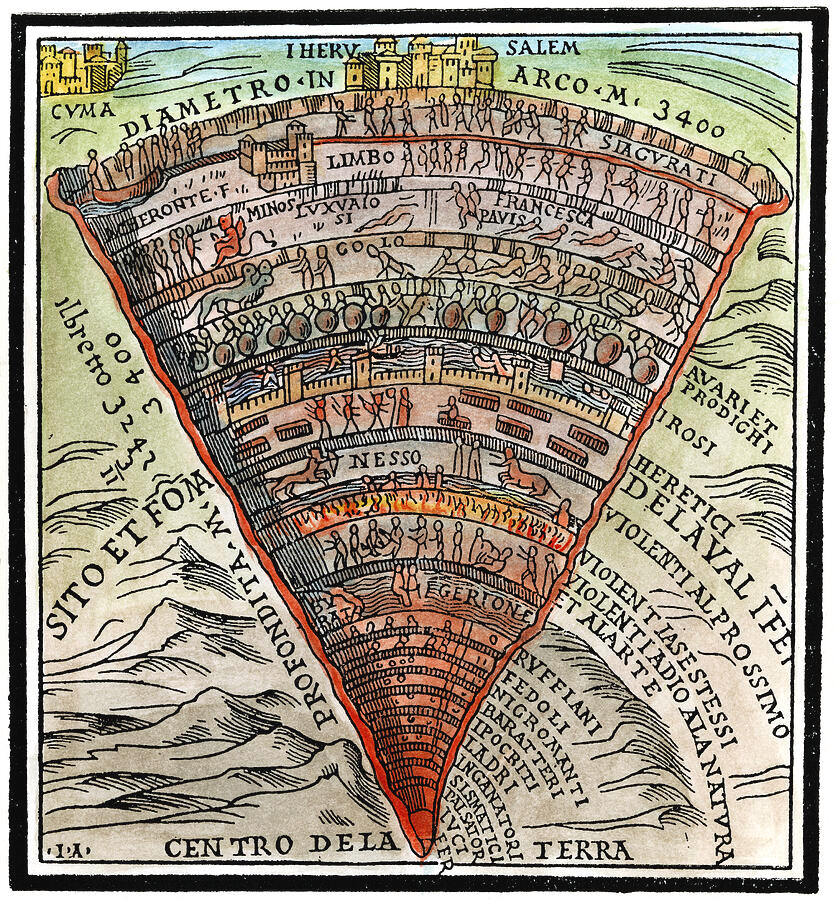
After wandering around lost in the forest for the first couple Cantos, Dante’s Inferno really gets going in Canto III, when Dante the Pilgrim and his Spirit-guide Virgil make formal entrance into Hell itself. This is the oft-cited scene where they behold “Abandon All Hope, Ye Who Enter Here” emblazoned on the “lofty arch” over the gateway, and have their first vistas of the astonishingly massive hosts of the damned. Dante is here on a quest to reunite with his lost love Beatrice in Heaven, but in order to reach her (as is so often the case in real life) he must first pass through Hell to get there.
Dante Alighieri famously innovated the idea, not present in the Bible, that Hell is a realm of ironic punishments–Contrapasso is the technical term–wherein the way you sinned while alive is how you will in turn be punished in the next life: e.g. the adulterous are swept away in constant storms because they failed to control their passions while alive; the wrathful have fires constantly rain down upon them that mirrors their inner soul; thieves are transformed from metaphorical to literal snakes; the divisive are perpetually cut in half by demons; the hypocritical are are forced to wear golden cloaks weighed down with heavy lead; and etc. Dante overall imagines Hell as a multi-tiered pit subdivided into nine levels (hence the origin of our modern saying, “There’s a special place in Hell for people like you…”), with each tier down containing an even worse class of sinners than the one above.
It bears emphasizing, then, that in Canto III, Dante and Virgil, although they have now technically crossed the threshold into Hell, still have not actually started on the first level yet. This is more the foyer of hell, where those mediocre and apathetic souls who were neither righteous enough for Heaven nor evil enough for Hell–whom the text describes as people “Who lived without infamy or praise,” of whom “The heavens expelled them […] Nor them the nethermore abyss receives,” of whom “Mercy and Justice both disdain them,” who like the proverbial fence-sitters of the pre-existence in LDS folk-doctrine, “have not rebellious been/Nor faithful were to God, but were for self”–persist in an endless and eternal “melancholy.” As Dante broodingly explains, “These have no longer any hope of death […] They envious are of every other fate,” even damnation, because then they would at least be somewhere. It also bears emphasis that these poor souls are not even trapped in Limbo–in the Inferno, Limbo is a little further down into the first level, and is where the virtuous pagans are permitted to reside unmolested–because even Limbo is still a definite place, someplace you can actually belong, but these damned souls are literally nowhere.
For that is exactly their Contrapasso, their ironic punishment: because they never took a stand while they were alive, they are never allowed to stand anywhere in death. They must constantly chase after an empty banner, and are everlastingly stung by wasps and hornets to ensure they never stop moving, nor ever remain in one spot.
Here it is also worth emphasizing that although Dante Alighieri was an orthodox Catholic who surely believed in the literal existence of Heaven and Hell, he was never actually trying to present a literal, physical description of Hell in the Inferno, but only a symbolic, poetic one. That is, his point isn’t so much that sinners will be sent to Hell to be tortured for all eternity (though he likely believed that as well), but rather that when you commit sin, you are already creating a mental hell within yourself. His moral lesson in Canto III, then, is that whenever you find yourself feeling apathetic, non-committal, indecisive, or simply too cowardly to take a stand when it matters most, then you are most definitely residing in a private hell of your own making. (Certainly the times in your life when you’ve said, “Whatever, I don’t care anymore,” are not the times when you have been in a good place mentally.)
In this, Dante Alighieri the orthodox Catholic was preaching sound doctrine: one of our old seminary scripture-masterys in Mormondom, after all, is Joshua 24:15, “choose you this day whom ye will serve; whether the gods which your fathers served that were on the other side of the flood, or the gods of the Amorites, in whose land ye dwell: but as for me and my house, we will serve the LORD,” clearly establishing that picking a side–even implicitly the wrong side–is still better than never picking at all. It’s also why the Resurrected Christ in Revelations 3:15-16 declares “I know thy works, that thou art neither cold nor hot: I would thou wert cold or hot. So then because thou art lukewarm, and neither cold nor hot, I will spue thee out of my mouth.” Even the cold (and the lowest level of Dante’s Inferno is frozen ice, recall) are better off than the lukewarm; it is why those trapped around the entrance are “envious are of every other fate,” even those in the lowest level. There’s at least a certain twisted dignity in having at a bare minimum chosen your own fate. Indeed, as the Apostle Paul and Alma the Younger both demonstrate, there is also still hope for those who zealously pick the wrong side, because they can still potentially be moved upon to pick the right one with equal zeal. But there is no potential prophet or apostle lurking within the cowardly, no great repentance open to those who don’t even have the wherewithal to sin greatly. It is the apathetic and the non-committal by contrast who are blown about by every wind of doctrine, with no hope that they will ever better themselves.
And what’s also interesting to note, is that this opening tier of Hell is the one that has by far the most people in it: “I never would have believed/That ever Death so many had undone,” Dante the Pilgrim declares in both awe and terror. Our own D&C 76 seems to confirm this view of the next life: recall that the lowest kingdom of the hereafter, the telestial, is assigned for those who “are not valiant in the testimony of Jesus” (vs. 79), yet is also the largest kingdom of all, for “the inhabitants of the telestial world were […] as innumerable as the stars in the firmament of heaven, or as the sand upon the seashore” (vs. 109). In LDS theology, the lowest level of the afterlife is also the largest, for it is filled with the “not valiant.” Somehow I suspect Dante would have approved.
And it is here, too, that I cannot help but recall a little data point I read after Election 2020–which you remember had the highest voter turn-out in U.S. history–that if “Didn’t Vote” had been a candidate, then “Didn’t Vote” still would have won over 40 states or somesuch. Even when the stakes couldn’t possibly have been higher–in the midst of the deadliest global flu Pandemic since 1918, the most vicious anti-immigrant acts since 1924, the worst economic meltdown since 1929, and the greatest civil rights upheaval since the murder of MLK in 1968–still the apathetic and non-committal, those who refused to take a stand one way or the other, were still the largest proportion of the electorate, as they also were in the Inferno. And of course the legions of the apathetic only grew even further in time for Election 2024, when the stakes were just as high, but voter turn-out had now dipped back down, the effects of which we are still reaping: tariffs, even worse inflation, economic instability, unprovoked wars and rumors of wars, kidnapping children, masked government goons shooting citizens in the face while violating damn near the entire Bill of Rights, a rapist president protecting his fellow wealthy pedophiles, and etc. We are all very much now living in a lower-case hell of our own making, regardless of what is awaiting us in the next life.
And I’m keenly aware of the counter-argument–especially in both libertarian and progressive circles–that if voter turnout remains so stubbornly low even now, that’s because people need to have something to vote for, not just against. The mainline Republicans have either been too cowardly or too complicit to stand up to the spiritual wickedness in their midst, and the Democratic establishment has similarly been too cowardly and lukewarm themselves, such that many voters have spewed them from their mouths. And I by and large agree with these assessments–to a point. Because ultimately, if it is a choice between a literal confirmed rapist pedophile openly setting up prison camps for immigrants and invading cities who voted against him, or a black woman who emphatically did none of those things–and your response is, “I’m not too sure about this black woman either”–somewhere along the line you gotta look yourself in the mirror and ask, Lord is it me? If you are unwilling to take a stand even now, when will you ever?
I need to be careful here, because my purpose here is not to foster or shift loyalties for candidates, but to cease to become so invested in candidates altogether–they are among the many winds of doctrine we can be tossed around by–but rather to have loyalty for the despised and vulnerable of the earth, and to block and oppose those people and policies who would hurt them the most, as Christ Himself admonishes us to do in Matt. 25:34-46. This is the stand you must take, the only stand worth taking, for our own sake’s if you can’t bring yourself to do it anyone else’s. Because it’s not just immigrants and refugees or even murdered suburban Moms and VA nurses that your apathy and indifference are creating a hell for, but ultimately yourself.