
I used to genuinely look up to Scott Adams.
I was 12, you see, when Calvin and Hobbes wrapped up its absolutely legendary run in 1996. That newspaper comic strip of childhood imagination and wonder at once fulfilled and transcended its format—and that only about a decade before print papers began to die off for good. But all that was still in the future; in the meantime, there was a massive Calvin and Hobbes-sized hole left in my 12-year-old heart I needed to fill–and the fact that my childhood was ending too made it all feel almost too on the nose. In short order, I’d be moving on from elementary school to the hormone-riddled grind of middle-school, which was intended to prep me for the even harder grind of high school, which would in turn determine if and where I’d go to the harder-still grind of college, where I would be forced to pick a major, pick a career, pick a life, and then spend the super-majority of my limited time upon this earth slaving away for my sustenance, with the dread assurance that no matter which path I chose, no matter which brass rings I chased, that they all only had the grave and regrets at their end.
For even at that young age, you see, I was already being hounded by my father and various well-meaning Church leaders to read up on books like Stephen R. Covey’s Seven Habits of Highly Effective People (and the fact that Covey was LDS seemed to give this book a divine imprimatur I could not escape), to encourage me to carefully schedule and painstakingly plan out my one wild and precious life, such that there would be no room left for spontaneity and wonder, only maximization of efficiency and productivity. Hamlet told Horatio, “There are more things in heaven and in earth than are dreamt of in thine philosophy”; Covey and his ilk by contrast seemed to say there wasn’t even anything beyond what is dreamt of in your day-planner. The childhood dream of Calvin and Hobbes truly was dead, it seemed.
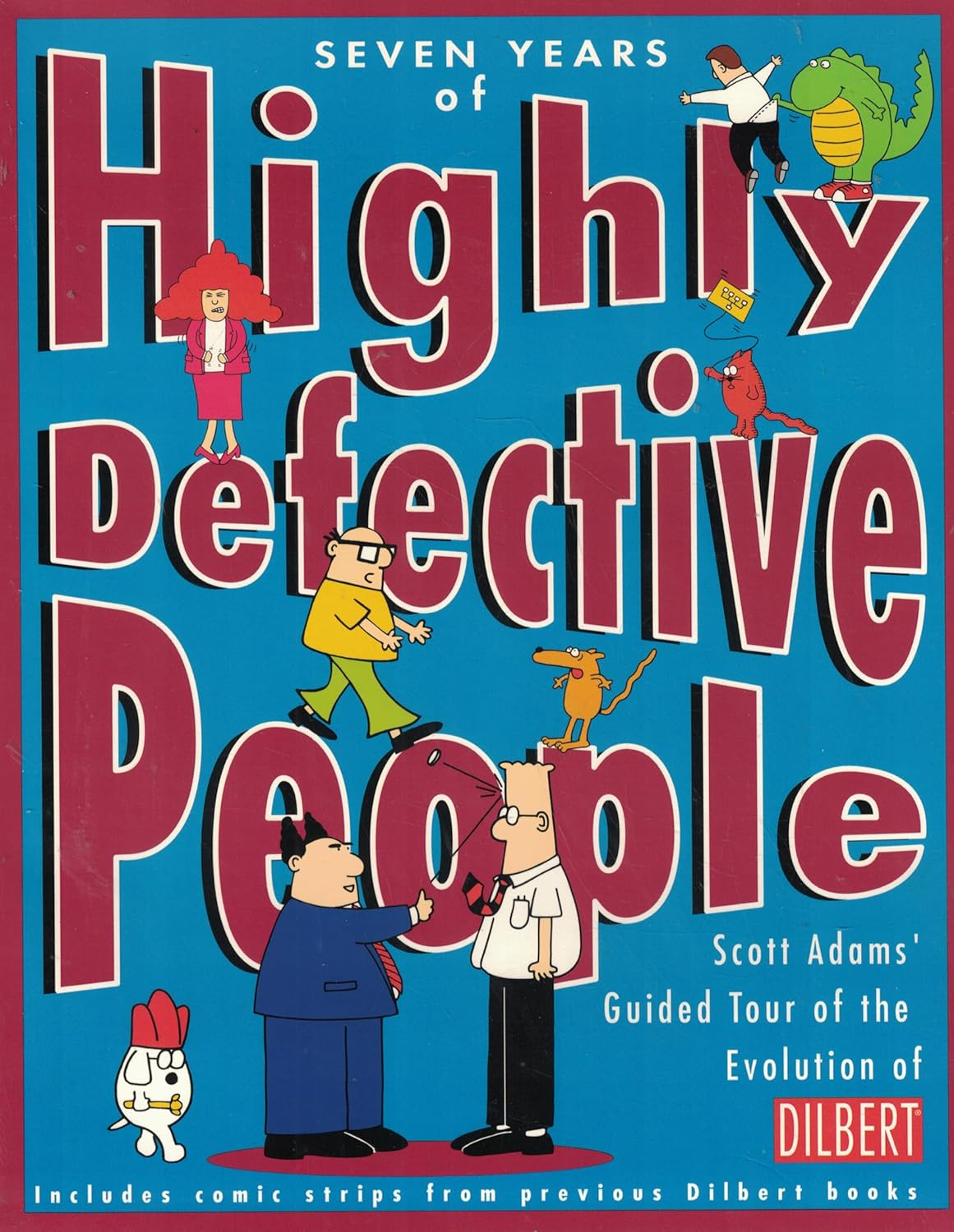
I mention this all as context for why I almost immediately latched onto Dilbert—by former corporate drone Scott Adams—as my comic of choice after Calvin and Hobbes ended. In this, I’m sure I wasn’t alone; in fact, I dare say it was almost a perfect transition from one to the other! Calvin and Hobbes was all about the passions and wonders of childhood; Dilbert then was all about the disappointments and indignities of adulthood. Calvin and Hobbes was there to memorialize all the wonder we left behind in our youth; Dilbert was there to mercilessly mock and skewer the office world we were all taught to work towards instead. Calvin and Hobbes was artistically ambitious and detailed; Dilbert was drawn crudely and simplistically, but in a manner that seemed custom-built to puncture the pretentions and self-importance of corporate America. Indeed, there almost seemed something Punk Rock about Dilbert’s blunt artwork! It was like if Joey Ramone had been forced into an office job, or if The Descendants’ Milo really did have to go to college. The fact that the title to one of his most popular collections, Seven Years of Highly Defective People, was a direct parody of Stephen R. Covey, only endeared him to me further.
Hence I not only bought and read Dilbert comic collections with the same devotion I once reserved for Calvin and Hobbes, but also Adams’ prose works (e.g. The Dilbert Principle, The Dilbert Future, even his non-humorist philosophical novella God’s Debris). I subscribed to his email newsletter in the late-’90s back when that was still a fresh idea (unsubscribing to it just before I entered the MTC was something I considered a sincere sacrifice before the Lord), and then followed his blog again after I got home from my mission and went away to BYU in the mid-2000s. On the rare occasions when I worked up the nerve to email him about a strip I found funny, he always responded promptly and graciously. In his endless and irreverent mockery of corporate buzzwords, executive incompetence, and white-collar worker exploitation, I felt in him–like I suspect many readers did–a kindred spirit, one who mocked the vanities of the world, who served as “a swift witness against” those who “oppress the hireling in his wages” (Malachi 3:5) who made the implicit call to forsake the things of this world and seek for the things of a better.
In this, of course, I was obviously projecting myself. Adams was a life-long atheist, and though he was less interested in mocking religion than the “New Atheists” who arose after him in the 2000s, he clearly did not take the spiritual seriously. If he didn’t see anything in this life worth reverencing, he never bothered imagining a better one to replace it either, not even in fantasy. (His early critics who claimed that Dilbert did not actually inspire workers to stand up for themselves, but only served as a safety valve to make them more complacent, were all eventually proven right.)
There was also, in retrospect, a mean-spirited streak in him right from the beginning. In those old late-’90s newsletters, for example, he coined the term “in-duh-vidual” as a veiled insult to mock all those self-important incompetents around him he perceived as utterly lacking in self-awareness. The man always loved his petty insults. Hence it should not have come as a surprise to me when he complimented Trump early in his first term for being a “genius” at insulting people, as though such were laudable or commendable or qualifying for anything, let alone the presidency; the cartoonist who had once endlessly skewered the “pointy-haired boss” as the platonic example of a grotesquely incompetent executive whose arrogance is matched only by his ignorance, was now openly voting for one. I hadn’t read either his blog or Dilbert for about a decade by then, so I was confused as to what had happened in the interim—when really, I should’ve seen this heel turn coming from the beginning.
Because his labeling of others as “in-duh-viduals” turned out to be self-projection as well, it turned out. There was (to cite just one example out of many) the time just a few years ago when he tried to hypnotize women online into orgasming and then ask them to email him if he succeeded. This was the sort of cringe behavior he would’ve happily laughed at back in the ‘90s, never done in earnest.
But that did mean it came as far less of a surprise to me when Dilbert was finally canceled in 2023, after Adams went on an unhinged, unreflective racist tirade on his blog against Black people. (Suddenly the fact that there were almost never characters of color in Dilbert felt far more telling.)
Then when he died of cancer just last month at only 68, and it came out that he had refused radiation treatment for two full years in preference for ivermectin–you know, the horse de-wormer that had somehow been co-opted by hacks and frauds as a COVID cure–it sure seemed to complete his transformation. Because I can definitely assure you that a cancer patient self-medicating with horse de-wormer and then dying anyways is precisely the sort of “in-duh-vidual” behavior he would have gleefully mocked in his 1990s newsletter.
But I didn’t mock; I mourned. Like Hugh Nibley once wrote of the Nephites, the tragedy isn’t just what happened to them, but what they had become in the end.
So what happened here? Was he always like this, and I was just too young and immature to see it way back when? Or did he become this way, after having been successful for so long that he started to believe his own hype, and so finally became the very thing he supposedly despised?
Or is this just one more example of why the Savior commanded us to “judge not, lest ye be judged”—not just because God Himself will hold us to the same standards we hold others, but because, even if you’re not religious yourself, how you treat others is inevitably how you treat yourself. You are in a private hell of your own making.
This of course means I must be extra careful to not judge my one time favorite cartoonist, either; I am highly unlikely to ever even be in a position to be tempted by fame and fortune, but if I were, there’s no telling how I would turn out either, if I would fare any better. It is more than cliché when we say that there but for the grace of God go us all.