
Once the last of the New Years Day hangover wears off for good, there is a profound malaise associated with the month of January, isn’t there. The fun and festive Holidays that had dominated the entire last quarter of the year from Halloween clear through Christmas are now completely over, the decorations are down, the trees are in the compost, the radio stations changed, the candy eaten, the presents forgotten, and what few lights are left up feel more sad than uplifting at this point–all that, and we still have at least a couple more solid months of winter grey and cold to face, without anything to alleviate it. Even if you follow the Latin American model of celebrating the 12 Days of Christmas clear through Three Kings Day on January 6th, the party has still officially ended by the end of the first full week of January at the latest.
And at least state-side, the only Banking Holiday left to break up the monotony until the Valentines decor goes up is Martin Luther King, Jr. Day–that solemn third Monday in January when we all pretend to have been anti-racist all along, when we act as though we totally would’ve marched with Dr. King if we’d been alive back then (even if virtually no Latter-day Saints actually did), as though the Civil Rights movement were all completed and finished and hunky dory now, as though racism itself and not Dr. King were killed that April day in 1968. It is at best a day of mourning—not just for the man, but for all of his idealism left unfulfilled—and at worst a brazen act of hypocrisy, and in either case does little to liven up the ennui of January.
Yet it doesn’t necessarily need to be this way! There is, believe it or not, a way to link together the recently vanished Christmas Holiday season with the MLK Day weekend that follows it, to make the former more of a protest and the latter more of a party. To loop back to 1968: that year was also when James Brown released not only the most iconic hit of his career but arguably of the entire ‘60s Civil Rights movement: “Say It Loud – I’m Black and I’m Proud.” The hit-single was released in August of that same year in the immediate aftermath of Dr. King’s assassination, and was integral towards replacing “Negro” with “Black person” in American vernacular. The track pushes back hard against nearly four solid centuries of dehumanization that sought to instill a sense of shame and self-hatred into people of color in America so that they would be easier to control, by instead making “Black” something beautiful, a trait to be proud of. (The track was also, like the rest of James Brown’s oeuvre, heavily influential on the development of Hip-Hop less than a decade later, both for its easy-to-sample Funk beat and for its empowering bravado.)
This was also a goal of Dr. King himself. As he explained to his supposedly-“moderate” white audience in 1963’s Letter From a Birmingham Jail, “I stand in the middle of two opposing forces in the Negro community. One is a force of complacency, made up in part of Negroes who, as a result of long years of oppression, are so drained of self respect and a sense of ‘somebodiness’ that they have adjusted to segregation […] The other force is one of bitterness and hatred, and it comes perilously close to advocating violence.” James Browns’ “Say It Loud” was one of those era-defining anthems that also helped to re-imbue his community with that same “sense of somebodiness” and self-respect.
And it was first collected onto a Christmas album, of all things!
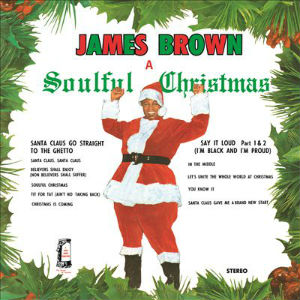
Seriously, in November of 1968, James Brown–the self-declared “hardest-working man in Show Business”–released A Soulful Christmas, his second of three Christmas albums overall and his fifth album of that year alone; and for whatever inscrutable reasons we can only guess at (he had a strict no-drugs-or-alcohol policy in his entourage at the time, so you can’t blame it on that), Brown chose to include his latest hit “Say It Loud – I’m Black and I’m Proud” as the opening track to Side B. Again, on a Christmas album.
I need to here emphasize that this wasn’t, say, some novelty Christmafied version of the track with sleigh-bells in the background or what have you, but the original 45 cut that was released in the Summer of ’68 and hit #10 on the Billboard charts, all while Civil Rights riots broke out in every major city in America in the immediate aftermath of Dr. King’s murder. This was one of the filler-tracks he selected for, again, his latest Christmas album!
He shortly thereafter kicked off 1969 by releasing an entire LP entitled Say It Loud–I’m Black and I’m Proud, as either he or his record-label correctly assessed that a hit that massive required an album all its own to surround it. But, that still does not take away from the fact that “Say It Loud”–perhaps the single most important song of James Brown’s career–was first collected onto a Christmas record! It’s frankly wild to contemplate.
Or maybe it’s not that wild at all! Maybe, upon further contemplation, it was completely apropos for James Brown to release his signature Civil Rights anthem on a Christmas record! For what other reason was Christ born than to free us from sin? And as Terry Pratchet once wrote, what else is sin but to treat other people as objects–which in turn was the entire raison d’etre of slavery? That is, are not all forms of segregation and racism that resulted from slavery therefore a sin? Is not racism therefore one of the sins that Christ sought to redeem us from? Is this not therefore the gospel of freedom? Is that not why numerous Christian preachers–including the Reverend Martin Luther King, Jr.–dedicated their lives to dismantling the sins of racism? Does not “Battle Hymn of the Republic” declare, “As he died to make men holy, let us fight to make men free”? What could be more in the Christmas spirit, then, than to sing another anthem of freedom? Is such not, in the words of Alma 5:36, another example of “The Song of Redeeming Love”–for if you don’t love yourself, how can you love others? From that perspective, was it not entirely logical for James Brown to include “Say It Loud – I’m Black and I’m Proud” as the centerpiece of one of his Christmas albums?
Certainly the song helps to directly connect the ending Christmas season to the following MLK Day; it at least helps to combat the malaise of the month of January, by carrying forward the lively Christmas season further into the New Year. The track can elevate Christmas into a form of resistance, and simultaneously make MLK Day more of a bona fide party.