
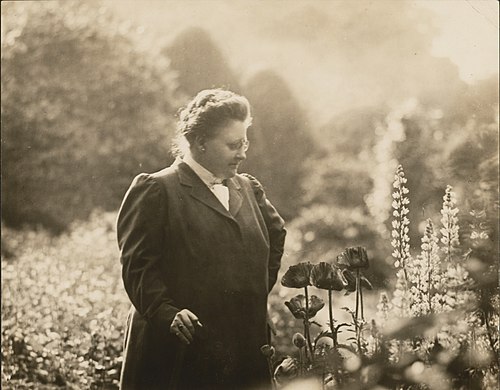
Amy Lowell was a New England poet from a wealthy family who at one point became associated with the Imagist school of poetry founded by Ezra Pound and H.D. during the 1910s. “No ideas but in things” was their clarion call, taking their cues from Japanese haikus and ancient Chinese poetry. (This was the same scene that generated Ezra Pound’s ultra-short “In a Station on a Metro” and William Carlos Williams’ “This Is Just To Say“.) Amy Lowell even financed a three-volume series of Some Imagist Poets, which is what caused the break between her and Pound: he accused her of “hijacking” Imagism by self-financing this book series, whereas at least one critic claims his real disgust stemmed from how she attempted to “democratize” the movement by including a wide spectrum of poets she paid equal royalties too, not just Pound’s private little club.
This is partly ironic, because Lowell’s by far most popular poem of all doesn’t even have a hint of Imagism about it at all: “Patterns,” wherein the narrator deploys language that would have been frankly risqué for WWI-era America (recall that Gone With The Wind shocked audiences as late as 1939 for finishing its four-hour run-time with, “Frankly my dear, I don’t give a damn”). In it, the feminine narrator wanders through the patterns of her garden, fantasizing a tryst with her lover: she looks at her “fine brocaded gown!” and says “I should like to see it lying in a heap upon the ground.” She then imagines herself naked in the garden with her lover as she “ran along the paths/And he would stumble after/Bewildered by my laughter,” till finally “my heavy-booted lover…caught me in the shade/And the buttons of his waistcoat bruised my body as he clasped me/Aching, melting, unafraid.” It is a surprisingly sexy poem even by today’s standards, let alone a hundred years ago.
The twist, however, comes with the revelation in the poem’s finale that her fiancée was killed overseas in the Great War: “For the man who should loose me is dead/Fighting with the Duke in Flanders/In a pattern called a war.” She finishes with the soul-rending exclamation: “Christ! What are patterns for?”
It is not even slightly an Imagist poem, though I think it’s enduring popularity gets to the heart of her break with Pound: there is actual sex and passion in Amy Lowell’s poetry. Contrast “Patterns” with, say, The Cantos, Pound’s massive, 800-page, multi-decade-in-the-making Modernist poem that gradually became more and more feverishly fascist as Pound took his hard-right turns towards Mussolini and antisemitism. Though only hinted at in the earliest Cantos (the ones he wrote shortly after abandoning Imagism), by the time Pound moved to fascist Italy in the 1930s, the overweening focus of The Cantos was on finance, wherein one can’t swing a dead cat without running into obsessive catalogues of financial tabulations; it frankly becomes downright tedious, if you ever choose to read the entire thing.
Cause here’s the thing to emphasize: human bodies are almost entirely absent from The Cantos. As this site has discussed elsewhere, “Pound for example rails against how ‘The tariff of 1816 murdered indigo’ in Canto LXXXVIII, even as he never breathes a word about any actually murdered human bodies: not those aforementioned African slaves, not the indigenous, and certainly not the Jews under European anti-Semitism. It becomes painfully obvious throughout The Cantos that the health of commodities matters more to Pound than concrete human lives.” Yet one could say the same thing about even his early Imagist poetry, too: “apparition of these faces in the crowd,” after all, were for him reduced down to only “Petals on a wet, black bough.” There is this constant sense of dehumanization throughout Pound’s poetry, a demiurge to deny the existence of human bodies–a denial that Amy Lowell emphatically does not do, who is everywhere keenly aware and unashamed of her body, in a manner that only ever seemed to disgust Pound.
Which perhaps also explains how Pound got seduced into Italian fascism: you have to dehumanize your own body before you can dehumanize others.
This, incidentally, is what was supposed to be so liberatory about the Restored Gospel: the utter rejection of all those ancient Neo-Platonic heresies that classified the human body as inherently degraded and inferior to some unseen realms of Platonic abstraction (Plato’s “Republic,” recall, is a repressive police state with heavy censorship), to instead have the audacity to proclaim that God Himself is an embodied being, with a glorified human body, that indeed not only our salvation but our entire exaltation is predicated on our gaining possession of a human body ourselves. One of the high heresies of Joseph Smith is that he presented a God that is not ashamed of his body, but glories in it; and while I will never in a million years defend Joseph Smith’s polygamy, I will express thanks that he made God a sexual being, so that we can cease to be ashamed of our sexuality as well. That is, the Restored Gospel of Jesus Christ has real sex and passion to it, as well.
Or at least should be. Nowadays we have thrown the baby out with the bathwater: distancing ourselves from polygamy (an undeniably good thing!), yet also distancing ourselves from our sexuality, as well, what with all of our incessant and insipid modesty lessons that follow the Neo-Platonic ways of the world in feeling ashamed of our sexuality, as something degraded that must be carefully repressed and silenced at all points lest it degrade us as well. Our religion is of course not unique in this regard; virtually all conservative sects do so. And I must needs tread careful here, I am not calling for violations of the Law of Chastity at all. No, I simply wish us to allow ourselves the same love of our bodies as Amy Lowell manifests in “Patterns”–because the other path, that of Pound, leads invariably to repression, oppression, death and darkness, both spiritual and literal.