
I had a student last Spring, a young immigrant from India, who selected as the topic for his final paper, “Why anti-Indian racism is worse than anti-Black or anti-Hispanic racism in America.” Seems he believed all the focus on the plight of Black people and Latinos in America was sucking up all the oxygen in the room, such that the plight of Desi-Americans was getting ignored. I am keenly aware of how obtuse it sounds when a white person tries to lecture a person of color about racism, so I tried as gently as I could to suggest that perhaps he should reformulate his thesis to read, “Anti-Indian racism deserves as much attention as anti-Black and anti-Hispanic racism in America,” that he should maybe see Black people and Hispanics as potential allies in combating racism, not competitors for attention (heaven knows white racists sure don’t differentiate between them). He at least toned down the intra-racial resentment in his final draft, though I’m still not entirely sure he internalized what I was trying to say.
But then, upon further reflection, it sadly made perfect sense that he perceived racism in America as a zero-sum game; I mean, he lives in America now, doesn’t he? Surely then he had already absorbed and internalized our larger culture, with its implicit assumption that everything is a zero-sum game: that if one business is succeeding, another must fail, that if one person is rich, another must be poor, that if one person has health insurance, another must be bankrupted by medical costs, and etc., that these are the way things ought and must be. I mean, are not all Americans engaged in endless competition with each other for intentionally scarce resources? Would this student not already have observed this fact in all facets of his new homeland?
Indeed, this zero-sum mindset is the very root of racist thought itself: that if one group is granted equal rights, then someone else perforce must not. I’ve seen a sarcastic bumper sticker on occasion that reads, “More rights for others doesn’t mean less rights for you. It’s not pie,” but what that bumper sticker mocks in jest is what tens of millions of other Americans appear to believe in earnest: that my rights are diminished, not strengthened, when someone else’s are defended.
It was also the pernicious logic under-girding slavery, segregation, Jim Crow, opposition to gay marriage, and a host of other evils down to our present moment. Seriously, go back and read all the defenses of these practices back in the day and on down to the present moment, and you will find one angry demagogue after another claiming that abolishing slavery, or desegregating restaurants, or passing fair housing laws, or legalizing gay marriage, would be an intolerable “violation of my rights!”, all without the slightest shred of self-awareness. Even today, the vicious rhetoric around abolishing DEI and Affirmative Action centers around the specious argument that unqualified minorities have been taking jobs from more qualified white candidates, without once acknowledging that unqualified white people have been taking jobs from more qualified minorities for centuries (including the most recent presidential election)—because they of course weren’t ever interested in equal rights at all, but only in seizing as much pie for themselves as possible.
It’s easy to assume that all these old racists were just bad-faith arguers, since it is so self-evidently the opposite that is true: defending other people’s rights in turn strengthens your own. When Martin Luther King, Jr. by contrast welcomed the white people attending the “I Have a Dream” rally, he declared to his fellow black people, “They have come to realize that their destiny is inextricably tied to our destiny!” MLK’s was the exact opposite logic of those racists opposing the Civil Rights Act; he accurately understood that to defend other people’s rights also defends your own, and strove to help white Americans understand this. But once you understand the base logic of those various racists, their thinking makes a crude sort of sense: if rights are a zero-sum game, then by definition rights cannot be equal.
Ezra Taft Benson, at least in the 1960s while still a leading John Bircher, was one such person who repeatedly made the argument that the Civil Rights movement undermined our rights as Americans, rather than fulfilled them (he spells this out explicitly in his 1969 book An Enemy Hath Done This). His stance was supremely ironic, because when he finally became Church President himself in the 1980s, his most famous Conference address was “Beware of Pride,” which was heavily indebted in its language and rhetoric to CS Lewis‘s Mere Christianity–and it was CS Lewis in turn who explicitly identified this zero-sum mentality as the doctrine of Hell.
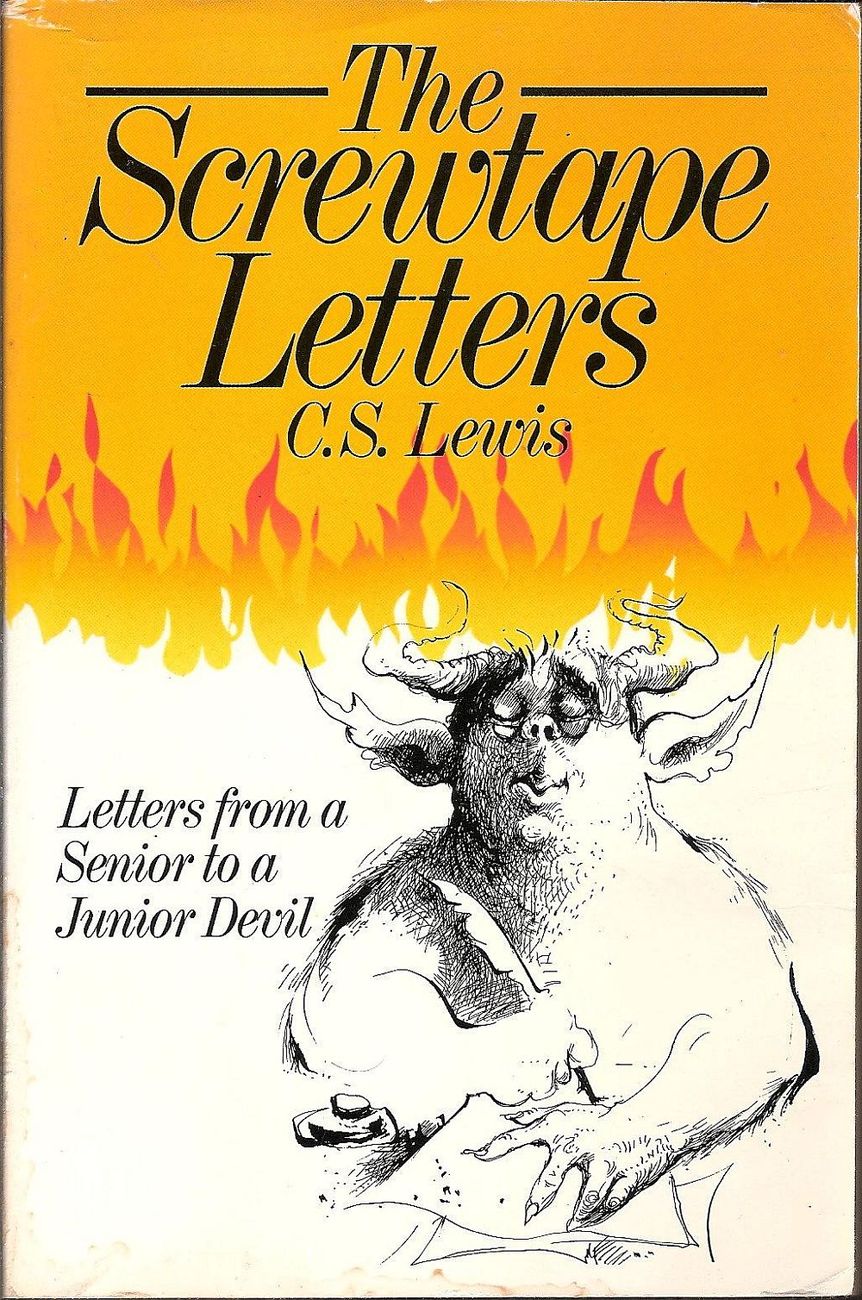
In chapter XVIII of Lewis’s most popular work The Screwtape Letters (a work I trust needs no introduction here), the older demon Screwtape explains to his junior charge Wormwood that: “The whole philosophy of Hell rests on recognition of the axiom that one thing is not another thing, and, specially, that one self is not another self. My good is my good, and your good is yours. What one gains another loses. Even an inanimate object is what it is by excluding all other objects from the space it occupies; if it expands, it does so by thrusting other objects aside or by absorbing them. A self does the same. With beasts the absorption takes the form of eating; for us, it means the sucking of will and freedom out of a weaker self into a stronger. ‘To be’ means ‘to be in competition'” (emphasis added).
According to Screwtape, the reason why Hell is superior to Heaven is because the devils are far more realistic, mature, and practical than the head-in-the-clouds idealism of the Angels; Hell alone acknowledges that everything really is a pie, and that therefore a bigger piece for me is perforce a smaller piece for you. Hence, it is only right and natural and just that beings be in constant competition with each other for what is, by definition, finite resources. These are the way things must and ought to be, according to Screwtape; indeed, the whole reason the devils work so indefatigably to tempt and damn humanity is so that they can absorb as many mortal souls into themselves as possible, at the obvious expense of Heaven. Indeed, they would gladly consume Heaven itself if they could.
Incidentally, this is also the doctrine of Korihor, identified by the Book of Mormon explicitly as “AntiChrist,” who declared, “every man fared in this life according to the management of the creature; therefore every man prospered according to his genius, and that every man conquered according to his strength; and whatsoever a man did was no crime” (Alma 30:17). On this point, Korihor and Screwtape are in complete agreement: competition and conquering are for them the rightful nature of life itself.
But of course CS Lewis did not share these sentiments at all, and was in fact parodying them in the satiric mouth of a fictional demon. And the reason why Screwtape is sharing this anti-sermon with Wormwood, is because he notes with disgust that God our Heavenly Father, “The Enemy,” propounds the exact opposite doctrine:
“Now, the Enemy’s philosophy is nothing more nor less than one continued attempt to evade this very obvious truth. He aims at a contradiction. Things are to be many, yet somehow also one. The good of one self is to be the good of another. This impossibility He calls Love, and this same monotonous panacea can be detected under all He does and even all He is…”
For God Almighty, the injunction is not to compete against or consume one another, but to “love one another,” because (as MLK noted during the “I Have a Dream” speech) to raise up others is to also raise one’s self. Both Benson and Lewis affirmed that Pride takes no pleasure in having, but only in having more than others; whereas for the Almighty, true happiness comes not from having more than others, but by ensuring that everyone has enough. This is why the converts on the Day of Pentecost in Acts 2:44-45 sell all that they have and “had all things common” (which is also endorsed by the Book of Mormon in 4 Nephi 1:3). It is why D&C 49:20 reads, “But it is not given that one man should possess that which is above another, wherefore the world lieth in sin.” It is the same logic under-girding the miracle of the loaves and the fishes, wherein Christ does not enjoin the five-thousand to fight viciously over scarce resources, but shares abundantly with everyone, equally, without money and without price. And of course it is the logic of the infinite and eternal Atonement of Christ itself, which is extended to everyone, freely, upon conditions of repentance.
Within LDS theology, the stakes are raised even further, because God’s endgame isn’t just to lift us up, but to make Gods of us ourselves, which he explicitly identifies as “my work and my glory” (Moses 1:39). In this model, mortals becoming Gods doesn’t diminish our Heavenly Father at all, but actually glorifies Him further. Lucifer could not understand this (he it was who wanted to take all the glory for himself, because he could not comprehend the concept of sharing glory with others); it is why he was cast out of heaven–or perhaps more precisely, why he cast himself out of heaven. We in turn also cast ourselves out of heaven, when we see ourselves in endless, ruthless competition with each other, rather than partners elevating each other towards salvation. It is why racism, competition, a zero-sum mentality and domination are all the literal doctrines of hell.