
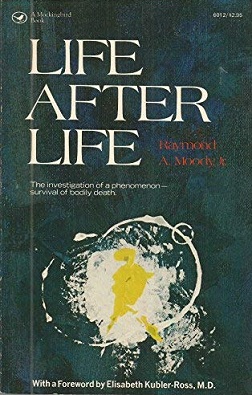
Dr. Raymond Moody’s short survey of modern near-death-experiences, Life After Life, was an international best-seller back in 1975, selling 13 million copies worldwide and getting translated into multiple languages. In it, he coins the term “near-death-experience” (or NDE) to describe what he claims is the common experience of people who have briefly flat-lined before getting resuscitated. Although he acknowledges that no two people report the exact same ordeal, Moody nevertheless argues that the archetypal NDE goes something like this: the patient has an out-of-body experience wherein they perceive their physical body as something distinct and separate from themselves; they approach a warm and inviting “being of light” at the end of a dark tunnel–one that is brilliant in its luminosity yet somehow does not blind–who causes their life to flashes before their eyes; the being of light then asks them, as lovingly and kindly as possible, what they have done with their life. It is a compelling portrait.
However, the book has largely been forgotten from the public sphere since its initial sensation. Skeptics galore have naturally called into question the statistical validity of a study that analyzes what is (by Moody’s own admission) an insufficiently-sized sample of 150 near-death-experiences, all derived from a tiny subset of self-reporting mid-20th-century Americans; they have also been deeply critical of how Dr. Moody glosses over alternative explanations for these experiences a little too quickly in their opinion, and accuse him of cherry-picking cases that fit his thesis while ignoring the ones that don’t.
But religious institutions have also been largely indifferent to the book since its initial success; likely that is because the book never explicitly endorses or champions any particular religious tradition as being the correct one (he cites alike the Bible, the Tibetan Book of the Dead, Plato’s Phaedo, and Emanuel Swedenborg in his literature review), so it has not been particularly useful for any one denomination’s proselyting efforts. Moody himself has become a believer in post lives and reincarnations in the decades since the book’s publication, so it has especially not become useful for Christian churches—including ours. You will not hear this book quoted in General Conference, cited in Sunday School manuals, nor taught in the MTC. The book’s ecumenicism turned out to be a liability, not an asset.
Plus, across the board, it turns that there’s not really a whole lot you can do with Moody’s claims. You can hope it’s all true; you can try and make it sync up with your own pre-existing religious beliefs; you can also dismiss it as just a common hallucination, one that not even everyone who has had a near-death-experience has shared; but it’s not really provable one way or the other, nor are there any moral lessons to be gleaned from the same.
And yet, and yet. Still I find myself reflecting on this little book, decades after its zeitgeist has passed and public interest waned. Partly that is because Jefferey R. Holland apparently had an NDE after his most recent hospitalization a year or so ago. He made allusion to it in his first Conference address back, but declined to elaborate on the experience. This was also in keeping with Moody’s observations in the book (and his defense for why he was unable to gather a larger sample-size) that almost all his subjects were reluctant to share their experience, for they had found that almost no one they told it to believed them–no, not even their ministers (one recalls Joseph Smith’s account with the Methodist preacher)–and only opened up to Dr. Moody once they were assured he would take them seriously. Even an Apostle found it difficult to articulate, which is odd, because are not such visions of the hereafter supposed to be the entire raison d’etre of our faith?
Because it really is indeed a core part of our doctrine that at the moment of death, “the spirits of all men, whether they be good or evil, are taken home to that God who have given them life” (Alma 40:11), is it not? That is, there is indeed some sort of preliminary judgment that occurs before the resurrection that is yet to come, exactly as Moody claims. And what exactly happens during that deathly interview, or what does it look like? Our theology, strangely, has shockingly little to say–as do most theologies. Hence Dr. Moody’s research may be as good a place to start as any, because in all the people he interviewed about their near-death-experiences, a common through-thread in all of them is that, even when they were shown some of the most embarrassing and self-convicting moments of the lives by this mysterious being of light, they nevertheless still “felt totally loved and accepted, even while [their] whole life was displayed in a panorama for the being to see” (93). In fact, they all felt that “the ‘question’ that the being was asking him was whether he was able to love others in the same way” (93). Hence when many of these subjects returned to life, even as they regretted having to come back, they felt “that it is [their] commission while on earth to try to learn to be able to do so” (93). That is, their unfulfilled mission on this earth was to learn how to love others the same way that God loves us.
I shared this passage with a friend, who said glibly that such a statement certainly seemed to fit in with the whole Hippie lovey-dovey ’60s era when the book was being researched and written; “And, you know, the entire Gospel of Jesus Christ,” I added, to which he readily acceded. It is not controversial to note that Christ declared that the two overriding commandments are to “love God and love your neighbor,” that upon these hang the law and the prophets; that we are to “love thine enemies,” not just our friends; that “a new commandment I give unto you, that ye love one another;” that “God so loved the world, that he sent his only begotten son;” and that per both Paul and Moroni, if we have not charity–the pure love of Christ–we are nothing, for charity never fails.
These are answers so pat as to be cliches, yet are somehow the absolute most difficult commandments to fulfill, far easier said than done. It somehow strikes me as completely apropos that when this “being of light” interrogates us upon the moment of death, it will specifically be on how well we loved everyone around us with the same expansive love–and it will be a test that the vast majority of us are actively failing as we speak. I am as guilty as anyone as treating the entire Gospel of Jesus Christ as but an intellectual exercise; but when I ask myself how well I love others around me–especially if I take as axiomatic that this is the premier question that the Almighty will ask of me at the moment of death–well, to quote Joseph Smith, “Search your hearts, and see if you are like God. I have searched mine, and feel to repent of all my sins.”
Part of me suspects that the reason we don’t cite Dr. Moody’s book much anymore is because we would prefer to be judged for literally anything else–on what our Church callings were, or how well we invested our money (is that not the point of the parable of the talents, supposedly?), or how far we got in college, or how well we excelled in our jobs, or how we voted, or what we donated our cash to, or how widely we traveled, or how “clean” the media we consumed was, or how many prayers we said, or a million other things besides–because if we are judged exclusively on how well we loved one another, each of us, deep down, know that we are going to fail that test catastrophically. But there is no escaping this test, because we are each and every day faced with an endless number of chances to improve our love for others, all while the exam could end at literally any moment; we are put on this earth to learn literally nothing else.
It is easy to love one another when you live in Heaven and the presence of God directly, I suspect; it is much harder to do so in this wicked earth life and vale of tears. That is why the test is so immutable, so inescapable. With every choice and action we make, we declare a million times over what we really think about all the people around us, and what our priorities really are. Suffice to say for now, I have been making some changes in myself since I recently re-finished this old book.